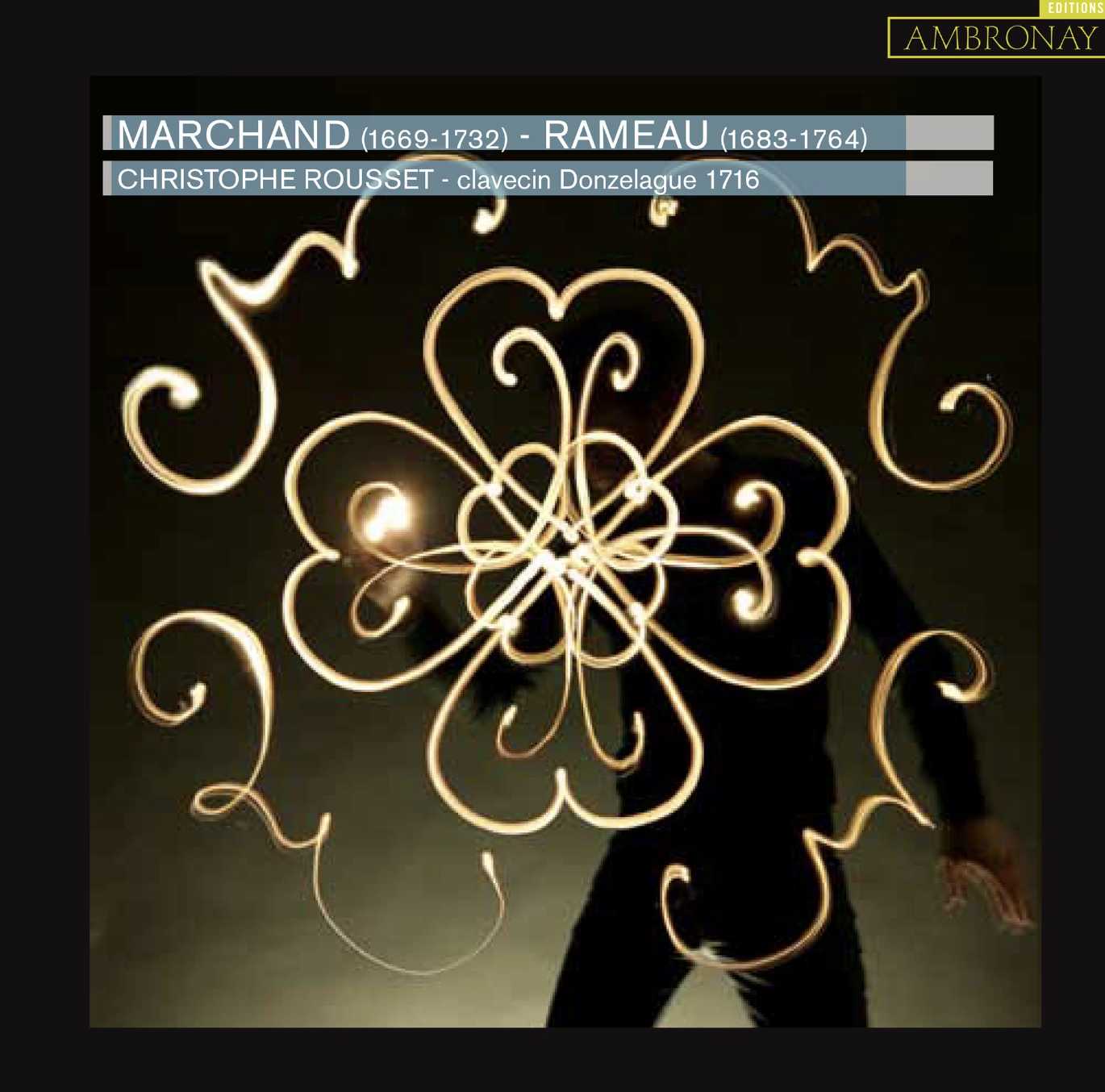
Marchand (and Rameau): Œuvres pour clavecin • Rousset
"Œuvres pour clavecin" is how the album is titled; the recording really is more of a feature of an original instrument, constructed in 1716. It has an usual tonal character, which is why one should seek out recordings like this—featuring ancient original instruments that give us further insight into the baroque sound world.
The music that brings this colorful instrument to light (in a dry acoustic) are two Suites by Marchand (d. 1732), a few extra movements by the same composer, then a Suite by Rameau (d. 1764). The Rameau pieces were familiar, while the Louis Marchand ones were not (for me). Marchand's language is more in the vein of other French clavenistes, at least of a previous generation (Louis Couperin, d'Angelbert, Fourqueray). They are not "character" pieces, or are not so-named.
Marchand's music doesn't surpass, for me, that of Jean-Philippe Rameau. But it is interesting enough to qualify for repeated listenings. Rousset's playing is best judged with the omnipresent execution of trills and other ornaments, as we might expect from music from this period; what makes this performance more interesting is the chosen temperament, offering the pieces its own character.
The Chaconne from the first suite by Marchand, as an example, is an exquisite piece. Not exactly the on the same level of Rameau's Gavote avec Doubles, but it's rich enough to qualify for gilding on the clavecin, or a to fill your head via your iPod with a stroll around Versailles.
The Rameau pieces are all very short, save for the first Allemande. They're light enough not to overwhelm those by Marchand, in comparison.
N.B. I took this recording with me to hear Rousset live in Washington, D.C. some years ago, which he graciously signed for me. I wrote this short review back in November 2012. I'd invite folks to compare this recording to two others, as of late (Dec. 2025): the Rameau release by Blandine Rannou and the Louis Couperin set by Jean Rondeau.
Rousset's style is very precise with timing, using far less rubato than the aforementioned harpsichordists. It came across in my re-reviwing this album. I found myself wanting some more rubato, some indication of feeling that gets lost when things are metronome-perfect.
The strength of this album is the presentation of the works by Marchand one, and two, the use of an extraordinary instrument. It showcases a flawless technique by Rousset, but one, I wish at times, would relax just a bit to indulge the listener with the emotional content within the music with rubato.