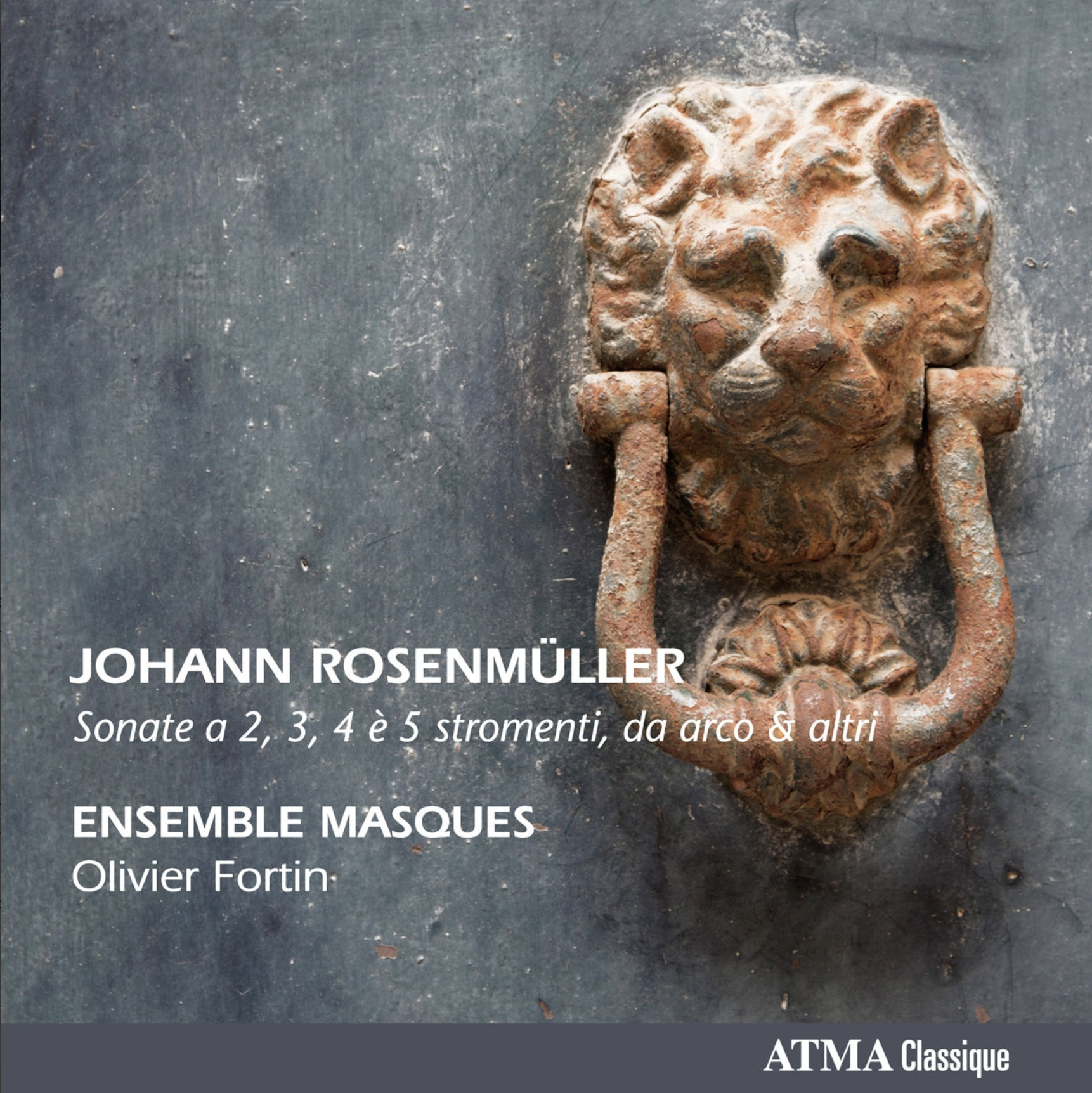
Rosenmüller: Sonate a 2-5 Stromenti da arco et altri • Ensemble Masques

N.B. I first published this review in 2013; I am revisiting it now in 2026 and have modified this review, assigning it a rating for the first time.
Ensemble Masques of Québec record the 1682 sonatas by Johann Rosenmüller on stringed instruments. The German is somewhat famous, I'm guessing historically, for escpaing arrest at home and finding work in Venice. His forward-leaning compositions are written in the fantastic style, short movements with ideas that don't particularly get well-developed. They are positioned historically at a time of transition in the period, old-fashioned, perhaps, in the same company as Corelli's string music, but far more adventurous in many ways than the works of Marini or Castello.
Rosenmüller's music sometimes appears as piecemeal in collections on record; here we get a more complete appraisal of 12 sonatas for a variety of configurations. Ensemble Masques has chosen to record these with all stringed instruments and continuo; both organ and harpsichord are utitlized, although not together. I think it's a very well-engineered recording.
The music is available to follow along with at home. With music that is not familiar, it's often helpful to have a score to understand what the musicians are contributing outside the provided notes on score. In the second sonata in G minor, I admired the contributions from Sophie Gent, as well as the second violinist in the "slower" sections, in terms of ornamentation and extra graces. Technically speaking, the composer provides a fair amount of fast, adventurous music, done in such a way that not only is each part difficult, but the extra challenge is playing in tandem with others in tandem. In the Sonata undecima for five players, this characteristic is on display; in the aforementioned G minor sonata for two violins, it's much of the same, including a lot of repeated notes, which speaks to the composer's knowledge of the stylo concitato, developed in Venice.
In the Sonata Seconda in E minor it opens with a delicious slow section with delicious harmony, with dissonances resolving over and over. It's nearly a forecast of Corelli's harmonic style. It's one of his pieces that I'm more familiar with, having been recorded by the Rare Fruits Council in their 2010 recording of the sonata on Editions Ambronnay. I think the Canadian recording sounds better, less shrill on my system, but the French recording offers a bit more dynamic variety and range.
I wrote back in 2013, perhaps unfairly, that I thought that Ensemble Masques played a bit too safe in terms of their style. There is a politeness that comes across which we nearly expect when we hear a concert of so-called classical repertoire. Musicians sitting on stage, dressed in black and white, ready to play music that anyone would point to as "high art." The Rare Fruits recording, also well-played, doesn't feel the same: I'm picturing musicians in jeans with shirts rolled up their arms, the surroundings lees likely to be an ornate concert stage. I like that sound, which at times is a bit more direct. There's more contrast, either through articulation, dynamics, or rubato.
The twelfth sonata in D minor has also been recorded by Ensemble Chelycus on Ramée. The piece goes through a section with some chromatic progressions: here I felt Ensemble Masques had a better grip of the music's feeling. Rare Fruits also performed this same sonata, and again, they have an athletic edge on Ensemble Masques, with both ensembles offering I think satisfying performances.
Credit is due to Fortin and his ensemble for committing the entire collection to disc. There's no disappointments in this release, although listening to all of the sonatas in one go is not likely something the composer would have expected, and I would recommend sitting down to enjoy one of these on multiple listens. Seeking out alternative recordings will show you how this music can also be approached, for better or worse. The sonatas are interesting for the composer's choice of themes and "inventions", how easily he goes from having the players play together in harmony to imitating each other in counterpoint, and for his adventures with harmony.
Ensemble Masques plays these sensitively with repsect to the harmonic tension that is a part of each of these sonatas, approaching the fast parts with technical perfection. While I think there is in some of these works more juice to squeeze with heightening dynamics and contrast, this album should serve as a reference with a consistent approach applied throughout.