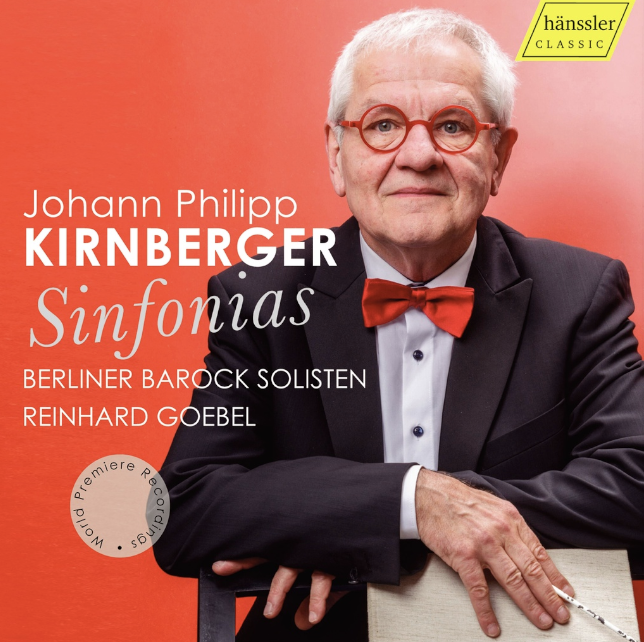
Kirnberger: Sinfonias • Berlin Baroque Solisten
Johann Philipp Kirnberger emerges from Reinhard Goebel’s liner notes as a man of exacting standards—perhaps a difficult personality, but one shaped decisively by his studies with Johann Sebastian Bach. His admiration for his teacher was profound, and the notes recount an intriguing episode in which Kirnberger sought an audience with Frederick the Great to demonstrate his compositional skill, echoing Bach’s own legendary encounter with the king that resulted in the Musical Offering, BWV 1079.
For listeners unfamiliar with Kirnberger, his music may already have made a strong impression through a 2020 NeoBarock recording of chamber works, which revealed a composer deeply indebted to Bach’s contrapuntal language. The eight sinfonias presented here—written before his appointment to Princess Amalia—suggest a stylistic pivot. While Bach’s influence remains audible, these works lean forward stylistically, engaging more clearly with emerging galant and early Classical sensibilities.
The second sinfonia in C minor makes this immediately apparent. Its repeated figures and darkly charged opening gesture recall the emotional world of Haydn’s Sturm und Drang symphonies. What follows brought to mind, fleetingly, the spurious “ouverture-suite” once attributed to Bach (BWV 1070): formally Baroque in conception, yet clothed in a more enlightened harmonic and melodic idiom. Kirnberger’s contrapuntal writing here feels lighter, more outward-looking. The final movement retreats, as it were, into a fugue—one that would not feel entirely out of place alongside Mozart’s string arrangements of Bach’s fugal works.
Most of these sinfonias follow a three-movement design. The fifth, in C major, seems particularly shaped by contemporary courtly taste. Kirnberger writes competently and often attractively: themes are well judged, development is assured. But innovation is not the point. These are unlikely to be works of bold experimentation. Given their intended function—court entertainment—they reflect prevailing aesthetic priorities rather than a drive to redefine the genre.
With durations generally falling between six and ten minutes, these are modestly scaled works. Kirnberger’s lifespan (1721–1783) places him chronologically before Haydn, and comparisons with Haydn’s symphonies highlight not only stylistic differences but functional ones as well. These sinfonias occupy a different expressive and social space.
Goebel notes that winds were employed as needed. The B-major sinfonia, scored with two horns, gains a welcome ceremonial color from their presence. Still, across the set, one senses music written to serve a moment rather than transcend it.
As a whole, these sinfonias are not profound statements, but they are historically illuminating. Kirnberger’s position within Berlin’s musical circles during the galant period places him at a moment of stylistic transition, and these works reflect that shift with clarity. When set alongside the music of Bach’s sons—Wilhelm Friedemann and Carl Philipp Emanuel—Kirnberger’s standing becomes easier to assess.
Goebel once again leads the Berliner Barock Solisten with the fervor that has defined much of his career, continuing his mission to bring lesser-known repertoire to light. The playing is sensitive and well-disciplined. The recording itself, however, places the listener at some remove: ultimate transparency is lacking, and the dynamic range is somewhat constrained. While the ensemble’s approach gestures toward period style, the timbre of the horns gently undermines that illusion.
Overall, I sense some untapped potential here—these works could perhaps benefit from a more sharply etched dynamic profile. Whether others will take up the mantle remains to be seen. The sinfonias are certainly interesting, if not consistently compelling. I am grateful for the opportunity to hear more of Kirnberger’s writing, though I am unsure how often I would return to this set as programmed. Heard one after another, the works can blur; they might fare better when interleaved with contrasting repertoire, either in the living room or, ideally, in a live concert setting.