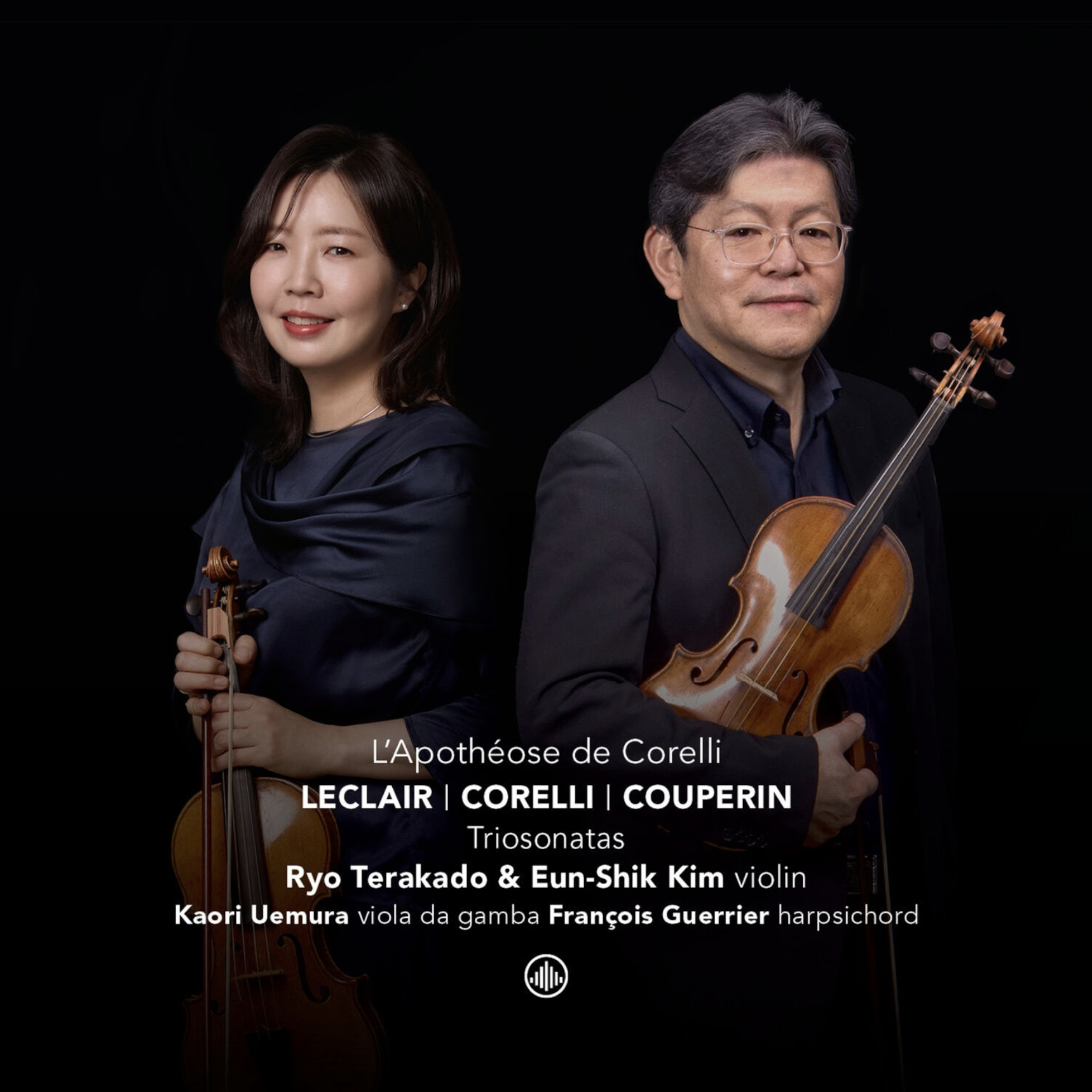
L’Apothéose de Corelli - Works by Leclair, Corelli, and Couperin • Terakado & Kim
The trio sonatas presented here with two violins and continuo form a thoughtfully curated program centered on Corelli and his influence beyond Italy. Alongside Corelli’s op. 3, no. 8 sonata, we hear Couperin’s tribute to the Roman master and works by Leclair, whose writing reflects perhaps the strongest embrace of Italian style among French violinists. Whereas ensembles such as London Baroque have often devoted albums to a single composer or a national tradition, this recording instead explores the lineage itself, tracing Corelli’s impact across borders.
Corelli’s C major sonata is presented with clarity and balance. Kaori Uemura’s continuo provides a firm foundation, while the two violins—Terakado especially—emerge cleanly from the texture. The articulation is precise, and the ensemble maintains cohesion throughout.
Couperin’s Le Parnasse de Corelli remains one of the most evocative programmatic works of its time. As in many recordings, the accompanying text is read aloud:
L’apothéose de Corelli, grande sonade, en trio; Corelli au piéd du Parnasse prie les Muses de la Recevoir parmi elles…
Corelli, at the foot of Parnassus, prays to the muses to receive him among them…
This narration reinforces the work’s narrative character and contributes to the sense of space, revealing the resonance of the acoustic. While spoken text in instrumental recordings is relatively uncommon—unlike in works such as Biber’s Sonata representativa, where it occasionally appears—it has become something of a convention for this particular piece. It’s one I’m not fond of at all.
The recorded sound throughout the album is warm and spacious, with a noticeable live acoustic. Earlier in 2025, Terakado released C.P.E. Bach sonatas with Fabio Bonizzoni on the same label, and while that recording shared some of the same interpretive restraint, the engineering here allows for greater depth and blend between instruments.
Leclair’s op. 13, no. 5 opens the album with poised ensemble playing and clear dynamic shaping. In comparison with other recordings, interpretive choices in this work and across the album tend toward structural clarity rather than overt theatricality. For example, The Sebastians (Folia, 2018) bring a lighter approach to Corelli’s opening movements, while Stravaganza’s Aparté recording offers a more overtly expressive and sonorous alternative with Corelli’s music. Terakado and Kim instead favor balance and refinement, emphasizing line and ensemble cohesion.
Terakado’s earlier recordings of Corelli and Leclair for Denon Aliare likewise reflected this aesthetic. Revisiting those performances, one notices the same technical assurance and purity of tone. Other interpreters, such as Patrick Bismuth, sometimes bring a more overtly rhetorical or dramatic personality to similar repertoire, offering a useful contrast in interpretive approach.
Leclair’s op. 8, no. 2 “Récréation” is among the highlights of this release. Its ouverture establishes an elegant tone, and the ensemble’s blend is particularly effective. The suite’s dances—including the Forlane, Badinage, Tambourin, and Chaconne—are handled with rhythmic stability and clean articulation. The Badinage, for instance, benefits from the performers’ precision, while the Chaconne showcases the ensemble’s ability to sustain momentum across a large structure.
Other ensembles have offered alternative perspectives through their recordings. Musica Alta Ripa’s recording of Leclair incorporates winds, introducing additional color and contrast, while the Four Nations Ensemble brings a more overtly extroverted character to the Tambourin. Terakado and Kim’s all-string approach produces a more unified timbre, with François Guerrier’s harpsichord adding subtle edge and definition.
Throughout the program, both violinists demonstrate impressive control over ornamentation and ensemble coordination. Their shared approach results in performances that are polished and stylistically coherent.
Conclusions
This album was a rewarding discovery. The trio sonata format—particularly in its French adaptations—offers rich expressive possibilities, and this program highlights those contrasts effectively.
Terakado’s long career in historical performance informs these interpretations. After early work as concertmaster of the Tokyo Philharmonic, his shift toward period performance following study with Sigiswald Kuijken has resulted in a substantial discography. Eun-Shik Kim proves an excellent partner, matching his tone and articulation closely.
Listeners familiar with Terakado’s previous recordings will recognize his interpretive priorities here: clarity, structural integrity, and refined ensemble playing. While other ensembles may lean further into dramatic contrasts or overt rhetorical gestures, this recording offers its own appeal through its tonal beauty and cohesion.
This release may not displace every existing favorite in this repertoire, but it stands as a strong and thoughtfully performed addition to the catalog, and one that reflects Terakado’s distinctive artistic voice.