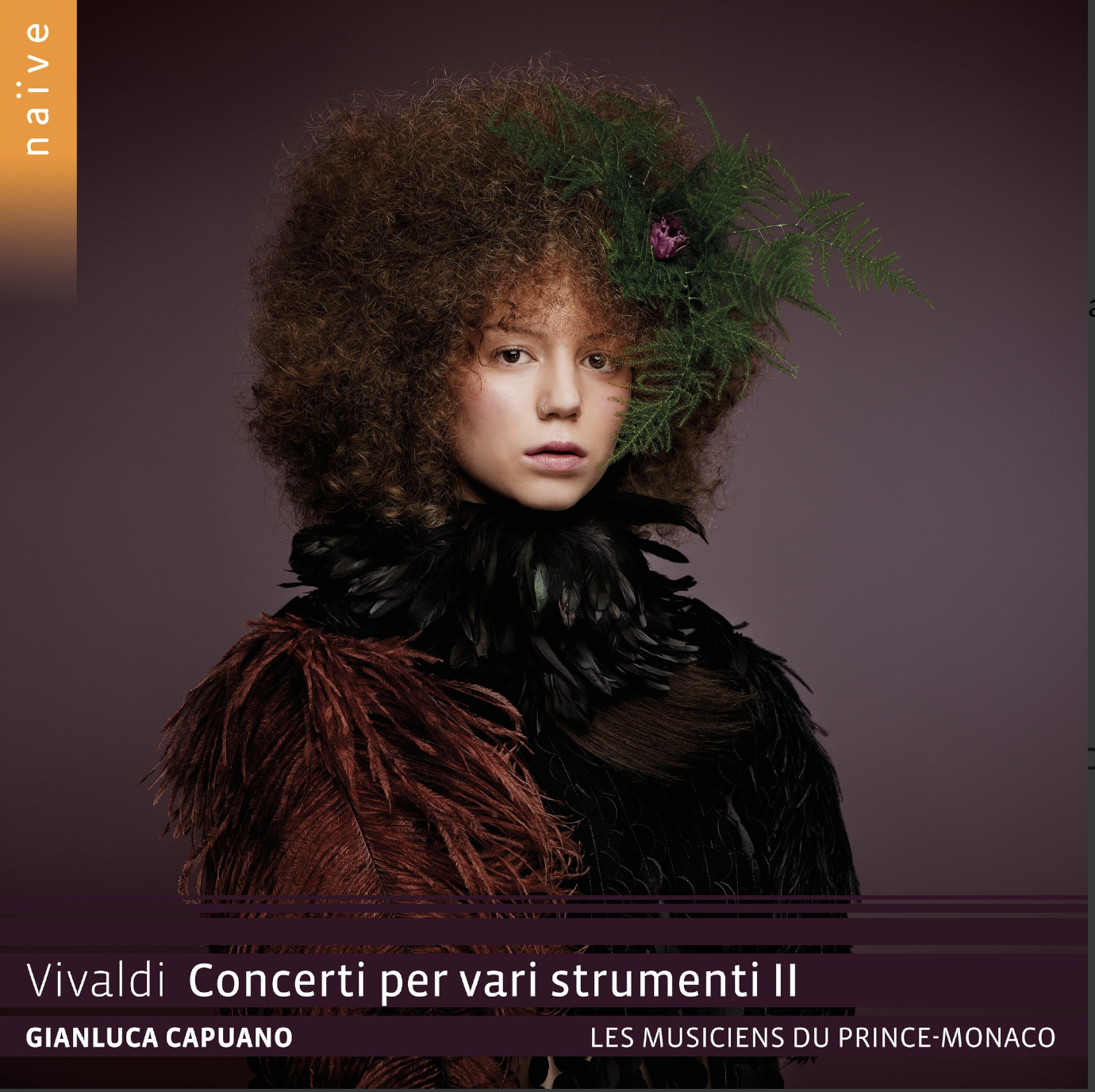
Vivaldi: Concerti per vari strumenti II • Les Musiciens du Prince - Monaco
The naïve classics series with Vivaldi's works continues. Six concertos are on offer across a 46-minute program — RV 570, 557, 543, 553, 535, and 555 — covering a pleasing range of combinations: strings alone, strings with winds, and a final showcase calling for recorder, chalumeau, oboes, and bassoon. Harpsichordist Gianluca Capuano leads the ensemble, also known for his work with Il Canto di Orfeo and Concerto Köln. Les Musiciens du Prince - Monaco was established by Cecilia Bartoli in 2016 with a committed HIP orientation and the financial backing of Prince Albert II and the Princess of Hanover.
Most of these concertos won't be unfamiliar to serious Vivaldi listeners, and that's the challenge any new recording faces on well-trodden ground. The ensemble brings a fuller weight than the current trend toward one-per-part scoring, and the acoustic space they're performing in is attractive — good left-to-right reflection, though less depth front-to-back in my listening room than I'd have liked. One of the pieces you may not already know is RV 553, a double concerto in four movements for violin, oboe, strings, and continuo in F major, with an Allegro alla Francese featuring dotted rhythms and a concluding Minuet. My Roon interface returns only two other recordings of this work.
By contrast, RV 555 — the concerto for four violins in B-flat — shows fifteen in the Qobuz catalog. The latter is a more extroverted, virtuosic piece; one can imagine it was written for a particular set of players. The engineers do well to spread the soloists across the stereo image, and the infectious ensemble energy in the third movement is one of the album's high points. That said, an interpretive tendency surfaces here that follows the ensemble throughout: phrase endings can come off a little rough, more abrupt than shaped. The frenetic energy in faster movements is real and effective, but the finesse between phrases sometimes isn't there. The slow movement's violin sound is particularly smooth, which makes me wonder what kind of strings are being used.
RV 535, the famous double oboe concerto, has accumulated 35 recordings in the catalog and earns its place here with Capuano pushing tempo convincingly. I do like a well-driven Vivaldian Allegro, but across this concerto and others, I found myself wanting more rubato. A small hesitation before a solo episode, a little give in an upward scalar run — these gestures would have added affective depth without sacrificing energy.
The album closes with one of Vivaldi's more extravagant scoring experiments: three violins, oboe, viola all'inglese, chalumeau, two cellos, solo harpsichord, and continuo with strings. You have to admire the man's instinct for showmanship. There's a natural grandness to his C-major writing, and this concerto has it. The middle movement features a solo violin against the harpsichord, and ensemble leader Enrico Casazza brings genuine attention to harmonic tension and resolution — a moment of interpretive care that stands out. Again, a touch more rubato would have served it.
Conclusions
The naïve Classics Vivaldi Edition remains a serious undertaking, and one of its strengths is its willingness to flesh out the series with lesser-known ensembles alongside the established names. Les Musiciens du Prince - Monaco makes a credible case for itself here. What I admired and what I quibbled with were both consistently applied across the album, which is itself a kind of integrity. The ensemble brings remarkable energy and real technical command, and when the music calls for it, they can purr like the engine of an Italian sportscar.
What's missing is a complementary polish — a willingness to breathe at phrase endings, to let the music settle before pressing forward again. That's an interpretive choice, not a technical deficit, which is why it registers as a mild frustration rather than a flaw. For instance in the opening of the Presto from the Tempesta di Mare concerto, RV 570 (track 3), a small pause before the solo episode would have been interesting. Then the upward runs for the recorder/flute? Do they each have to played so quickly, in time? Or could they be more tenderly approached with a little rubato, slowing the runs down a bit for affect? We do get this approach in the end of track 4, from RV 557. It’s nearly needed in a final cadence, to stop the perpetual momentum.
At 46 minutes, the program leaves room on the disc that could have accommodated another concerto or two. For a series this committed to comprehensiveness, that feels like a small missed opportunity.