Les Voyages de L’Amour • Ensemble Meridiana
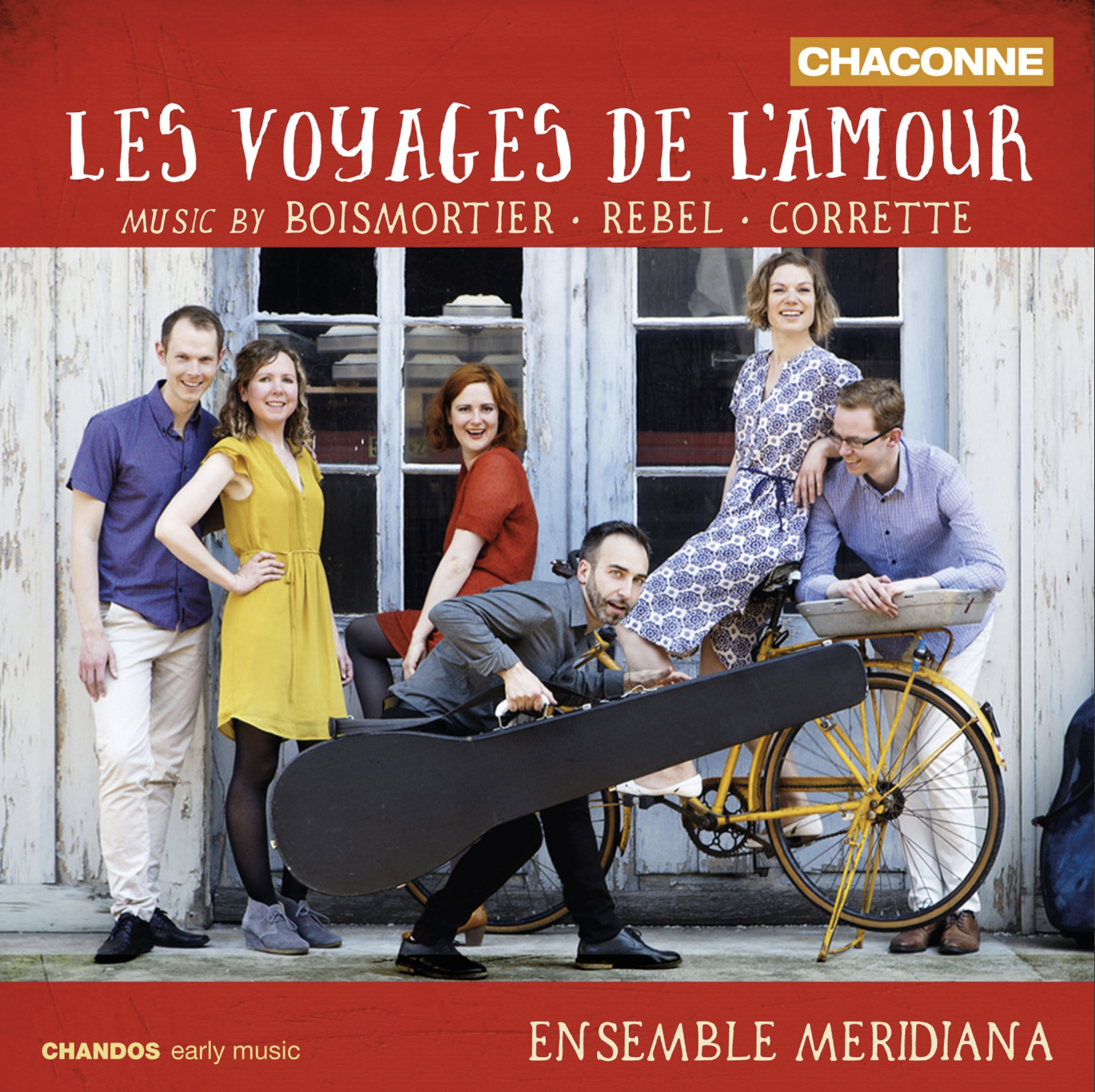
It’s funny sometimes how you come into discovering a new recording. And by new I mean new to me, not necessarily new to the world. In this case, the album features music by Boismortier, Rebel, and Corrette, all French composers, if the title of the album didn’t provide this clue? Hot on the heels of the Linn recording I just reviewed, I came upon another Linn release and in the back of that booklet was this ensemble’s Telemann album. It had a really interesting sound to it, given the acoustics. This came out a few years later. To date, the ensemble is still around and performing, but alas, this is their most recent CD, now ten years in age.
The first two pieces—a selection from Boismortier’s Les Voyages de l’Amour and Rebel’s Les Caractères de la Danse were new to me. The Rebel sonata in B minor for violin, however, was not. Four more pieces by Boismortier follow, his premier ballet, op. 52 no. 1 and his sonata for 2 bass instruments, op. 14 no. 3; then the concerto à 5 op. 37 and finally a trio sonata from the same collection in G minor.
The recording ends with the lighter concerto comique from Michel Corrette, no. 6 V’là ce que c’est.
Boismortier’s music to my ear is always interesting. He was a prolific composer, roughly contemporary with Bach, who made a career for himself in Paris composing and selling his music. There’s an unmistakable French flavor to his music, but it’s been tempered by the Italian style.
The Concerto is a colorful three-movement piece, played here by recorder, oboe, violin, bassoon and bass. It’s not a concerto in the orchestral sense, but rather a chamber piece. The ensemble’s contributors are all strong players upon their instruments and despite recording with a ounce too much reverb, there’s good balance between them all.
The trio sonata here is played by oboe, bassoon, and continuo. It’s a short piece, also organized into three movements.
The sonata for two bass instruments is taken up by bassoon and gamba. Theorbo adds a nice textural component to the basso continuo. The pieces from the Premier ballet de village en trio are colorful in the contribution of different instruments movement by movement: recorders, violin, quinton, alto recorder, oboe, not to mention a variety of plucked continuo. It mirrors the flavor of the opening track, which uses the variety of instruments on hand. I applaud the ensemble for being flexible with their instrumentarium. The playing throughout is effective, sensitive, and played with good intonation.
I like very much Rebel’s violin music and Sabine Stoffer here does well in the solo sonata.
I was pleased to discover this release. I was also to find that this ensemble still finds opportunities to perform with chamber music. I found the sound on their 2011 Linn release to be more supportive, but the ensemble’s refinement is definitely something to notice in this Chandos release.
The pieces here are perhaps ignored for multiple reasons, despite offering appetizing experiences. Some of this music may have marketed to amateurs, and as such, isn’t considered as serious or as important as musical entertainment. While Rameau and Leclair dominate the late baroque from a French perspective, this album is proof that there is more than those two on offer.
One cannot also miss the album covers and interior photos of this ensemble who always wear infectious smiles. It speaks to their approach to the music, I am certain. While a decade in the can, this recording offers still fresh entertainment.