J. Schenk: Sonatas for violin, op. 7 • Ensemble Castor
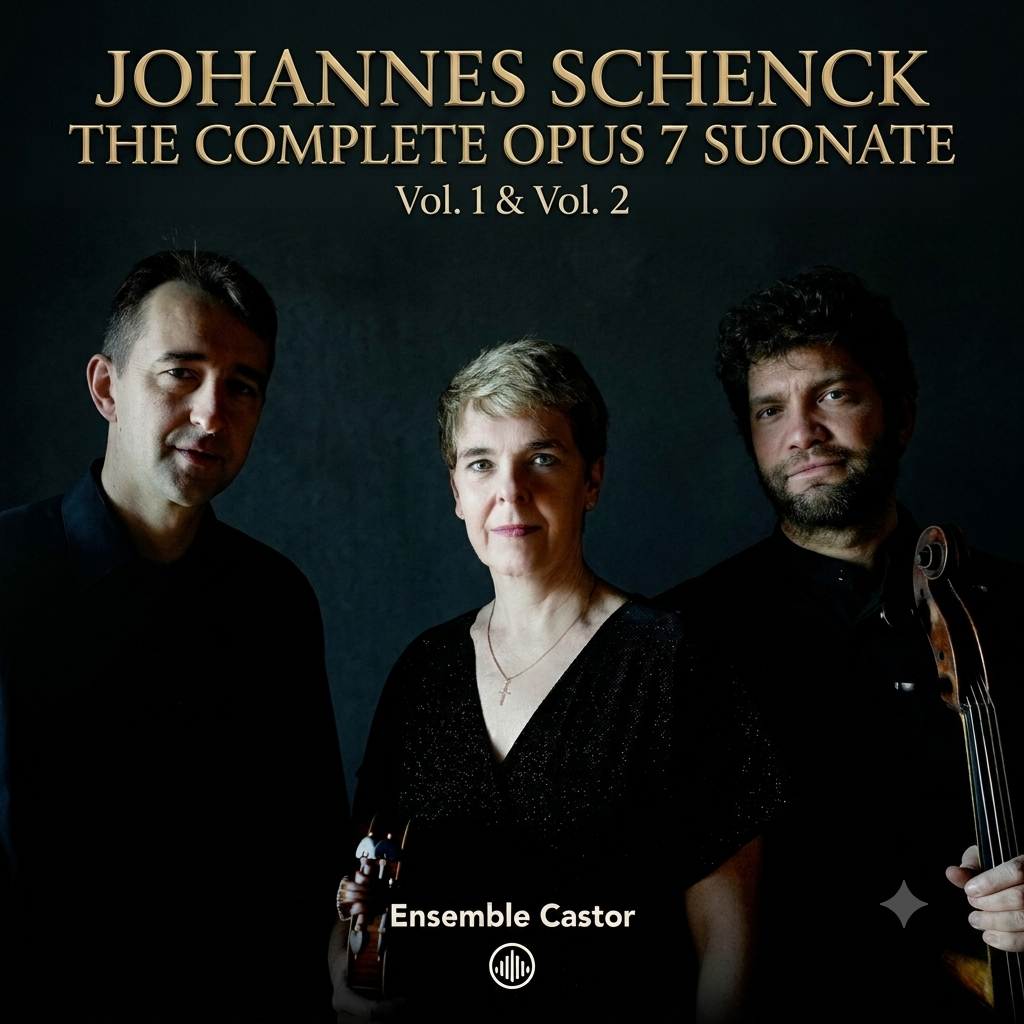
The opus 7 collection by Johannes Schenk (b. 1660), a composer known for his writing for the viola da gamba, has been recorded by the trio of Petra Samhaber-Eckhardt (violin), Philipp Comploi (cello), and Erich Traxler (harpsichord) across two volumes, the second of which came out this past month on Challenge Classics. The Austrian violinist heard here studied with the likes of Andrew Manze and Enrico Onofri. Both she and Traxler play on modern copies of Baroque instruments; hers is modeled after Giuseppe Guarneri del Gesù and the keyboard is modeled after a Christian Vater original. Comploi plays an original 1721 cello from Vienna. One may wonder if the cello is the appropriate instrument here given the composer's background. However the title page, like Corelli's opus 5, lists violone o cimbalo as the accompanying instrumental choices.
The composer's works include ten official opuses, including vocal works, chamber works, and gamba suites; the set of violin sonatas was published in his home of Amsterdam in 1699. It would therefore be an interesting comparison to think about these works alongside Corelli's opus 5.
The two recordings, to my ears, have a very similar sonic signature; they were both recorded at the Rittersaal Schloss Bernau a year apart. The recording, I think, achieves a good balance of instrumental detail with some acoustic ambience; the balance among instruments is good, with the violin up front.
The pieces don't follow a consistent pattern. The work that opens the first disc is called a Sonatina and is rendered across seven movements, many dances with French spelling (e.g. Gigue, Allemande, Courante, Sarabande, etc.). Some are marked Fantasia, Capriccio, and Prelude. The eleventh sonata from the second set is labeled a Sinfonia. Many movements include Italian tempo indications, speaking to a mixed style.
Prelude in stile francese op. 7 no. 9
The dotted rhythms of the short opening movement, marked Vivace, speak to the French style. Schenk was inventive when it came to melodic material. His harmonic language isn't too far removed from Corelli's; however, across the set, it's less formulaic than Corelli's own harmonic signature. There are plenty of rhetorical gestures one recognizes in the violin part; the composer packs the Allemande with ornaments, which get good treatment on the violin. They follow contrapuntally into the basso continuo part in the Courante. Schenk's style is a refinement of the phantasticus manner mastered by Biber, now molded onto dance forms. The Sarabande, to my taste, comes off the most "French." Perhaps odd to us, the piece ends with a Rondeau and not the fun Gigue. The short movement works as a kind of coda, pulling in that French whiff that dominated the Sarabande. I might have ordered these differently, but it is what it is.
Sonatina, op. 7 no. 4
The opening of this short work has a lot of repeated notes, perhaps mimicking the function of a trumpet. The opening movement made me notice the ensemble's tuning, which I really like. They land some chords with delicious thirds.
The second movement, marked Allegro, has good material but it remains underdeveloped; the movement is played in less than a minute. In Corelli's hands, I think, there might have been a binary treatment with a second section. In this way, Schenk's style, even refined, speaks to the phantasticus aims mentioned earlier.
The Aria reminds me of something by Albinoni in style. The concluding Gigue is likewise short, but sounds fun. It makes me wonder about the function of such a piece — was it intended for amateurs? What you should know is that Castor never comes off that way: their cohesion as an ensemble, their tuning, and their blend with one another are all well handled.
Sonatina, op. 7 no. 5
This one is structured in five movements, the inner Allemande, Courante, and Sarabande offered with extensions named variatio. As in other pieces, I noted here, in the Allemande, how Schenk uses the last measure of his cadences to highlight the triad in the violin part. Between the repeats here, I might have enjoyed a bit more variation in how these were interpreted on the violin. When one thinks of Corelli's collection, and the subsequent publication of a version that included the composer's own interpretations — ornaments that looked, on the surface, more involved to those who read music — it would have made for an interesting experiment here. As such, both of these releases are world-premiere recordings, and there may have been some interest in playing close to the page.
The work's Gigue employs double-stopping, which showcases the composer's knowledge of the instrument and was likely meant to bring virtuosity to the fore; the piece also goes higher in the violin's gamut, offering another distinguishing virtuosic element.
Aria, op. 7 no. 18
This work opens with an Adagio followed by six variations. The piece, while divided into tracks for us, plays as a continuous whole in reality. The composer's variation style follows an approach led by the violin, over a repeated bass. The third variation, exploiting ornaments, was among my favorites. The fifth employs double-stopping; the final variation offers plenty of repeated notes.
Conclusions
It's obvious that Schenk attempted to include the kitchen sink in this collection. Variety is the operative word, although the semantics of how these sonatas are labeled are somewhat superficial to today's listeners. It's hard to say how these titles would have sat with musicians in the period. Ensemble Castor does an excellent job bringing these to us, with supportive sound and good balance throughout.
A luxury collection may have included variation in the basso continuo; I would have at least encouraged the use of a single keyboard as the continuo support in each release, alongside one with a solo cello. What we get instead is strong consistency. These albums are important for fans of the Baroque violin sonata. They offer us a fresh voice in a crowded space. Schenk proves to be an affective voice, offering these works in easily digestible packages. In many ways, for me, his style is in alignment with Graupner, whom I also highlight this week.
These two albums continue the ensemble's strong tradition, which I first encountered with their recording on DHM with Mozart/Haydn.