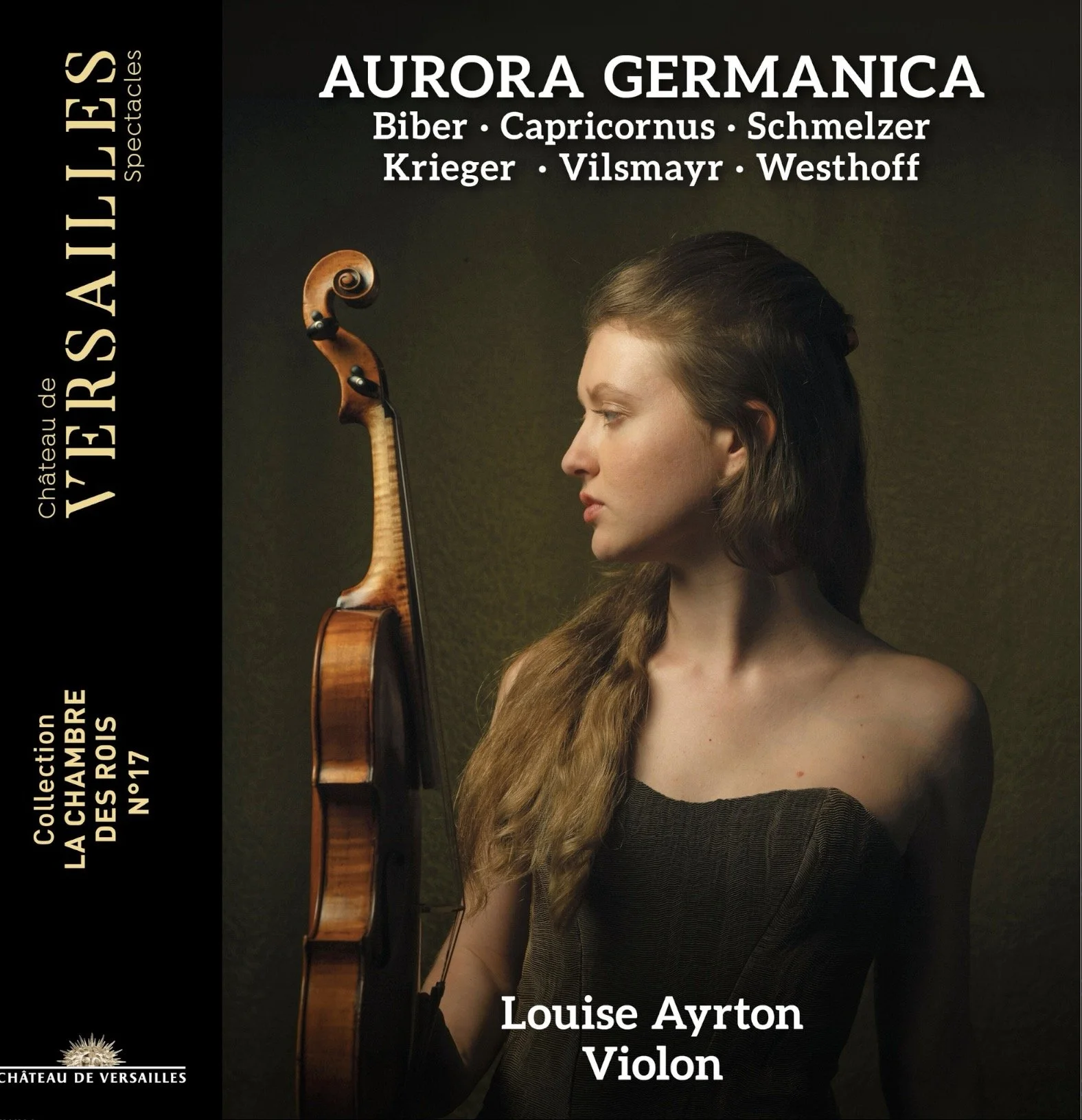
Aurora Germanica
Violinist Louise Ayrton describes this program as an attempt to trace the thread of time backward — to the foundations of the old masters of the Germanic school. Her stated aim, from the booklet, is to
rediscover the deep roots of German Baroque music for the violin
She is leader of Ensemble Jupiter, and took her master's at the Royal Academy of Music in London in the studio of Pavlo Beznosiuk. This album serves as a coming-out effort, and a rather audacious one given the complexity of the works assembled.
She approaches a range of mid-period baroque composers on a Saxon violin made in 1758, with a rich continuo group behind her: keyboard (harpsichord and organ), lute, guitar, viols, and cello. For fans of the baroque violin this repertoire is not exactly on the path to discovery — these composers have been recorded before. But as is so often the case with recordings today, the guise of rediscovery underwrites a rich program of even richer music from before the time of J.S. Bach.
The recording location isn't given in the booklet, but the setting seems luxurious in depth and width, with a focused light placed on the violin. In the quieter passages her instrument has a slightly pursed sound; played out, it carries a gorgeous tone. One caveat worth stating once: balancing several continuo instruments against a single violin is a hard problem, and here the continuo occasionally takes the upper hand — the end of the von Westhoff, the closing Gigue of the Schmelzer. The miking keeps the violin in enough focus to overcome it.
The von Westhoff Sonata No. 3 in D minor starts at track 10. My go-to for this has been David Plantier's recording, which takes a very rhetorical approach. Ayrton is more graceful in the opening, using dynamic contrast to her benefit. The tempo for the second movement seems right, allowing her to shape the dramatic material the composer hands the performer — ripe content for adding harmony with double stopping. Her articulation in several runs, echoed in the basso continuo, makes for attractive moments. The third movement, the Imitatione delle campane, is nicely done, the pizzicato in the continuo part reverberating in the performance space. She handles the bariolage well, with nice dynamic shading. I would have liked a bit more rhetorical drama in the fourth movement, but the fifth, a final fast movement, is exciting and rollicking, as it should be.
The Schmelzer A minor sonata was, for me, perfected by Hélène Schmitt, and like moments in the von Westhoff it opens with rhetorical phrases for the violin. Ayrton doesn't lean into that aspect so hard, instead forming a continuous line that breaks and picks up with the same intensity and volume. Her approach departs from Schmitt's with perhaps more elegance, and what makes it work for me is her application of color, enhanced with ornaments and dynamic shading. Her articulation in the variation section is nicely done. The playing from all the musicians is technically assured, leading to a celebratory finish to a work with so many delicious moments in it.
The album ends with the Vilsmayr A major partita. Performed without the continuo group, it lets us better conceptualize the performance space; the acoustics support a clear presentation of Ayrton's sound. I'm not a violinist, but the piece comes off as virtuosic both on paper and to the ear. It might be fair to compare it to the solo fantasias of Telemann — and if we do, Vilsmayr, born in 1663 and Telemann's senior by eighteen years, comes off as the more accomplished violinist and arguably the more innovative. Ayrton's violin has a great lower register, which the composer frequently invokes as a kind of pseudo-bass support. He also writes dialogue, the lower line answered by an upper voice. The partita pulls out all manner of tricks across its movements, including pizzicato and strumming. Ayrton is technically present throughout, though in a few spots I felt the composer was imitating an actor on stage and the declarative phrases might have benefitted from leaning into that drama. What I will say is that her approach is consistent, and that consistency supports her artistic point of view. Her playing is more elegant and, I'd wager, a bit more polished than the version we get from Gunar Letzbor.
For fellow fans of Biber, the group offers the Sonata No. 3 in F major, C. 140, from the 1681 Nuremberg set. The opening demonstrates how well synchronized the ensemble is. Biber shows his virtuosity in part through a wide gamut; Ayrton's violin is not as loud in the upper register, but the sound is focused and sweet. The playing at the start of the Aria is beautifully done — a supple smoothness to her phrasing that meshes well with the more textured lute underneath. The variations come gradually rather than frenetically, which I think was a smart choice, and the piece builds to a truly frenetic third section. The musicians maintain composure while still arresting attention. There are many fine performances of this sonata; these players have added their own worthwhile take.
Conclusions
There are other works here — from Krieger and Capricornus — that I'll leave the reader to discover. Much of what I've said in service of Biber, Vilsmayr, and von Westhoff applies to those performances too. In addition to great playing, the sound on this recording supports the music well, and the engineering solves the continuo-balance problem about as gracefully as one could ask.
All the musicians and those who support them should be proud of this release. This music is above all colorful in conception, and hopefully as fun to play as it is to hear filling one's living room. I hope these musicians take it upon themselves to explore more from these composers in a future release.