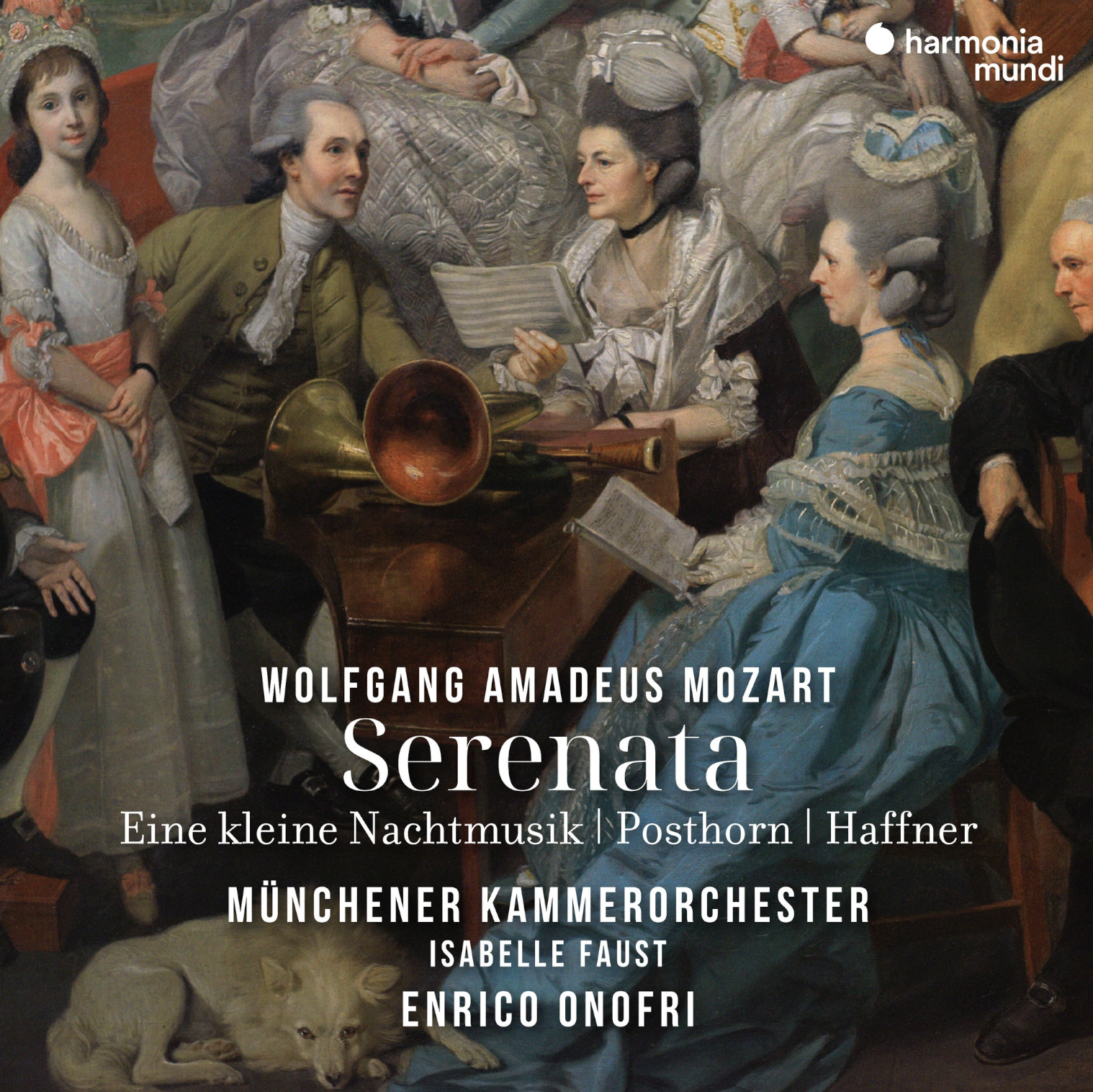
Mozart: Serenata • Münchener Kammerorchester
The last album I purchased featuring Mozart directed by Enrico Onofri was one that took considerable talent to identify; it included the 40th symphony which Onofri directed with his own personal stamp upon the famous work.
This time around, Harmonia Mundi is carrying Onofri, joined by their “regular,” Isabelle Faust. This double CD set was released at the start of the year on Qobuz; I listened to the 192kHz high-res edition. It offers very dynamic and polished performances, for me, becoming a new reference for these pieces.
The big pieces on this recording include the Serenade, “Posthorn” K. 320, the Serenade “A little night music” K. 525, and the Serenade “Haffner,” K. 250. The recording is rounded out with three marches: K. 249, K. 335 (1&2).
Mozart’s “Haffner” Serenade (Serenade No. 7 in D, K. 250) and “Posthorn” Serenade (Serenade No. 9 in D, K. 320) come out of Salzburg’s very specific culture of outdoor/ceremonial music—works written to mark public occasions, but on a scale and with a craft that goes well beyond “background entertainment.” The Haffner was composed in July 1776 for festivities surrounding the wedding of Marie Elisabeth Haffner (of a prominent Salzburg family) and was performed on the eve of the wedding; it’s unusually expansive, and its prominent solo writing (especially for violin) pushes the serenade toward something almost symphonic in ambition. The Posthorn serenade, dated 3 August 1779, was likewise tied to civic ceremony—commonly linked to Salzburg University’s end-of-term “Finalmusik”—and it’s famous for its bright, theatrical scoring (including timpani and a distinctive post horn episode in the minuets), a canny example of Mozart turning a functional commission into a showpiece of color and architectural confidence.
“Eine kleine Nachtmusik” (Serenade No. 13 in G, K. 525) is the outlier: written in Vienna and completed on 10 August 1787, it’s scored simply for strings and yet became Mozart’s most iconic “serenade” precisely because it distills Classical style—clean phrase structure, buoyant rhythmic lift, and memorably balanced contrast—into a compact, public-facing form. Unlike the Salzburg serenades, its original occasion is unknown, and Mozart’s own catalogue entry suggests it may once have had five movements (with a second minuet now lost), adding a small aura of mystery to a piece that otherwise feels effortlessly inevitable.
I would not characterize these as “outdoor” performances, but the dynamics that emerge here, sometimes in an almost terraced fashion, would support easy recognition given a social, celebratory setting.
The Posthorn opens bright, with quite a wallop from the percussion. Later in the movement when the Allegro takes over, the horns contribute a nearly equal bite. By the time the movement ends, it’s clear that this ensemble has a great sound, one that benefits from those hard mallets on the timpani. A good start!
The energy is especially palpable in the opening to the Haffner. The Allegro molto has a lot of repeated figures; I liked the phrasing Onofri imparts to the piece, not to mention the near “surprise” change in dynamics. This is Mozart with real personality. Faust’s contributions come later in the serenade, in the second–fourth movements.
The menuetto-trio movement (third) opens brashly with horns blaring; when it comes, there will be some listeners who decide this isn’t for them; I personally like Onofri’s direction here. When Faust appears later, it’s a kind of surprise. There’s a sweetness to her tone that contrasts well, I think, with what came before it. The balance when she plays provides additional information about the acoustic space where this was recorded; there’s some depth to the ensemble’s sound, with the solo violin taking a natural lead. The engineering puts her sound in focus, compared to the “back” of the orchestra.
Faust’s sound is integrated in the following Rondeau which clocks nice and fast. Altogether the serenade contains three menuets, which seemingly speaks to the music’s function to support dancing.
By the time we get to the last movement, it’s already obvious, but the tight playing by the strings and well-integrated winds showcase a virtuosic ensemble. The performance space provides a supportive acoustic, the recording made at Bavarian Music Studios in Munich. There are times that the quiet ends of phrases are a bit more difficult to hear, which listening at home will be a trade off between the recording’s generous dynamic range and what volume you like. The sound says to me it’s not a great, big space like a concert hall; given the original function of these pieces, I think this sound supports the setting of an indoor fête, but the alternative of performing outdoors is not conducive to a good recording. One might imagine some locations that might have provided a little more support of the ensemble’s lower frequencies.
The shorter serenade, the most famous “Eine kleine nachtmusik” I’m used to hearing in a single-string version. This rendition uses a chamber-sized orchestra, with four cellos and two double basses. With music so familiar, it’s probably best not to get too creative, but to simply play the music as clean with good dynamic shading for the inherent strong phrasing.
And that’s really what this group does under Onofri’s direction. Some may find the tempo on the fast side, for the opening Allegro but I liked it, especially so when they take the typical graces to slow a bit at the conclusion of phrases.
The second movement for me often sags; under Onofri’s push with tempo, I think their solution works well. The menuetto/trio movement has nice dynamic contrasts.
The success of the last movement is dependent upon tight playing across the ensemble. I am left with nothing but admiration for how well they appear to have been rehearsed.
The marches, while not as profound music as the serenades, are played equally well; the one in D, K. 249, has great support from the Kammerorchester’s brass.
Conclusion
There are times you can hear the conductor taking deep breaths before the start of some of the bigger movements. This doesn’t bother me; as a conductor I was known to make audible sounds to encourage players to breathe together. For me it’s a reminder that there’s real people in front of us.
Two of these serenades have a good background with recordings, of course the third is outclassed, as one of Mozart’s most famous pieces. Across the recording I think these performances are strong and they stand out with horns, percussion, and trumpets that are ready for the outdoors; the other notable thing is the strong tempos matched with strong dynamic phrasing.
The tempos, dynamics, and tight playing all around for me push this recording into a comfortable position as a reference. I sometimes find that Mozart is played politely; here because of the direction and the acoustic support in the recording, things are a big more naked and certainly bold. I think the music benefits from Onofri's background in HIPP and for his insight into not taking Mozart's music too seriously. For these reasons I recommend it warmly.