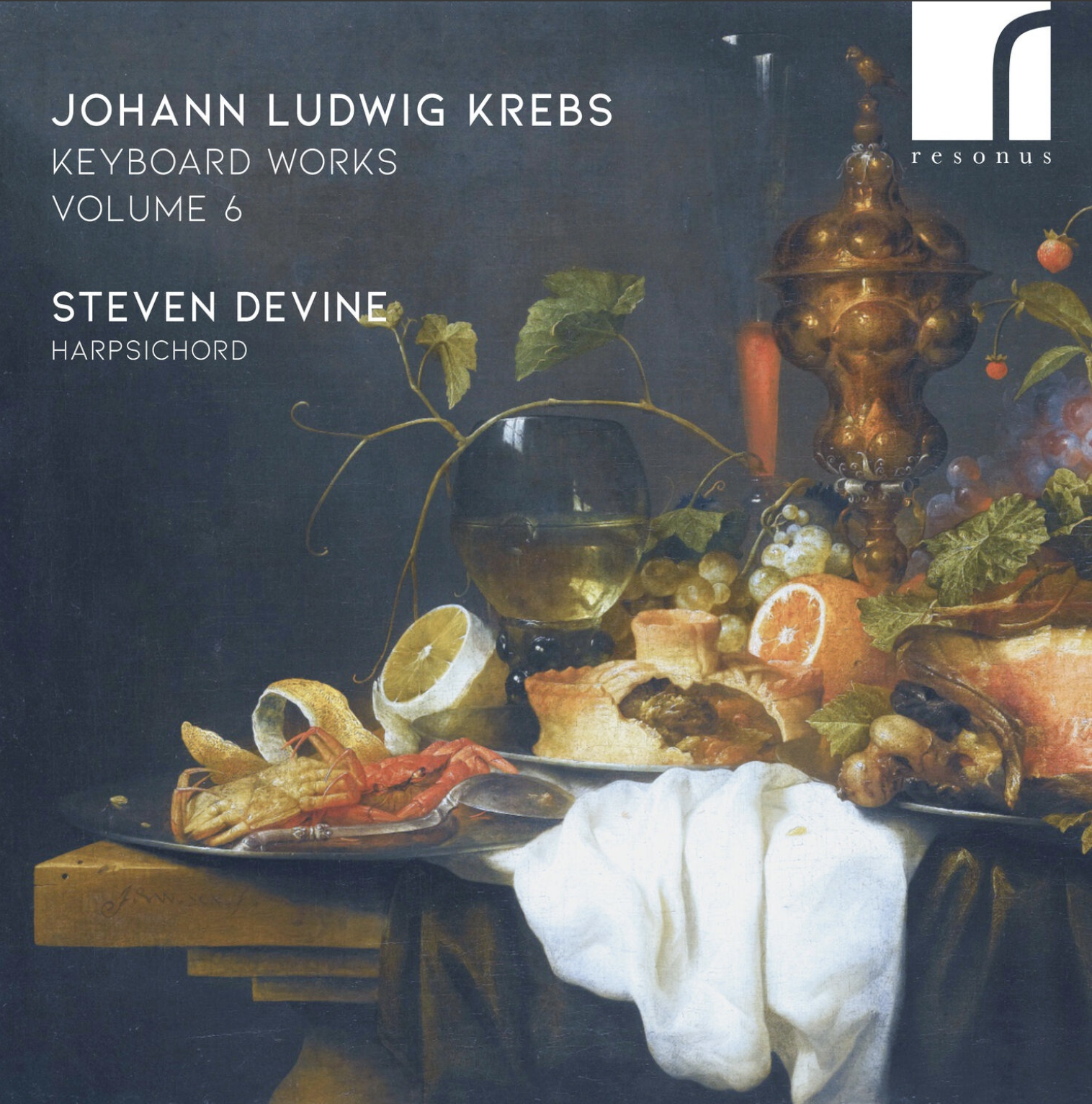
Krebs Vol. 6 • Devine
The last album I examined in this series was Volume 4. According to the liner notes, this sixth release marks the final installment of Steven Devine’s traversal of the harpsichord works of Johann Ludwig Krebs. (The organ works are explicitly outside the scope of this project.)
Taken as a whole, this album sustains the high level of performance and presentation established across the series. More than that, it feels like a fitting culmination—both musically and sonically—of Devine’s engagement with Krebs.
Krebs between past and future
Any discussion of Krebs must begin with his stylistic position. His voice is a distinct one, but it looks in two directions at once, Janus-like. In the Suite in F major, KrebsWV 811, one hears a composer leaning toward the galant idiom; in the A minor Suite, KrebsWV 819—particularly its Fugue—he looks decisively back to his teacher, J.S. Bach.
The A minor suite repeatedly invites comparison. The Allemande and Courante open with gestures that recall Bach almost immediately, and the Polonaise brought to mind a movement from the Anna Magdalena Notebook. More broadly, the suite aligns well with Bach’s six partitas. I wouldn’t argue for equivalence of stature, but the quality of invention is consistently strong, and Devine’s playing is commanding throughout.
It’s also worth remembering that these works date from the 1740s, a period when Bach’s own sons were already writing in a contemporary style that J.S. Bach himself seemed content to leave behind. Krebs, like Bach, wrote overtures in the French style and an Italian concerto, but he absorbs these models and reshapes them into something personal rather than imitative.
The opening preludes
The album opens with six short “preludes” or exercises that immediately situate us in a fresher stylistic world. These pieces rely as much on rhythmic motive as on melody, again inviting comparison with Bach while asserting their own character. The liner notes do particularly good work here, providing context on the genesis, publication history, and stylistic orientation of these pieces, with useful quotations that frame Krebs’ relationship to his teacher.
Performance and comparison
Revisiting Brad Bennight’s 2013 Centaur recording—focused on the suites and including the same F major Suite—proved illuminating. Bennight’s playing has a sense of agency I still admire. For a direct point of comparison, I listened closely to the Courante. Both performances are persuasive, but Devine introduces a degree of rubato that becomes increasingly apparent as the suite unfolds, especially in the Sarabande and Gigue. This flexibility in phrasing contributes to a sense of freshness that aligns well with Krebs’ emerging stylistic independence.
Sound and production
Sonically, Devine’s recording is on another level from the older Centaur disc. The improvements in clarity and presence are unmistakable. I sampled tracks from Volumes 2 and 5 as well: Volume 5, recorded in the same location, nearly matches the sound quality heard here, while Volumes 1–2 strike my ears as slightly brighter and perhaps more resonant.
Across the entire project, consistency is aided by Devine’s use of the same instrument—a copy of a 1710 harpsichord by Colin Booth—which helps unify recordings made over a span of years and venues.
Final thoughts
I can’t say whether Resonus intends to package these six volumes as a complete set, but taken together they firmly establish Krebs’ harpsichord music in the recorded canon. Through Devine’s advocacy, I found myself increasingly interested in Krebs’ compositional voice rather than treating these works as historical footnotes.
For fairness’ sake, I should note that at least one earlier recording exists on Brilliant Classics, with Michele Benuzzi performing Krebs on both harpsichord and a Silbermann-copy piano. Whatever the merits of those performances, Devine’s project is advantaged by markedly superior sound.
Congratulations are due for an ambitious and successful undertaking—one that fills a genuine gap in our understanding of Krebs’ harpsichord output.