Bach: Das Wohltemperirte Clavier • Sturm
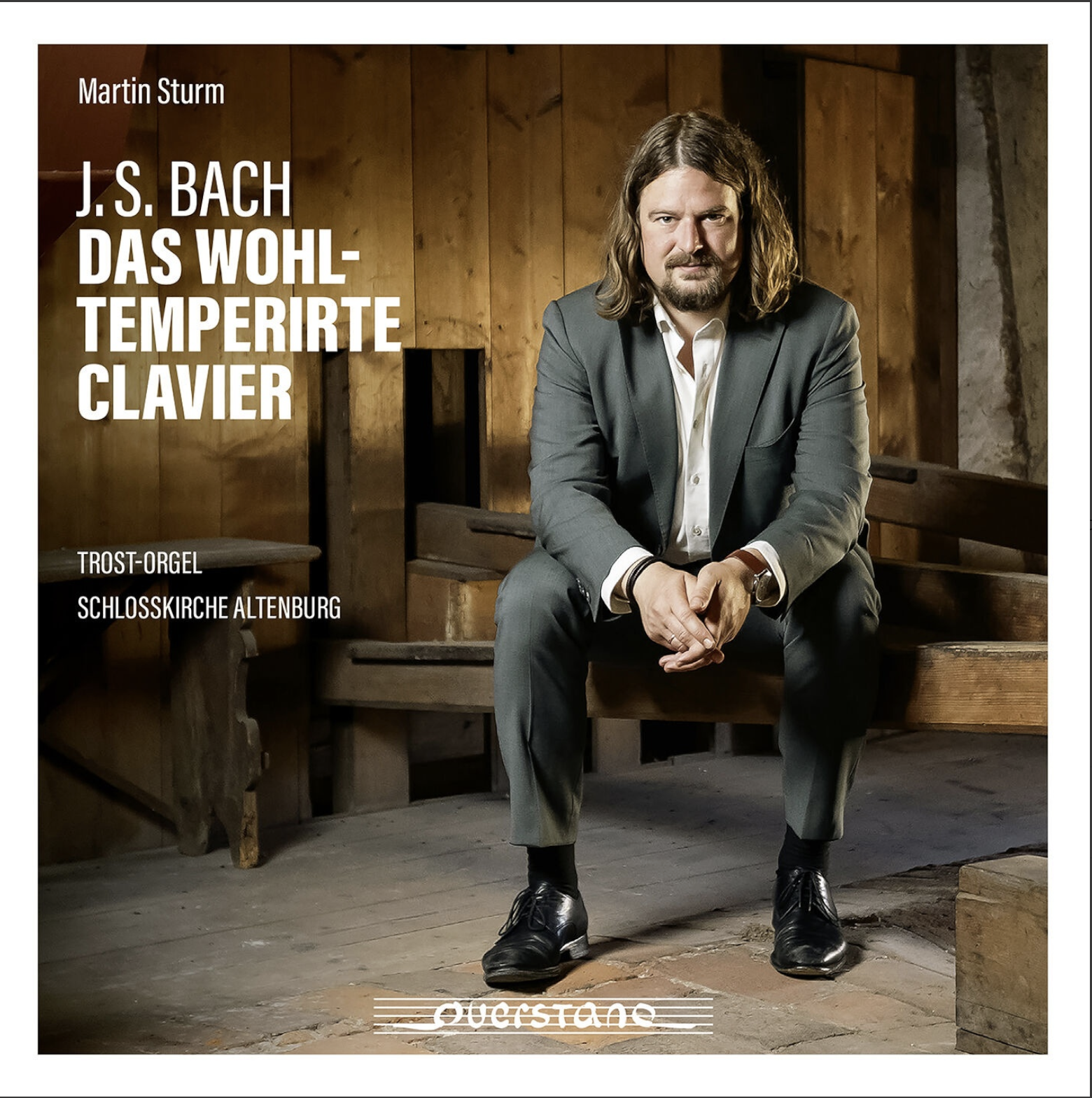
This recording—featuring keyboard player Martin Sturm—presents alongside the first book of Bach’s “48” on organ, improvisations by the performer on clavichord. I am not sure the clavichord pieces are going to be the draw to this album, but are an interesting bonus; the real interest for us is to hear the Well-tempered clavier on an organ.
The instrument chosen is the Trost organ at the Schlosskirche in Altenburg (Altenburg castle church). The maker was a contemporary of Bach, and the booklet makes the case for this instrument being a good fit for Bach’s music.
The immediate questions that arise are:
- Isn’t this a harpsichord collection?
- Is the organ, or this specific one, well-tempered, in the way we might believe Bach to have envisioned necessary for the performance across all the keys?
Before we answer these questions, I think it needs to be pointed out that this recording is prime catnip for organ nerds: the booklet notes outline all the stops on this historic instrument, and the performer includes his registrations for each prelude and fugue, including for some, but not all pieces, application of the pedal.
The booklet notes also provide some interesting background on the collection with analysis from a numerological perspective: I had never come across the point, highlighted, that the A minor fugue could be a tombeau for Bach’s first wife; given that the consecutive measure numbers outline her dates of birth and death.
The detail also brought forth that Beethoven likely learned Bach’s preludes and fugues at the organ and not the piano seems moot as a rationale for performing these pieces at one today. The notes swiftly pivot to discussing the benefits of the organ built by Tobias Heinrich Gottfried Trost, advocating for his skills as builder of instruments that could cover the full gamut of one’s musical needs. The allied assumption, then, is that why wouldn’t we want to hear the completeness of Bach’s music on such an instrument?
Performance-wise, there are some pieces such as the opening C major prelude BWV 846.1 that I found a bit slow; but I was pleased to find that Sturm isn’t afraid of speed; the opening of the D minor prelude (BWV 851.1) is an excellent example. The recording I think well accommodates the quick and the slow, revealing the interesting colors of this extraordinary instrument.
One of the “colors” is offered via tremulant, which Sturm applies in the opening of the prelude in E-flat minor, BWV 853. This key is a prime exemplar for determining the well-temperedness of the instrument, a key that, let’s be honest, isn’t a popular one. The booklet notes that the instrument is tempered, using Neidhardt I. For those interested in the topic, Johann Georg Neidhardt wrote in 1732 a tome on tuning: see this overview or this specific investigation on tuning for Bach.
What we don’t know—at least I do not, nor does the booklet address—whether this tuning was applied originally or as part of a restoration. Either way, it’s an attempt at well-tempering, which is not the same as equal-tempering. It’s clear, I think, that the association of color in keys was such a central concept in baroque times that Bach’s composition was to serve to illustrate a solution that would work across different keys without losing what today, at least, we’d call “character.” The date of Neidhardt’s treatise suggests to me that a search for serviceable tuning solutions that opened the possibility of performing a wider variety of music on a fixed-tuned instrument such as an organ? It must have been in vogue. Bach’s contribution, then, was to provide a cycle of pieces that spoke to this trend.
So, yes, this organ is well-tempered, and yes again, it means that we get some interesting color too. The F-sharp minor pair, BWV 859, is another great candidate to appreciate the flavor of Neidhardt’s tuning. The piece also showcases Sturm’s playing, in the way I’ve heard him many times roll chords, which seems to be an organist’s trick in how we hear the harmony, playing with the space’s acoustics. This pair also does well to provide a contrast between a very articulated sound in the prelude with a sustained one in the fugue. I’m not an expert at organ playing, but across this set, I found the performer’s registrations provided interest in each pairing, offering across the board a very complete showcase of this particular instrument’s virtues.
In the link above I noted a comment that the key of G major suffered with Neidhart’s tuning, but I don’t know which of his 21 tuning options it speaks to; the G major prelude, BWV 860.1, does seem to support the comment, the final chord best allowing us to appreciate this key’s flavor.
If memory serves, this isn’t the first recording to apply the organ for these pieces. If we’ve answered the second question about the use of one tuning for use across the entire work, then the first question is left: would Bach have performed this, or imagined it performed upon the organ?
Or, you may not care. Does it work on the organ?
There is likely a strong case to be made that Bach’s collection was made for pedagogical purposes. One can’t ignore the challenge of learning to play in different keys, and having good material to play in each key, one in a free style and the other in contrapuntal music, would fit the needs of those guiding the development of younger musicians.
For this purpose, then, I don’t think Bach would have cared if you sat at the clavichord, harpsichord, or an organ: while the technique used across each instrument is different, the main function, of finding comfort in your hands across different keys, would have been the same.
One might question the use of pedal, but I don’t think the solutions presented take anything away from the music. Instead, I think it supports it well. I don’t think because pedal works well that the collection was conceived as organ music, but you can’t take the organist out of the composer either. Conjecture about Bach’s use of this music in his time is always interesting, but I will say after listening to this recording, that yes, I think the organ works for these pieces, at least as they’ve been presented to us here. Which says more about the musician performing these preludes and fugues than the composer who wrote them. Kudos, Mr. Sturm!
The sheer amount of variety that Sturm does bring to each individual piece is a bit overwhelming in a way that hearing these on harpsichord or piano is not. I’d still like very much to hear these pieces on those instruments, but hearing them here on organ, especially with pieces I already know so well, was an enjoyable discovery. My favorite, BWV 869 (B minor) works well, as we might expect, upon an organ, and the tuning of this particular instrument suits the key especially well.
The notes also highlight Sturm’s experience as a composer and improviser; the four pieces offered on clavichord are interesting additions to the recording; why the performer chose the intimate house instrument over the organ I cannot say. I’d suggest that these pieces would have been interesting if written out, worked on and perfected over time; as improvisations they perhaps more interesting for us to audition.
Today to hear improvisational music we often are subjected to one particular class of musical style—jazz. But if we want to indulge the understanding that Bach, himself, was an improviser and likely did start his ideas at home and might eventually perform them publicly after being improved upon, then, the use here of a clavichord allows us to entertain this notion. The presence of early versions of some of Bach’s pieces—likely made by students before Bach had put down his pen over the years—supports this notion as well.
Tracks 26 & 27 on disc 2 of this set, I think, were the most profound improvisations. If he truly is improvising fugues, again, I have high admiration for the performer.
I know that the balance between the clavichord and organ is “accurate” in the sense of recorded levels, but across the organ use in this recording, a high level of dynamic range is achieved, which I felt was realistic.
I’ll end here by saying I wasn’t expecting to like this album, but it always feels good to be surprised. I think Sturm has given new life to this set, while showcasing his strong skills as a keyboard artist, and in particular, organist. His name is new to me and I shall look forward to his next project. More Bach-style improvisations could make for an interesting project all its own. If Bach did not advocate for this set to be performed on the organ, too bad; we already know he approved of the builder of the instrument.