À due • Raimondi & Demgenski
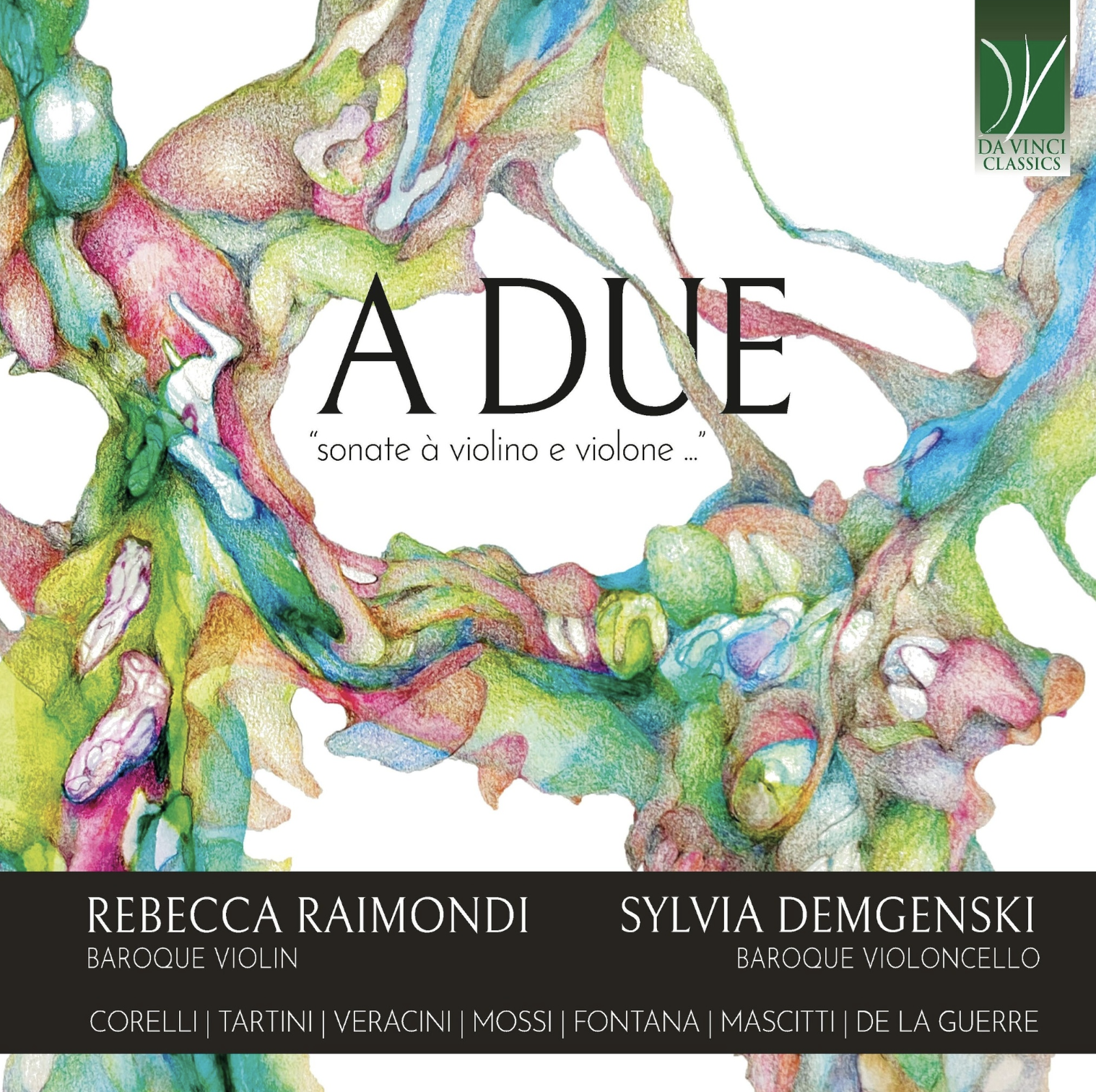
The premise of this disc on Da Vinci Classics is to present a variety of baroque violin sonatas with an unusual continuo option: single cello. I am not sure this pairing would have been so unusual in the Baroque. Corelli’s opus five, that’s represented here with the fourth sonata in F, dictates the use of a bass instrument or a harpsichord, but not both. We are usually presented with a pairing of a cello and a harpsichord for the basso continuo, although as of late, more performers are playing with this tradition of HIPP and offering alternatives. This is one such example.
I auditioned this recording via Qobuz and no booklet was available. Add to this my unfamiliarity with the artists, both playing baroque instruments. The composers represented on this disc include Mascitti, Corelli, Mossi, de la Guerre, Veracini, and Tartini. The disc opens with a short piece by Giovanni Fontana, offering a more complete survey of solo sonatas across the entire period. Here are links, if you’re interested:
In both cases, I found the sound from both musicians to be excellent; the recording bathes the performers in just the right about of reverb, to my own taste.
The Mascitti piece presented is the multi-dimensional work entitled Psiché or Pysche, which is where I started to get a sense of the approach for this recording. Raimondi isn’t the type of performer to exercise every potential apparatus (ornaments, special effects, tonal special effects), but, I will say, is an affective player. The bass part realized by Demgenski is often in just-time with the violin, offering what we might expect, with the addition of some chordal rolls at the point of cadences.
The opening of the Tartini sonata (D. III, opus 1) makes me wonder if a keyboard or lute wouldn’t be ideal here, but within the Grave I think the case is made that a single stringed instrument such as a cello can work just fine.
Raimondi’s playing in the faster movements does well to articulate through the double stopping. Rubato expressed through the violinist’s role is echoed nicely by the cello, reminding us that these two musicians are in lock-step. The little slides Raimondi adds feel natural and support the style of Tartini’s writing.
Veracini’s fifth sonata is a powerful work, set in the reviewer’s favorite key of G minor. I feel that both players are feeling this music in the same way; their playing is sympathetic to each other, with strong technical skill on display by Raimondi.
The sonata by Elisabeth-Claude Jacquet de la Guerre gives Demgenski a workout in spots; but as ever, neither musician gives us the sense that they’re being led to sweat. They’re both technically strong.
My only question when auditioning this recital was the performance style used for the Fontana; these early Italian works are often treated with their own language borrowed from the singing tradition. The approach here seems pretty much consistent with the approach across the other pieces; there’s some of the vocal hesitation that’s realized by the cello before a cadence; there’s a later ornament by the violin that adds a bit of spice. I don’t know if either musician swapped out bows between these pieces; but my guess is they did not. Nor is it required—but the style of the Fontana is the piece that left me wanting for something a bit different.
Overall, this release from June of this year is a strong contribution to the canon of baroque violin sonatas; the aim clearly was to get us to accept a single instrument as the continuo, and in this case, something other than a keyboard.
I think this duet makes the case for a single cello. One might have imagined a gamba for the Mascitti or the de la Guerre, but I honestly didn’t miss a beat with cello throughout.
As much as this album is doing to promote the idea of a single bowed continuo instrument, the strong playing by Raimondo is ultimately something to be celebrated. She’s a strong personality that exhibits strong rhythmic vitality across her playing, with good technical control using an instrument with a gorgeous sound.
This album surprised me in a good way.