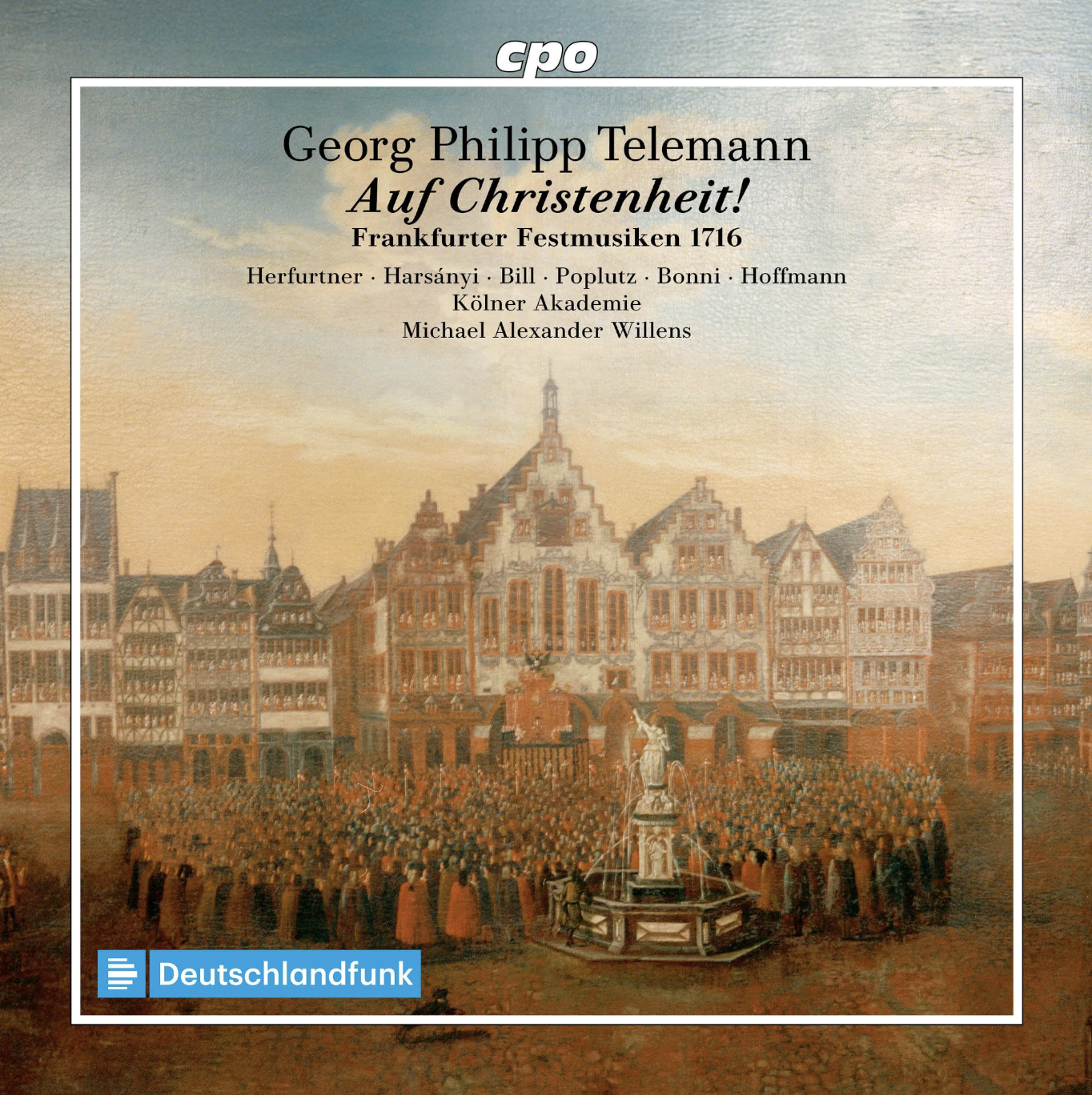
Telemann: Auf Christenheit! • Kölner Akademie - Willens
In this recent release from the Kölner Akademie, we get a recording across two discs of Telemann’s Frankfurt festival music (TWV 12:1), pieces that had a lasting space in Telemann’s mind.
Written in 1716 for civic and courtly celebrations in Frankfurt am Main, Telemann’s Frankfurter Festmusiken offer a revealing snapshot of the composer at a moment when his reputation was rapidly consolidating beyond Hamburg. Commissioned to mark the birth of Archduke Leopold of Austria, these works—one sacred (Auf Christenheit! begeh ein Freudenfest) and one secular (Deutschland grünt und blüht im Friede)—demonstrate Telemann’s exceptional ability to navigate the overlapping demands of liturgy, politics, and public spectacle. Rather than treating these genres as separate spheres, Telemann integrates them into a coherent musical language that balances rhetorical clarity, ceremonial grandeur, and genuine expressive invention.
My mind first goes to another composer—J.S. Bach—and the music we have that he wrote for festive occasions. Like Telemann, there would have been trumpets, which always seem to indicate a festive atmosphere. But the comparison reveals Telemann’s ability to write more dramatic music than Bach; for instance, the third track on disc 2, Ich werde zwar Deutschland mit Feuer und Schwert could easily have been stylistically pulled from an opera.
What makes this music especially important within Telemann’s output is how fully it displays his stylistic synthesis. Italianate lyricism, French ceremonial gestures, and German contrapuntal discipline coexist without strain, serving both symbolic meaning and musical interest. The church music frames the sermon within a festive yet devotional structure, while the outdoor serenata uses allegory, vivid orchestration, and dramatic pacing to translate political optimism into sound. These works are not marginal occasional pieces, but central examples of Telemann’s mastery of public music: music designed to function in real civic space, for real audiences, while still bearing the marks of a composer with unmistakable personality and craft. Heard in this light, the Frankfurter Festmusiken reaffirm Telemann’s stature not merely as a prolific composer, but as one of the most adaptable and rhetorically astute musical minds of the early 18th century.
The majority of these works is arias and recitatives, with a few choruses; a “concerto” is also included, lasting about 9.5 minutes. My guess is this instrumental number, again featuring trumpets, might have been used as scene-change.
The playing by instrumentalists throughout is strong, the standout being, by design, the trumpets, backed by percussion. The singing too is strong; the character Mars is a bit dramatic, performed by Thomas Bonni. From the first disc, the fourth track an aria with chorus features two soloists and chorus; Telemann gives equal weight to the instrumental and vocal forces; in this track, I found a lot to admire for how the whole ensemble is presented, especially with balance. Another example of good balance comes in the aria, Das echo wird auf allen Gassen with horns.
Ultimately, this large-scale work is an important one in helping us understand Telemann the composer; while his instrumental music has now been well-established in the catalog, it is perhaps time to explore more of his vocal music. While I made a comparison earlier to Bach, the style of this work is closer in style to the music by Heinichen. It’s not hard to hear the development into a galant style, wherein Bach’s music holds onto counterpoint to a severe degree.
And this is where I need to come clean: this music does not speak to me in the same way as Bach’s does. To get into this music, you do need to follow along with the booklet (thanks CPO!) to bring context to what you’re hearing (unless you understand the German). Upon repeated listening, I have little patience for recitatives and the subject matter isn’t compelling like a good opera libretto.
I have little doubt that this music made an impact and helped Telemann’s reputation. That said, it’s not a piece I will likely come back to often, maybe most appropriately a few of the tuneful numbers. My rating, in this case, reflects the utility of the album. The performances are technically high, revealed in a large acoustic space that fits the size of the ensemble.
My own taste aside, recordings like these are important for providing access to the general public and likewise students of music of these historically-significant works. Despite what we think of Telemann today, during his time, he was in the late baroque, one of Germany’s most significant musical voices.