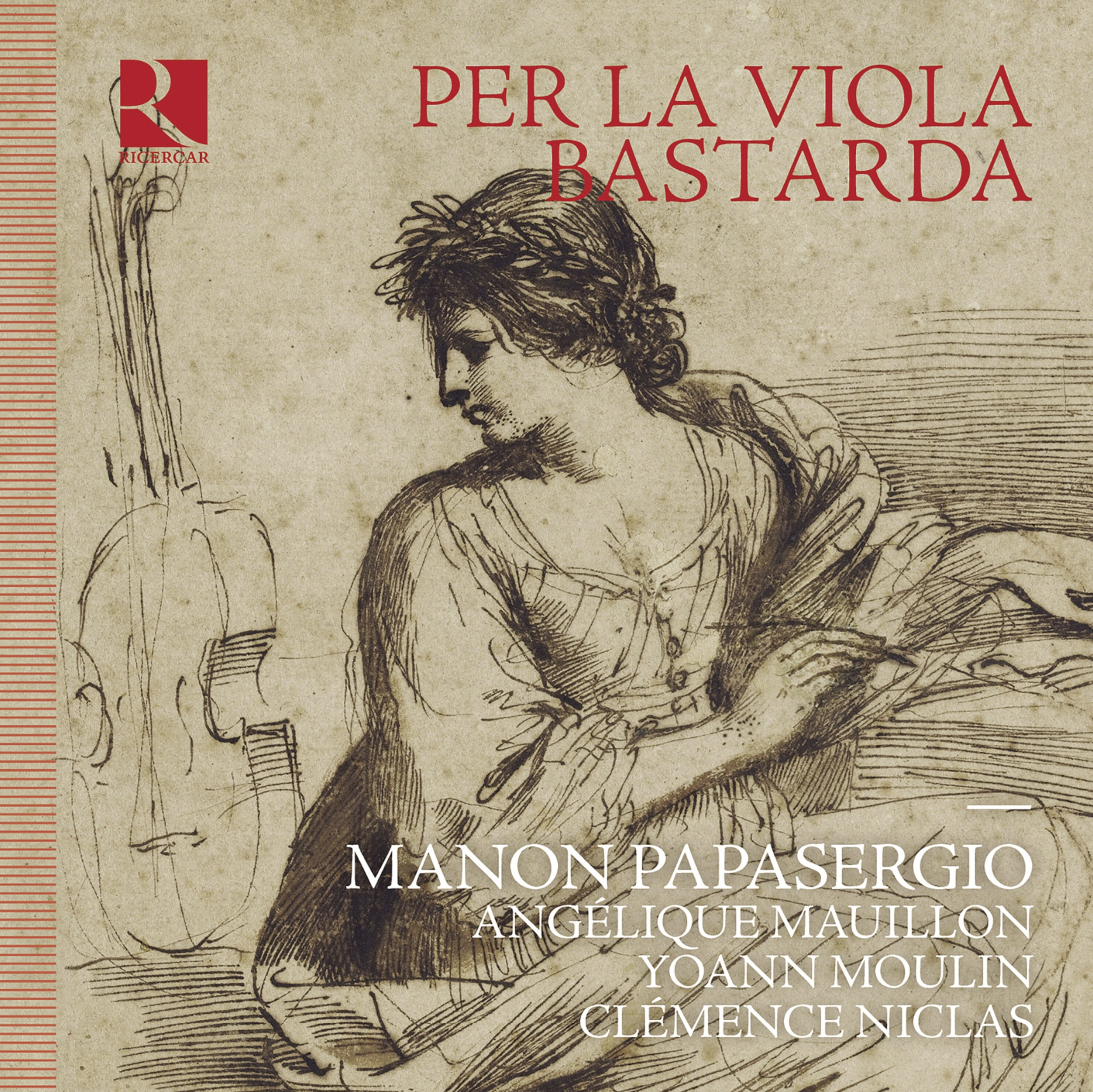
Per la viola bastarda
This curiously named album is born out of polyphonic music from the early baroque, but realized for instruments instead of voices. The musicians here have dedicated themselves to performing in an old tradition, with the viola da gamba as the star.
Per la viola bastarda is an impassioned portrait of the viola da gamba that shows how but found its solo voice in late Renaissance Italy. Instruments were gradually developing their independence through increasingly ornate ornamentation of songs and madrigals and moving towards what would be known as the sonata by the end of the 16th century; the viol was not to be outdone and virtuosos of the instrument composed some remarkable works for it. They used a way of making diminutions alla bastarda that moved between the different voices of the polyphony with an inventiveness and sensitivity that paved the way for the seconda prattica.
Wherein musicians would adopt diminutions on songs, with a clear melodic component, these pieces are different, having the harmony of polyphonic works (multiple voices) realized by an instrument. Manon Papasergio is joined on this album by harp, organ and harpsichord, with participation in some tracks by Clémence Niclas, a soprano who participates by contributing one of the lines from the polyphonic piece. The composers represented on this album include Lassus, Luzzaschi, Bassani, and among others, Ortiz. Papasergio also includes original works, writing:
As the art of playing the viola bastarda is intimately linked to that of improvisation, I wanted to include two pieces of my own on this disc, one on the tenor of the Bergamasca for viol and continuo in the manner of Ortiz), and the other on the popular melody of the Monica, this time inspired more by pieces for polyphonic instruments such as Piccinini’s works for theorbo and Frescobaldi’s for harpsichord.
I was also pleased to see a very popular work represented here across two tracks, de Rore’s Ancor che col patire.
Track six includes diminutions on Ancor che col patire realized by viol and organ. Papasergio is a deft player, executing runs with technical security. In the performer’s own variation on La Bergamasca, I think, it’s likely easy for you to recognize the bass pattern from this dance; the material performed by the bass viol is all over the place, in the attempt to represent the harmonic content within the ostinato. While the piece doesn’t last long, I think it can help those needing a reference for how this bastarda playing works.
Another popular old piece presented here twice is Susanne un jour. First the ensemble performs the version by Lassus, sung, and like many of the pieces on this disc, it carries with it a haunting quality, due in part to the harmonies. Instruments, of course, especially in the hands of specialists, some of whom became virtuosi, would take these long-held notes, recognizable as melody, and then take this starting point into new directions; one can probably see a parallel here to the performance of jazz standards in the last century as a similar musical enterprise. The interpreted version follows, based upon a version left to us from Orazio Bassani.
Bassani is mentioned in the liner notes as an important viol player, and the result here is an engaging piece, demonstrating not only Bassani’s claim to fame during his time, but Papasergio’s own affective playing.
When a modern day listener pulls up this recording and sees that it contains contributions from the performers themselves, they may ask: is this… authentic? I applaud Papasergio for offering us her own attempts at diminutions on these pieces that were attempted by so many different composers and musicians throughout this period of history. For the composers of this era, it was not a solitary position to just put music to paper; performers found composition a part of being a musician. In this way, it allows these modern day musicians to come full circle in an historical way to fully realize the role that their forerunners of the time exercised. The last track, Partite sopra la Monica, is performed by Papasergio alone. I found it the most compelling track on the disc.