Imprinting: Beethoven and Schubert • Accademia Bizantina
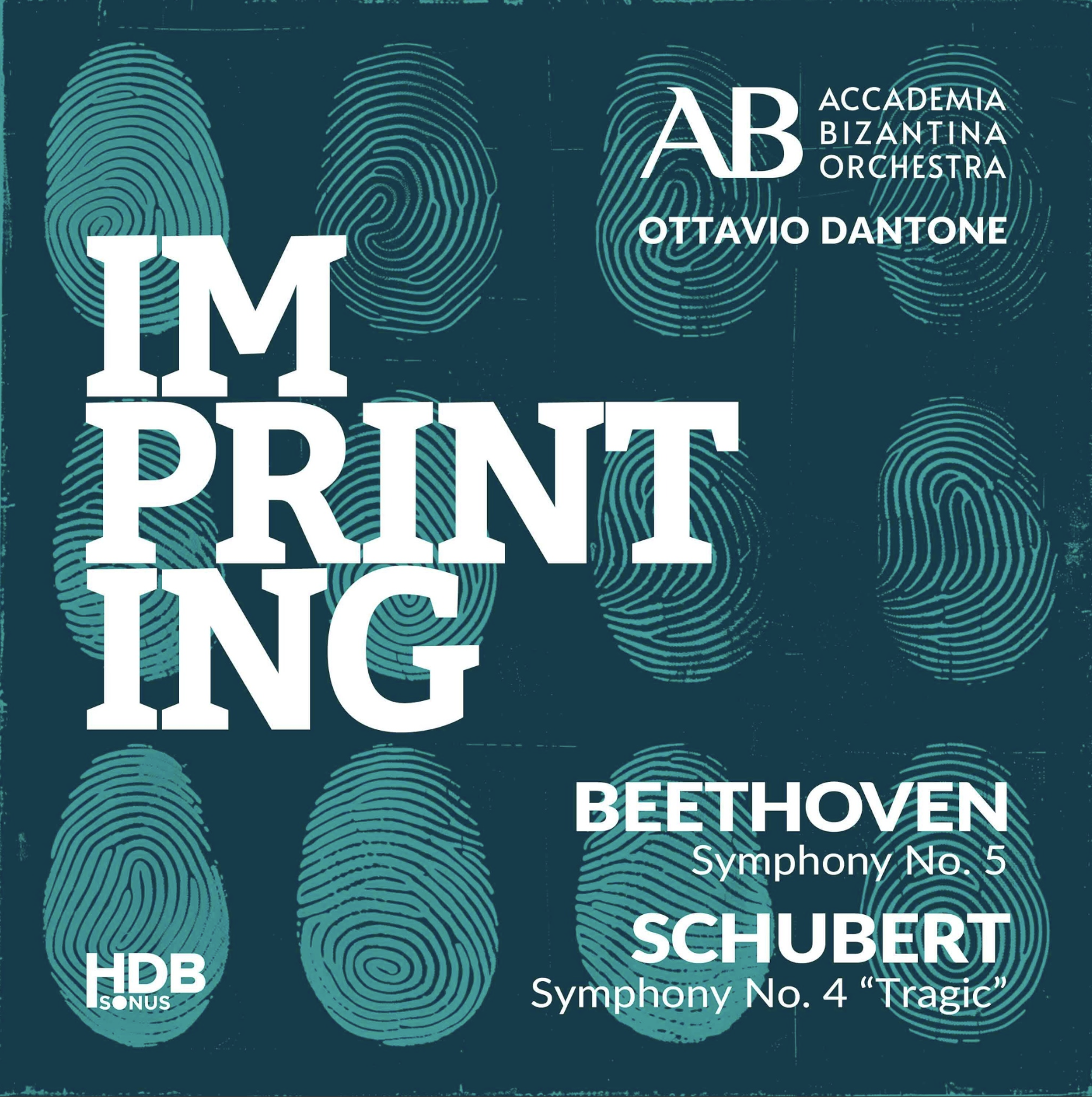
I was a bit surprised to see another Italian conductor taking up Beethoven’s Fifth Symphony so soon after our earlier experience here with Enrico Onofri’s album. This one, led by Ottavio Dantone, pairs it with Schubert’s Fourth Symphony. Perhaps more surprising is how large Accademia Bizantina has grown: some 50 players here. Both Dantone and Onofri are proponents of HIPP, but of the two recordings, it’s Accademia Bizantina that plays on historical strings, brass, and woodwind instruments.
The soundstage has good width and depth. I don’t know anything about the Teatro Dimora in Mondaino, but the sound is pretty good. I’d like a little more transparency, though turning the volume up a few notches works wonders. For those interested in the HIPP approach, the colors on this album are more interesting than on Onofri’s with the Munich Chamber Orchestra, despite that orchestra’s use of valveless horns. The horns here especially offer a robust ripeness that I’m drawn to.
This is the third volume of Accademia Bizantina’s Imprinting series. Dantone presents the series as a study of the Classical-to-Romantic language read through the rhetorical and gestural habits that survived from earlier eras. His argument is that later composers notated more precisely as the shared conventions of 17th- and 18th-century practice faded. Some of the performer’s job remains unwritable, though, and early-music philology helps recover it in later repertoire.
Beethoven
The ensemble uses Bernardo Ticci’s new critical edition, but the booklet doesn’t detail what that entails. I’ve read that he prepared it for this very recording, correcting errors in previous editions. The opening is a bit slower than we might expect, and certainly slower than Onofri’s brisk entry; I can’t help but miss the feeling of the silent downbeat. The tempo that emerges afterward is nice, and the flow of the first movement is aided by a lot of dynamic shading across the ensemble.
I was less impressed with the second movement, whose approach might best be labeled “simple.” Instead of connecting the opening with wider phrasing, Dantone takes a more Baroque approach, using shorter phrase lengths. It’s not my favorite for this movement, but it does offer a new way of hearing it. The slower tempo also works against the approach. The wind playing is again commendable, with lovely colors.
The Scherzo also opens slowly, though of course it’s a quiet entrance before the horns come in. Dantone does interesting things with dynamics across the whole ensemble, but the line in the lower strings again needed a little more connection, and a quicker tempo might have helped push things along. Still, the dynamic treatment is worth a listen for how much it changes things. It kept me pulled in and engaged.
By the finale, I wanted the tempo to rip. Instead we get more of the same: shorter phrase lengths, strong attention to dynamic variation, and a tempo that holds things back a bit.
Schubert
The liner notes connect the two works, noting that Schubert was inspired by Beethoven. His symphony came about eight years later and is also in C minor. I suspect that, like me, many readers know Schubert’s “Tragic” Symphony less well than Beethoven’s Fifth. Two touchstones are Claudio Abbado’s recording with the Chamber Orchestra of Europe and Sir Roger Norrington’s HIPP-informed set with the Stuttgart Radio Symphony Orchestra on modern instruments. Norrington is open to longer phrase lengths, but his first-movement tempo holds things back for me. From the introduction on, I prefer Dantone’s tempo, and that holds when the Allegro vivace starts up. The wallop Accademia Bizantina delivers is impressive.
In the Andante, Norrington pushes harder on tempo, though both tempos work for me. Accademia Bizantina again sounds superior, both in the recording and in the color of the winds. Abbado’s 1980s recording sounds completely different: smooth and elegant, with far more reverb. I prefer both Norrington and Dantone, with Dantone’s the superior recording.
Dantone’s dynamic punchiness works in favor of Schubert’s third movement. It’s done well, though Norrington’s tempo is perhaps truer to the Allegro vivace marking.
Schubert balances the symphony with its outer movements; the short third gives way to real urgency in the fourth. Here the Dantone recording excels in the way the strings are split left and right, offering stereophonic bliss. There’s also a palpable texture to the string sound that I admire, and it comes into its own in this movement. I expected Dantone to do more with the dynamic interjections, but he doesn’t go overboard, which in hindsight may be a smart move. He offers plenty of color and stamina in the development, and here the short phrase groupings work to the music’s benefit, more so than in the Beethoven. In the recapitulation, I just sat back and admired how good this ensemble sounds. That’s no small thing, given how many of these players come from outside its Baroque core.
Conclusions
I have to admit I missed the ensemble’s earlier Imprinting albums: Mozart’s “Jupiter” paired with Haydn’s “London,” and Mendelssohn’s “Italian” with Schumann’s Third. Schumann is a bit too far advanced for my palate, but I’d very much like to hear the Mozart and Haydn pairing.
For me, Accademia Bizantina’s sound and all-around cohesion are commendable. The period winds and brass give this recording its historical charm, if I might call it that, and for me they’re the real standout. As mentioned, a few of Dantone’s tempos might have benefited from a mild push forward, especially given the way he hears the phrasing in the Beethoven. Still, the interpretations are strong.
Against Norrington’s good set, I preferred Dantone’s interpretations. Against Onofri’s Beethoven Fifth, I much preferred Onofri’s direction. Both ensembles are clean and technically sure, but Onofri’s reading was just so fresh and riveting.
I commend Accademia Bizantina for expanding its repertoire to explore not only the Classical period but its evolution into the Romantic. As a series, there is some value in juxtaposing major works by different composers.