Beethoven & the Italians
Introduction
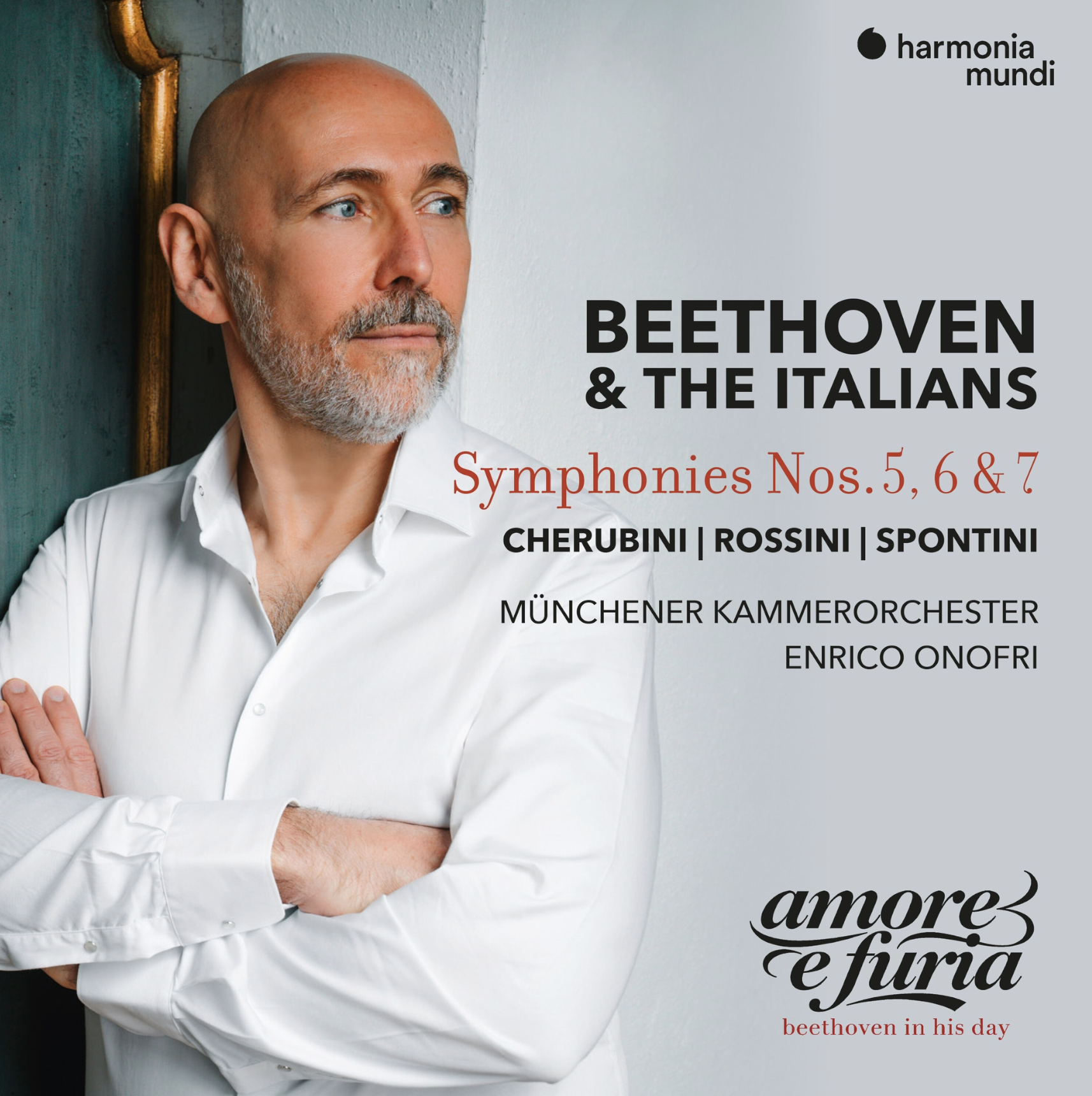
This Harmonia Mundi release from the Munich Chamber Orchestra, with nearly three hours of music, works as three separate productions across three discs; each disc pairs a Beethoven symphony with additional music by contemporaneous Italian composers — Cherubini, Spontini, and Rossini specifically. The reason I can say this is that the orchestral forces change across each CD: while some string players stay consistent, the leaders change, as do the winds. The notes don't specifically say which sessions belong to which disc, but my guess, based on the shifting personnel, is that each CD was made at a different time — the booklet's credits list July, August, and November 2025 as the recording months.
I'll get to the booklet in more detail later, but it has nothing to do with the enjoyment of this release, directed by Enrico Onofri.
Presented here from Beethoven are his fifth, sixth, and seventh symphonies. I'd say his fifth, ninth, and third are the most popular; maybe eighth after that?
The first CD opens with the overture from Médée by Cherubini, which Beethoven had attended in 1802, according to the liner notes; Beethoven would set about writing the fifth symphony in 1804. The opening track crackles with energy, perpetuated by hard-sticks on the timpani. It's the kind of sound, especially so with the percussion, that one can't quite place the ensemble as period or not. By the time we get into the first movement of the Beethoven it's clear that Onofri's period background has a play with the interpretation. The Munich ensemble is not a period group. The other element that promotes a period sound to my ears is the lack of the tell-tale "symphony hall" sound; the performance space is far smaller. The liner notes identify the location as the Bavaria Musikstudios in Munich. The resulting sound is very transparent with short reverb; some may not like the sound, but I found it an asset in this repertoire.
I'll be candid with readers: the "Italian" pieces here I am far less familiar with; the Cherubini pieces were new to me. The Beethoven symphonies were very familiar, especially so the fifth, which I am assuming many readers will have a closeness with as well.
Onofri's conducting of classical repertoire for me has been interesting. I really enjoyed a live performance he did some years ago with Mozart's 40th symphony and all the interpretive flourishes he added. Such flourishes can be taken two ways: "Why??" and "Oh, that's clever!" To be honest, there are so many performances of this repertoire. I want something different.
CD 1
His approach here with Beethoven's 5th is perhaps less controversial but just as satisfying. The first movement has some rubato moments that feel just right. Not why, not clever, just right. The second movement has real clarity around the winds, especially the clarinets and bassoon. The balance is really what's on display, emphasizing some layers that many times get buried beneath the sound of the strings. The balance for me here is beautifully judged. So are the dynamic contrasts.
Some may bemoan the smaller sound with the introduction of the cellos in the third movement; I didn't let the expectation I had from so many other recordings pull me down. The balance is ideal when everyone plays forte. For me this performance promotes Beethoven's orchestration with acute clarity. This is partly down to the choice to use just 25 string players. It's a Kammerorchester after all.
The very soft, crisply articulated moments three-quarters through are so satisfying before the timpani comes in.
The crisp articulation comes through in the opening of the triumphant fourth movement. Hearing the brass cut through the strings was another surprise. I admire a big string sound but this approach for me was like hearing the symphony anew. Bravo!
Spontini's overture to Olimpie was familiar to both Beethoven and Berlioz. Brass and percussion provide a satisfying opening with the composer's revolutionary spirit alive in Onofri's interpretation. This is one of those cases where, when possible, I'd encourage listeners to turn the stereo up and milk all of the great dynamic range that's here to enjoy — especially so if you won't be disturbing the neighbors.
CD 2
The sixth symphony was completed in 1808 and was debuted alongside the fifth! It's unusual for having strong programmatic associations, in addition to the five-movement structure. Here dynamic range across the recording is important for the wide gamut of dynamics. The opening movement benefits again from that transparent sound and the ability for the strings to nearly disappear under Onofri's baton.
Mutes on the strings transform the sound considerably in the second movement. The softness of the strings is something to note; it's one movement where the isolation of the winds comes out and really works well, but some may want more thickness from the string ensemble. What I appreciated on a technical level is how the foundation from the double basses was felt despite the lightness on top. It's a very specific detail that elevated the performance for me.
The storm that comes in the fourth movement I suspected would be a triumph under Onofri's direction, and I wasn't disappointed. As intended, the movement gives way to the finale. It has served for me to work as a reflective movement, one that looks back over the purported walk one took out in nature. The pizzicati pop here, well supported with a good tempo.
Rossini's William Tell Overture is next. The opening declamations by the solo cello work nicely although the instrument isn't out front. The build-up to the mayhem is nicely judged. The bite of the brass feels right. The flute solo was nicely handled. The galloping finale is nicely punctuated with cymbals. The transparency again helps us hear this piece anew, at least for me.
Tucked in after the Rossini, the disc closes with something worth calling out on its own: a world-premiere recording of an alternate ending Beethoven sketched for the second movement of the Pastoral, before crossing it out and restoring the version we know. It's a genuine rarity rather than a filler track — four bars Beethoven drafted, rejected, and left in the autograph manuscript — and it's the kind of thing that gives this set real documentary value beyond the performances themselves.
CD 3
Two symphonies: first, Beethoven's seventh, then at nearly the same scale, Cherubini's Symphony in D.
Many of the same superlatives relay to the performance of Beethoven's A major symphony: great transparency, nice balance between winds, strings, and the percussion. The timpani really stand out to propel things forward. The Munich ensemble throughout plays with great precision. All around, a noteworthy interpretation. Some may miss the "big string" sound in the finale, but I found the balance, again, here refreshing. Yes, I would have liked a bigger horn blast. Especially in the ending? Bells up, my friends! But alas, they were buried.
The D major symphony was composed in 1815 and has a more classical flavor than the revolutionary spirit carried by Beethoven. The liner notes suggest a close synergy with Haydn's London symphonies, although that may be a bit too severe. This piece was new to me and was a nice discovery. It didn't fare well at first, and Cherubini later reused the material for his String Quartet No. 2 in C major.
I can't imagine how the third movement hit audiences; the rising figure that repeats is unusual but satisfying. It's the final movement, while short, that perhaps best captures the flavor and power of Beethoven's style, although thematically it isn't unlike anything he wrote. Throughout, the composer is writing for strings, using the winds and timpani in a supporting role. It's where I think a larger string force might have benefitted the performance, but this ensemble plays with fire and precision, which is clearly felt.
Conclusions
Onofri has a special place in my heart as a favorite interpreter of baroque repertoire on violin. He has proven in this release that he has talents in front of larger ensembles with later repertoire. His interpretations, here led with the Munich Chamber Orchestra, are finely presented. The orchestra's precision, the balance of strings with winds and timpani, and the period style all come together for me to present some new favorite interpretations of Beethoven.
The familiar William Tell Overture was another treat for me. The other pieces, while I may not play them as often, add context to the world Beethoven occupied in the first quarter of the 19th century.
While many may have one or more editions of Beethoven's symphonies, I think the program here warrants investigation, and the great recording enhances the value of this set and these interpretations further.
Booklet
The booklet includes a creative story by Onofri, "quasi una fantasia," which some may enjoy, using historical touch points. I was hoping this wasn't a replacement for what we normally get in the form of liner notes, but we get those too. The story helps connect the works and the album concept.
What continues to infuriate me is the layout and font size created by the folks in Arles for their recordings. While I do sit with a laptop on my actual lap to take notes while I listen, and eventually write these reviews, I more often am controlling my system with my phone. And while I listen, I like to pull up the booklets.
The Harmonia Mundi booklets are worthless on a phone. The width of the column of text and its size make it impossible to read. And they go so far as to add hyperlinked arrows to navigate the album. The same goes for their recent album with Christie and Langlois de Swarte, featuring Rameau's violin music. Same layout and font, same worthlessness on screen.
Do know I take nothing away from these musicians in my application of a rating here based on the booklet, but this label, which has a huge catalog of very good recordings, is not helping its customers using digital media or streaming by sticking to this booklet format.