An Italian Portrait (Cantatas by G.F. Händel)
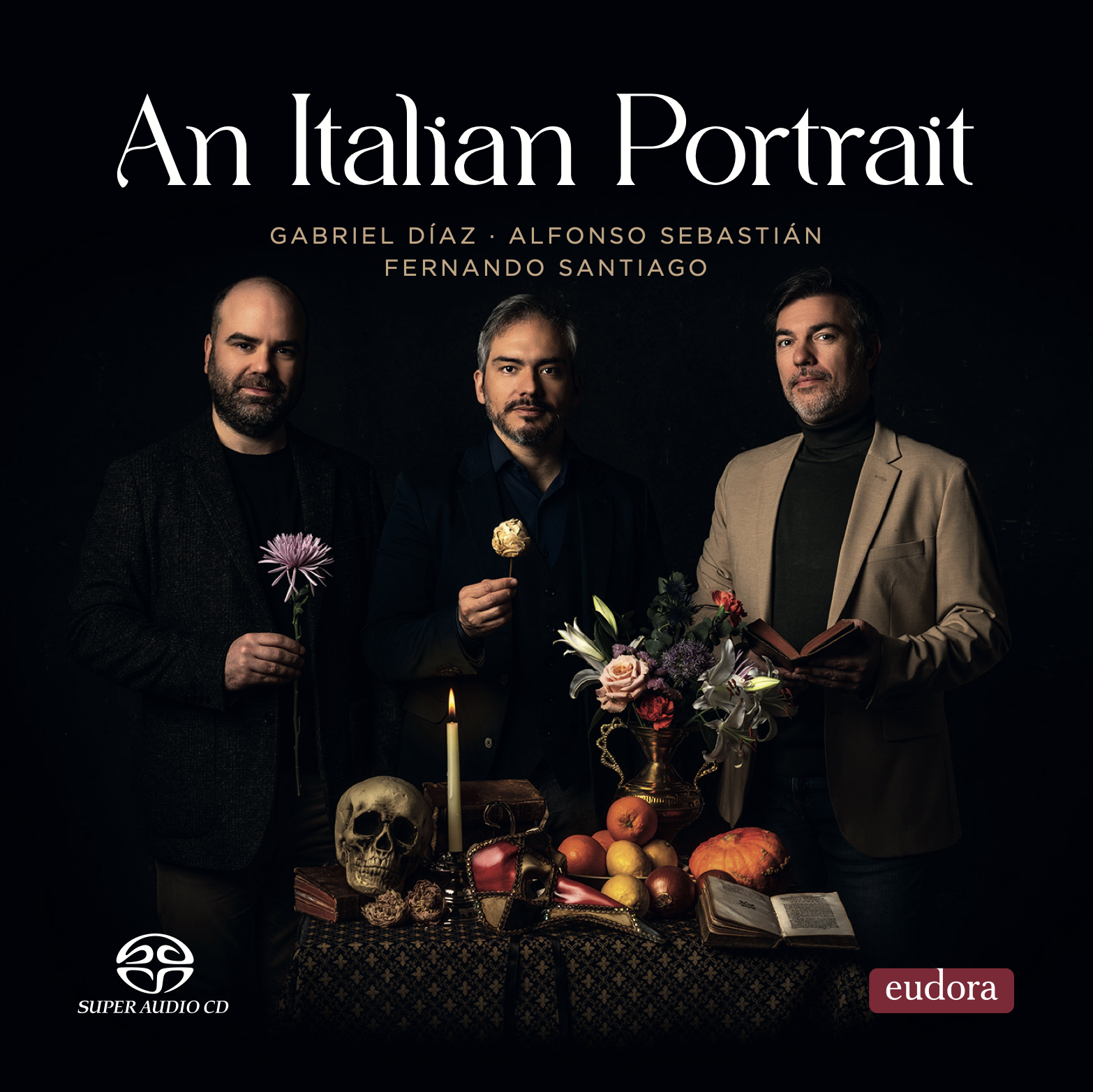
This album features cantatas for solo voice, sung here by countertenor Gabriel Díaz. Before I discuss the music, the production value of the booklet that accompanies this album has some issues.
- The album credits the three musicians on the cover but never specifies who is who.
- The album cover never specifies the music or composer that is performed; the pieces include HWV 120b, HWV 91a, HWV 167a, HWV 125b, and HWV 109a.
- The booklet includes an essay which spends too much time questioning what CD liner notes are; however it does not include the lyrics or their translation to English.
For the record, since the packaging won't say so: Díaz sings countertenor, Alfonso Sebastián plays harpsichord, and Fernando Santiago plays baroque cello.
The notes do, however, point out that these pieces were intended for a female singer and that whether or not Handel may have leaned into a kind of pornographic portrayal by not caring so much about gender, or that he may have homosexual inclinations, that it shouldn't matter. The truth is, Handel used singers with different genders than their characters for opera, why not for cantatas?
A booklet without the lyrics renders the recording nearly useless if one wants to understand the context of text with music, which of course is one of the central themes of appreciating sung music. Understanding Italian, of course, might save the day, but sadly I am in the camp that would need the lyrics and a translation.
I found Díaz's voice easy to enjoy: he uses vibrato for color and ornament without applying it constantly, and on the whole I found his interpretation quite nice. The sound of the harpsichord and cello is subdued, pushed back, while Díaz's voice is up front and left; there's enough supportive reverb to make a nice-sounding presentation in the living room.
The pieces themselves don't come from a single occasion or a patron's commission — they represent a cross-section of Ellen Harris's edition of the lesser-known continuo cantatas, spanning from genuine Italian-period Rome/Florence pieces (91a, 167a) to works whose only surviving texts turn out to be later London copies or revisions (109a/b, 120b, 125b).
HWV 91a, Clori, degli occhi miei is dated 1707 and likely was penned in Florence. HWV 120b, Irene, idolo mio likely includes material that Handel composed before his trip to Italy. The cantata is presented across six movements — three recitative-aria pairs, not the two-pair, four-movement shape you'll find in most of the other cantatas here.
The pieces include a/b notation as they have existed in multiple versions. Altogether, Handel wrote over 100 of these works, most of them during his years in Italy, and they served, we believe, to help him discover his vocal style that would later be important to his success with operas and oratorios.
The first aria from HWV 91a (track 8):
Aria 1 — Quel bel rio ch'a duro scoglio (Allegro, D minor)
Quel bel rio ch'a duro scoglio Frange intorno i chiari umori, Sai che dice in sua favella? Dice ognor col mio cordoglio: "Questo sasso è il cor di Clori, Cruda Clori, ancor che bella."
That lovely stream, breaking its clear waters against the hard rock — do you know what it's saying, in its own language? It says, always, echoing my sorrow: "This stone is the heart of Clori — cruel Clori, for all her beauty."
The text and theme point to an audience of poetry connoisseurs, attuned to its transition into music. Handel likely had these performed for private audiences, such as the Arcadian Academy, hosted in Rome by figures like Cardinal Ottoboni.
The voice's opening material first appears in the continuo, and that contrapuntal relationship shows off Handel's mastery. I'd have wished for a stronger declamation from the cello and harpsichord, but the voice does well to bring contrast against the hard rock's appearance.
The aria from HWV 120b, In tanti affanni è immerso il core, translates to "In so many torments is the heart immersed" (track 4). Díaz has great control when the voice sweeps up. The aria changes character when it transitions to a minor mode; the voice carries the sentiment and style well. Intonation is also well maintained throughout.
Conclusions
Those interested in Handel's Italian cantatas will find a few options in the marketplace. HWV 125b is covered by Xavier Sabata with Forma Antiqua on Amore X Amore (Winter & Winter, 2009). The album features a far more dramatic singer, but I am not sure it's called for with this repertoire. The continuo team with the Zapico brothers is a bit more interesting, but the recording was made in the confines of a smaller space, which might not be to everyone's liking.
I think the presentation here is well-done by both the continuo and the singer. I too don't care who sings these, a woman or a man; of most importance to me is not applying constant vibrato, and while Díaz doesn't avoid it altogether, it's quite tolerable and an effective component of his interpretation.
The folks at Eudora Records should have seriously considered including the texts of these works. I own Ellen T. Harris's book, Handel as Orpheus, which may include some of the texts, but like many of you, having to look them up is not how I'd prefer to spend my time.
Those already familiar with these particular works will find allies in these performances. For those exploring this side of Handel for the first time, you'll find many tuneful arias among the recitatives. For instance, the opening of HWV 109a could easily have served as an oboe sonata. For those who want to understand how Handel brought this Arcadian poetry to life, you'll have your work cut out.