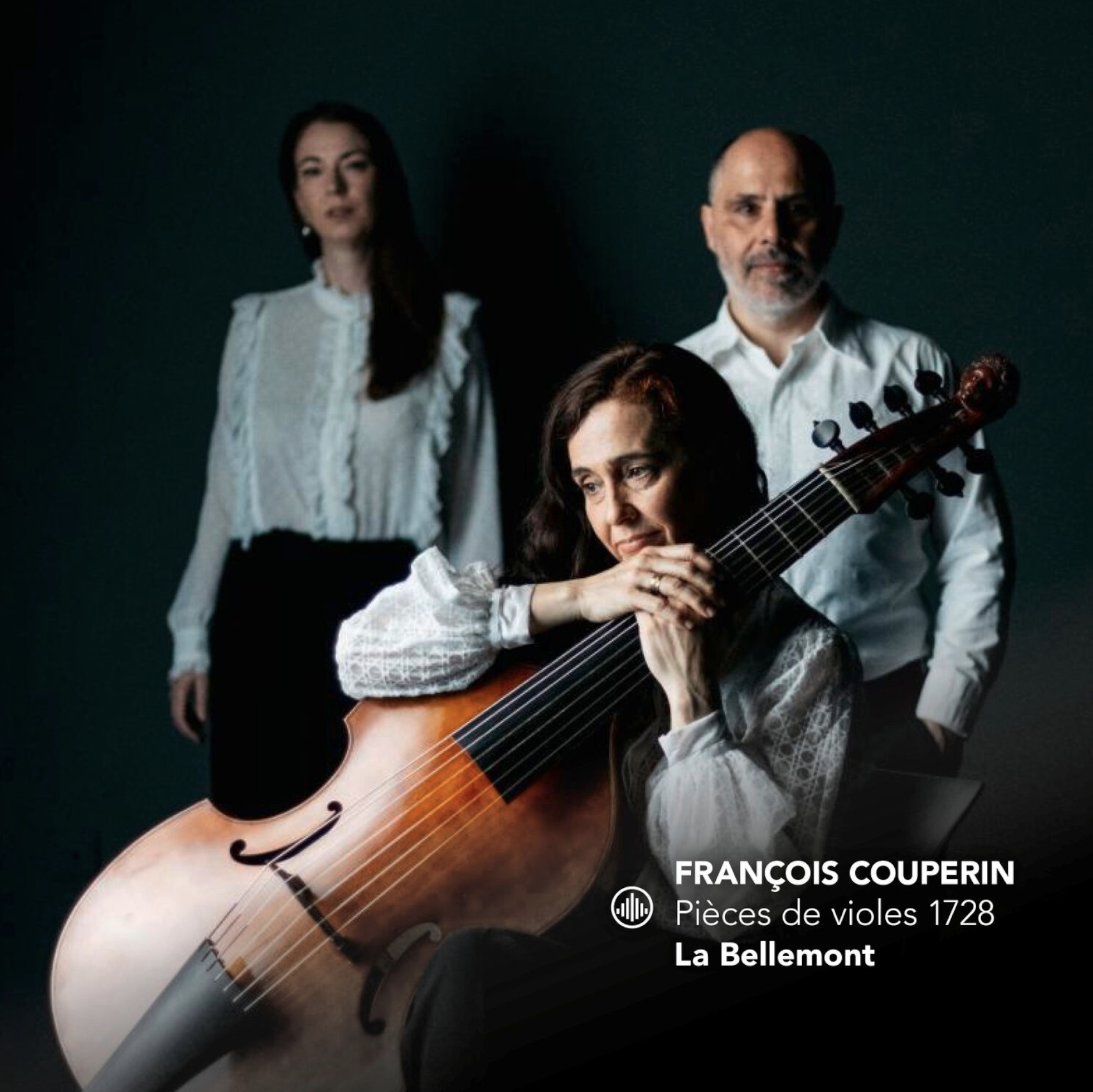
François Couperin: Pièces de violes • La Bellemont
The liner notes describe Couperin's Pièces de violes (Paris 1728) as his "penaltimate publication" [sic] — his second-to-last, before the fourth book of harpsichord pieces closed out his catalogue in 1730 — comprising two contrasting suites.
Following a period practice of transcribing pieces for other instruments, La Bellemont punctuates the two viol suites with Rafael Muñoz's arrangement, for theorbo and viol, of Robert de Visée's own theorbo transcription of Couperin's harpsichord piece Les Bergeries.
Lucy Robinson provides excellent notes to accompany this recording — of just 38 minutes, not the 44:10 the booklet lists as its total; the booklet's own track-by-track timings actually add up to 38:28, matching what Qobuz and Roon report. The printed total looks like a simple misprint. The ensemble leads with Sara Ruiz on gamba, whom I'd admired for her recording of Telemann, and Johanna Rose, whom I've auditioned here. Laura Puerto plays harpsichord, and Rafael Muñoz plays theorbo and guitar.
Curiously, the album was recorded in 2015 and only just released. At first I thought it might be a typo, but a photo of the recording session shows a MacBook Pro with the old light-up Apple logo, which confirms the vintage — Apple dropped that design in late 2016. At a genuine 38 minutes, I suspect the collection's brevity may be part of why it sat unreleased for so long, though there are myriad possible reasons. What's on record here, regardless, is a very direct recording with sensitive and detailed playing.
While we likely don't think of Mr. Couperin as a gambist, the notes suggest he knew the instrument well, and his writing for the instrument showcases a strong ability to represent a full range of human emotions.
The opening of the A major suite, the Prélude, offers up a strong voice in just two and a half minutes. The Fuguette follows, showcasing frivolity cast in a stylish outfit. The Pompe funèbre isn't particularly sad, but it does suggest introspection. Here it feels highly appropriate to include another gamba as part of the continuo group. The final track, La Chemise blanche, makes me think of some kind of musical joke, and is odd for opening in a minor key, given the suite's key center of A major. Whatever the inspiration, it's a daringly hot piece.
The opening suite is longer, and its opening Prélude is simple enough, but both the ornaments and the eventual use of two strings on the gamba add sophistication. The movements aren't particularly long, but each is long enough to offer up some inventive, tasty themes — one of the more memorable being the Gigue. The final movement, which switches to major, is titled Chaconne ou Passacaille — potentially showing confusion at the time over what separates the two ground-bass forms, or, again, suggesting, alongside the details of the cover page, some humor on the part of the composer.
Given the shortness of this collection, one can only wish that M.F.C. had provided us more. Lucy Robinson calls these pieces among his greatest achievements. I can't argue that the pieces come off strongly. And I can't imagine them getting more love from the musicians on this album.