48° North. Caldara, from Venice to Vienna • BanXhies
Introduction
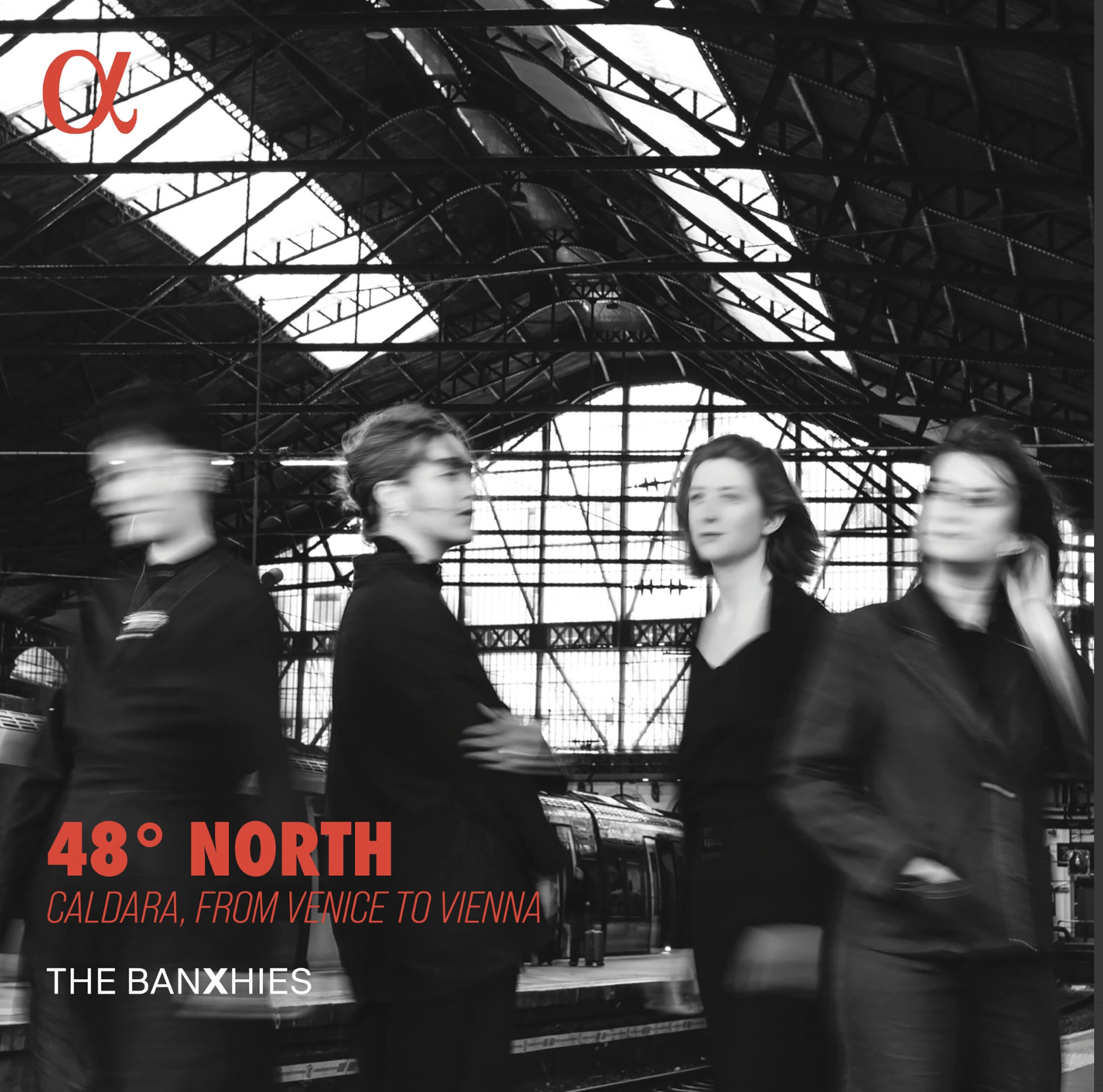
The name of this album isn't particularly helpful in understanding what you're going to hear within; in a store you'd have the opportunity to turn the disc over and see a track listing: Caldara, Biber, Vivaldi, Bach, Muffat, Fux, and Froberger. Legrenzi, Porpora, and Marini too. Now the image of the four artists in the train station might make sense: this will be a musical journey.
The BanXhies are a four-person core ensemble, joined here by Emmanuel Arakélian on organ. Louise Acabo performs on harpsichord and organ; Suzanne Wolff on cello; Yaoré Talibart and Roxana Rastegar are the violinists, who trade first chair across the album.
The liner notes frame it this way: Caldara as a composer "at the crossroads of tradition," his blend of Italian clarity and Germanic depth leaving its mark on Mozart, Beethoven, and Haydn.
Sound
The recording was made at the Christuskirche in Paris, in September and October of 2025. For me the acoustics support the music in a traditional way; the tell is the solo harpsichord track — a Froberger Toccata (track 16) — that reveals about as much of the instrument up close as the reflections of the space. The sound is really nice, on the whole.
A very nice foundational bass is heard in the Biber, from his opening Mystery Sonata, the Annunciation (track 17). The detail in the violin, played by Talibart, is perfect.
The Music
This is the ensemble's debut, and offering "best hits" from a variety of personalities is a smart way to show their versatility and affective gamut. At just over 68 minutes, the album is generously filled, and I'm happy to report the group's approach to the repertoire is enjoyable throughout.
Tracks 18–20 borrow from Muffat's G minor concerto from his Armonico Tributo, and the opening is slow and rich in conception and tone. The balance in the faster Aria is a bit off, given this arrangement, as the continuo comes off a bit heavy. The final movement shows off their technical acumen — the ensemble has a tight, rhythmically locked-in sound. Impressive.
The album opens and closes with instrumental pieces by Caldara. In this case it's his opus 1 trio sonatas; the album opens with two E minor sonatas, the complete no. 5 and then two movements from his no. 2. The album closes with two selections from his fourth, in B-flat major. Caldara's writing is a continuation of the Corellian style, advanced perhaps with a more cosmopolitan mix of musical ideas, not to mention an expanded range for the violin. The ensemble does both the dramatic slow and the fast and spirited equally well. The second track, for instance, pits the two violins in a contrapuntal chase, and both ladies are well-matched for the game.
Legrenzi's Spilimberga, from his op. 2, opens with the two violins and organ. It's an example of the slow and dramatic, played without excess; the drama comes later, with some rhetorical injection that first comes to the violins before the organ, supplanted by the cello. The drama comes in the form of juxtaposing two different moods. There could have been more of a build-up before the final cadence, sure, but it still comes off effectively, with affekt.
Porpora is known for his vocal music, but here we get a short visit with two movements from his op. 2 Sinfonia da camera. The opening is notable for the tessitura of the violins; the drama is all in the resolution of harmonies, and the presentation is clean and dramatic, but not overly so. The violins' ornaments are consistently well rendered. The two violins sound particularly far apart in the second movement, but the tightness of the ensemble wins out and the result is masterful.
Vivaldi appears by way of one of his cello sonatas (smart idea), and they choose his best, in my opinion, with the very charming opening slow movement (RV 46). My introduction to this sonata was by way of Christophe Coin and Christopher Hogwood. I remember listening to it non-stop. That said, this performance has a good lead with Wolff on cello, but I found the business of the harpsichord a bit distracting. The final movement is also offered and is better done, but I would have moved the cellist to the forefront here — the balance across this sonata suffers a bit, with the cello sounding as if it's in the background.
Fux's trio sonata K. 320 is presented in its four movements. It was likely conceived for two recorders, though the violins of course cover that range comfortably. Here again, in the slow movement, the drama to be felt is in the way the two upper lines play into each other and then resolve against the basso continuo; they use dynamics to do this, which is appropriate, but I wanted just a bit more. I'm reminded of juicing citrus: you can squeeze the lemon with your hand, but using an additional implement can render even more juice.
The ensemble mixes the continuo keyboard instruments here across the piece, which makes for a luxurious result; the closing Passacaglia benefits, for me, from the texture introduced by the harpsichord. Both violinists are brilliant, although the balance again favors the cello a bit. I really enjoyed hearing this piece, as it was new to me, and I found it far from pedestrian.
Conclusions
The music presented here — while in many cases samplings from larger works, and in some cases done in arrangement — does well to showcase the extraordinary talents of these musicians. At the same time, the performances aim to provide us an aural lesson of musical style encountered and interfaced by the composer Antonio Caldara.
The program does not stick to all trio sonatas, and that was a smart move; the performance of solo keyboard and the Vivaldi cello sonata allows the ensemble to flexibly show off the talents of all in consort and alone.
While I did point out a few areas of concern, these together minimally detract from the supreme enjoyment this album offers. The ensemble excels at the faster movements, at cadences, and the natural presentation of ornaments. They recognize the dramatic content of the slower movements, and I am hoping over time they squeeze some of those moments a bit more.
Most would counsel me to say that, in their present form, they play these slower movements in good taste. I can't disagree about the taste.