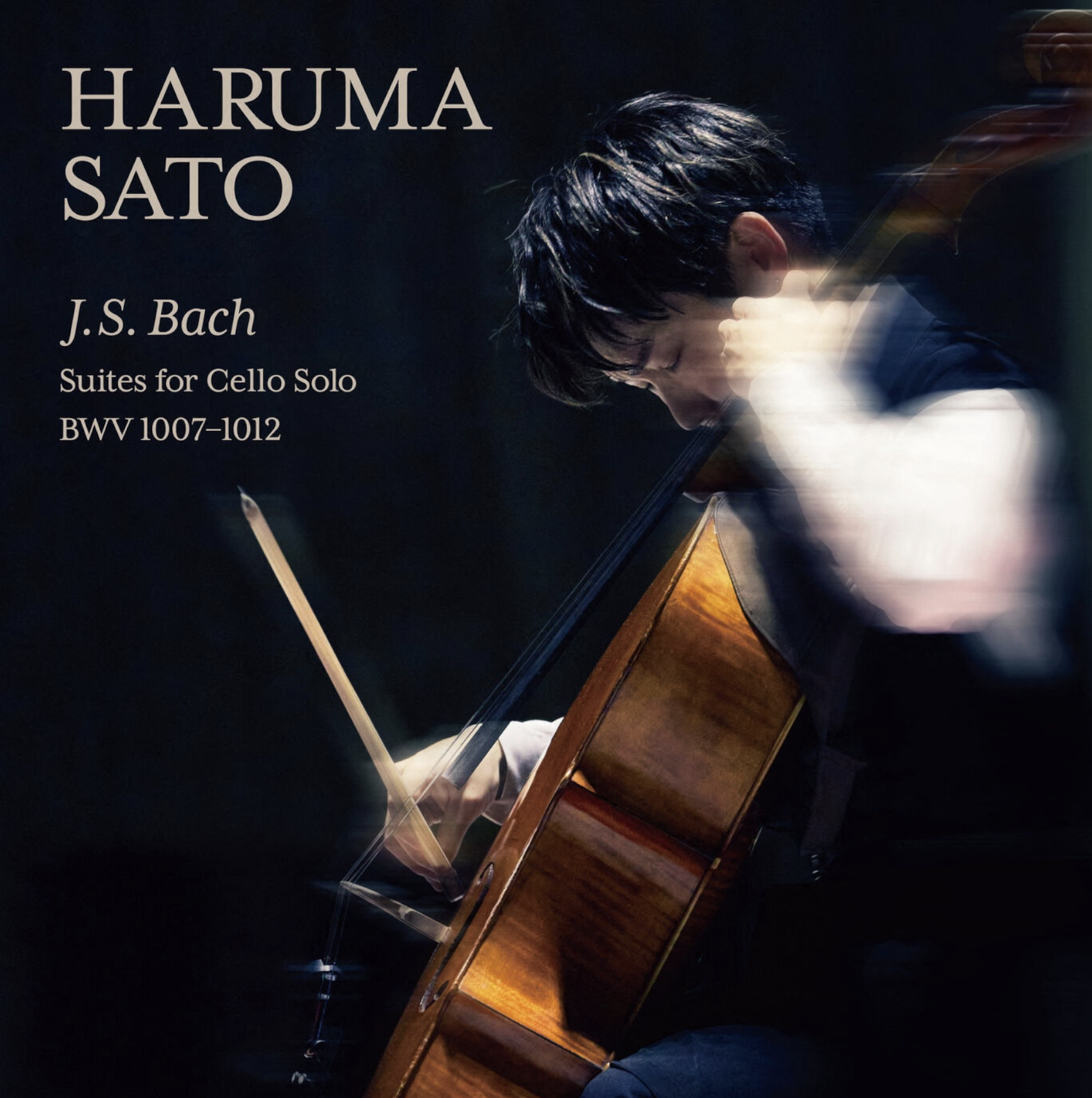
J.S. Bach: Cello Suites • Haruma Sato
No booklet accompanied this album, which simply appears to have been released by Universal Music, without any label credited. The metadata reports it as coming from a live concert this year in Tokyo. This source cites an April concert date. Sato was born in 1998 and first started on the violin before switching to cello. He won the 2019 ARD International Music Competition in Munich (at the ripe age of just 21!).
Needless to say, he's a "modern" cellist and not an HIPP specialist. It is difficult, however, not to hear the HIPP influence in his performance — in some rhetorical approaches, and in the lack of continuous vibrato. His sound is good, bordering on gorgeous in some places, but it isn't ultimately done justice by the recording. There's a bit of smear between the acoustic and the sound he's producing, through no fault of his own. I went back to the second recording by Ophélie Gaillard: the sound on her recording is what we'd ideally want with any solo cello recording. I switched to headphones for this one and found that the amount of reverb — lasting at least four seconds (with 7 seconds being listed by a source when the sanctuary is empty) — was still annoying, but it was far easier for me to hear the artist separate from the reflections.
His approach in places can border on the dramatic (the opening of suite no. 2), but he's by no means leaning heavily into rubato. His ending of this same movement made me smile with his unique solution to the final cadence.
The same suite's Courante has a few spots that sound "messy." I have a feeling it's not so much an issue with articulation or clean playing, but an interpretive decision to rush the notes, which then competes with the resulting acoustic feedback that's captured. At the end there are several seconds of reverb.
The Sarabande offers some interesting approaches to playing the two strings together. The trills are saved for the repeat, but I loved the solution in the first run.
I admired his phrasing in the Courante of the E-flat major suite, BWV 1010, although a trill in the repeat of the first part sounded a bit sloppy. In the Bourrées, he steps back with intensity and lets the reverb from St. Mary's Cathedral take over. Something tells me these weren't his favorite movements; there's less effort to differentiate the phrasing in a rhetorical method. Some dynamic contrast enters, however, in the repeat of the second half of the first dance. The second dance slows down a bit, I feel, for no appreciable reason.
The Allemande from Bach's C minor suite, BWV 1011, is a pretty dramatic affair, and Sato delivers with appropriate gravitas using large, full brushstrokes. However, he prefers to linger over pushing the momentum forward; one of the chords has an out-of-tune upper pitch on the first run. His use of vibrato comes out in the second half, which I appreciated. It felt appropriate, even if it had been done by a historically-focused performer.
The Sarabande from this suite can be easily manipulated with drama given its wandering theme, but Sato's interpretation keeps things on the more subtle side. The drawn-out pulse is remedied with his reading of the Gigue. Some little flourishes with double stops made me sit up and take notice.
The sound in the sixth suite, BWV 1012, is different. This review reports that he used a 5-string instrument. That makes sense; it carries with it a more penetrating tone. There are some timing issues that I didn't especially care for in the opening Prelude, which one could suggest is the application of rubato, but with Bach's repeated figures, it wasn't, for me, necessarily successful. His Courante catches on just right, for me, with a great tempo that he keeps up throughout to great effect. His articulation is nice and sharp — something I noticed elsewhere too, though it was somewhat obscured at times by the larger cello used across the other suites. My favorite pair of Gavottes, I think, benefitted too from the smaller instrument. The tempo, I think, wanes a bit before the end of the first dance, but the phrasing helps keep the dance buoyant. Some intonation issues enter in the drone portion of the second dance. The second time around he's more careful, but at the expense of the voicing of the top of the chord.
Conclusions
It's obvious that Sato has some real technical abilities on the cello. There is a lot to admire in this performance, even though the audio, for me, doesn't come across as ideal. In terms of a live performance, there's much to admire, presuming the takes weren't edited.
For those who have access to Apple Music, the album is offered in Dolby Atmos, and the aforementioned site I linked to preferred that sound. I unfortunately don't have a way to audition this effect on my two-channel system, although the effect using Apple's AirPods Max headphones was interesting.
Where I'd guide him in taking these interpretations further is to listen more. No one needs another performance where one presents all the right notes at reasonable tempi, emphasizing all the accents just so in the dances. That's what's required at an academic recital. What the world needs more of is an artist who is listening to themselves play, one who exploits those profound moments Bach gives us. We do that through changes in performance in the repeated dances, in applying rubato, dynamic contrast, and the like.
These performances aren't devoid of these elements, but perhaps they're not fully realized just yet.
I know I've offered some critical comments during my listen of this recording. The primary thing I want to come across is this: however this sounded live — a single cello in a space I saw online that's quite vast — capturing it well would have been a challenge, I think. The recording, however, isn't a reproduction of what it sounds like sitting amid the pews. The microphones are capturing him up close, and likely the reflections he himself could hear sitting in that spot. However it sounded live, the recording unfortunately suffers. I'll leave that there. There should also have been some adjustment made in how the larger and 5-stringed cellos were captured; the smaller one comes across a bit intensely by comparison.
What I do want you to know is that this man has talent. There's a strong voice that emerges throughout, mostly to satisfying ends in many of the dances. The inclusion of some flourishes that don't appear in the score had me smiling. I want more of that next time.
An album like this is put out to introduce a young artist. Taking on the complete Bach cello suites under the age of 30 is an achievement. (Remembering, perhaps, that Yo-Yo Ma's first recording, made in 1982 and released in 1983, was set down when he was 27?) Doing so in a live setting, without the safety of retakes, is a bold move. And those who need to take notice of young talent will know this.
I'm hoping Sato has the opportunity to revisit these suites, maybe sooner rather than later, in a more controlled environment. There's extraordinary potential waiting.
For now, this isn't, for me, a must-own kind of recording, but exploring young talent in standard repertoire is always worth your time, at least once — and this recording is no different, despite how it sounds, or a few inconsistent foibles.