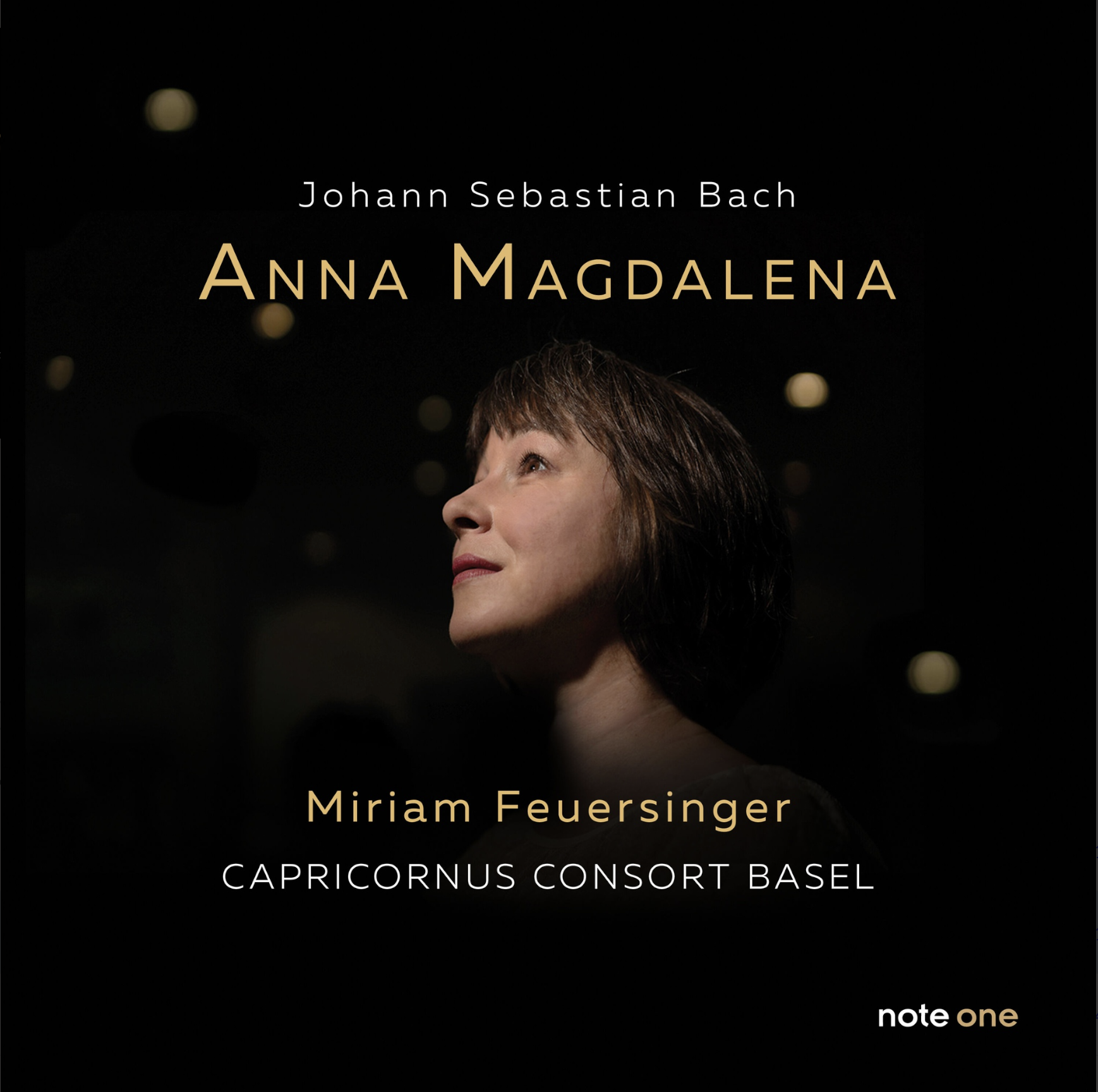
Anna Magdalena • Feuersinger
Miriam Feuersinger is here accompanied by the Capricornus Consort Basel in a program dedicated to works for soprano, an effort to present pieces that may have been performed by Johann Sebastian Bach's second wife, a soprano with a "clear voice." The booklet notes provide significant context on Anna Magdalena and their life together, and on the sad decline in her standing after her husband's death. It doesn't reach the depth of David Yearsley's book, Sex, Death, and Minuets, but if you want to imagine some of Bach's music performed by his wife, this album offers the opportunity.
The first half of the album is a series of soprano arias, including the famous Bist du bei mir from the so-called Anna Magdalena Bach Notebook. The instrumental support is gorgeously played and recorded. An instrumental number, the Adagio und Fuga Fk. 65 (for two flutes and strings by Wilhelm Friedemann Bach), is offered within the performance of the wedding cantata, Weichet nur, betrübte Schatten BWV 202. That is the program in the Qobuz streaming edition; the booklet lists the piece after the cantata, presumably the CD's ordering. Its placement in the stream seems like a mistake to me: it's well played but interrupts the cantata.
The star of this album, maybe more so than Bach's own wife, is Miriam Feuersinger. When I read about the quality of Anna Magdalena's voice, it seemed to match perfectly what I was hearing from my loudspeakers. Her voice has a nice, clear upper register, and while vibrato is used, it's expressively applied.
The second track is Bete aber auch dabei from BWV 115, featuring piccolo cello and flute, a piece I became acquainted with through Nancy Argenta's performance with Sonnerie. This performance is ultimately more satisfying: the clarity from the instruments, the tempo, the tone of the transverse flute, and then the entrance of Feuersinger's voice? What a beautiful piece of music. Bach's wife wouldn't have been able to perform in Leipzig's churches, but you can imagine an intimate performance like this in private quarters. What soprano wouldn't want the opportunity to take part in this delicious experience? The voice is nicely focused, and the articulation the words require is clearly audible.
Track 5 for me is Die Seele ruht in Jesu Händen from BWV 127, featuring two recorders and oboe along with the voice. Again, before the voice enters, the instrumental introduction is about as luxurious as one might expect, with deep clarity from the basso continuo. Rodrigo López Paz's oboe solo has excellent texture and blends well with the voice.
Track 6 for me is Herr, der du stark und mächtig bist from BWV 10, a happier and more festive affair than the preceding arias. The music is swifter, and Feuersinger is not caught out by the agility the vocal line's upper register demands. The continuo, with its nearly continuous moving line, is perhaps the hardest part; again, the entire ensemble is on fine form.
Stölzel's Bist du bei mir is accompanied here on lute and organ. A domestic performance would have suggested clavichord, but given the church used for this recording, the lute makes good sense. The piece doesn't get the schmaltzy performance it sometimes does, and Feuersinger offers some nice expressive moments.
The complete cantata Weichet nur, betrübte Schatten makes sense given its wedding theme, and it may well have been performed at Bach's own wedding to Anna Magdalena in December 1721. But no source names the couple, and the dating is unsettled: scholars have proposed anything from Weimar around 1714 to Köthen, while the booklet leans toward c. 1721.
The accompaniment is lean, scored for oboe with strings. The first aria features in this recording a fleeting part for harpsichord and cello, technically sure and well articulated, and the recording supports it with a realistic balance between keyboard and cello. The oboe solo in the aria Sich üben im Lieben, in Scherzen sich herzen is well played, but what stands out is its position within the acoustic, which sounds absolutely gorgeous. Again, good balance is achieved between the instrumental solo and the singer.
The finale, set in a gavotte rhythm, isn't my favorite part of this cantata, but it closes with fitting lyrics (Francis Browne's booklet translation):
See in contentment a thousand bright and prosperous days, so that soon as time passes your love may bear its flower!
The jaunty rhythm offers an almost tongue-in-cheek treatment by the composer.
Conclusions
We know so little about Anna Magdalena Bach, but what we do know is that she met Bach in musical circles and that he could vouch for her strong singing abilities. We know she was quite musically literate and, of course, she is famous for copying his suites for cello in a musical calligraphy that closely matched her husband's. This album promises to bring us closer to music that may have been well known to Bach's wife, even performed by her, but the suggestion is ultimately conjecture.
Musicians today look for creative ways to build programs, and the Bach's-wife conceit is more creative than simply calling this disc "Works for Soprano by J.S. Bach." However we arrive at this music, it is lovingly performed by period experts. The audible results attest to both expert performances and an expert recording. In all, just north of an hour of gorgeous music featuring a singer I very much enjoyed.