Histoires d’un Ange and Visions du Diable • Johanna Rose
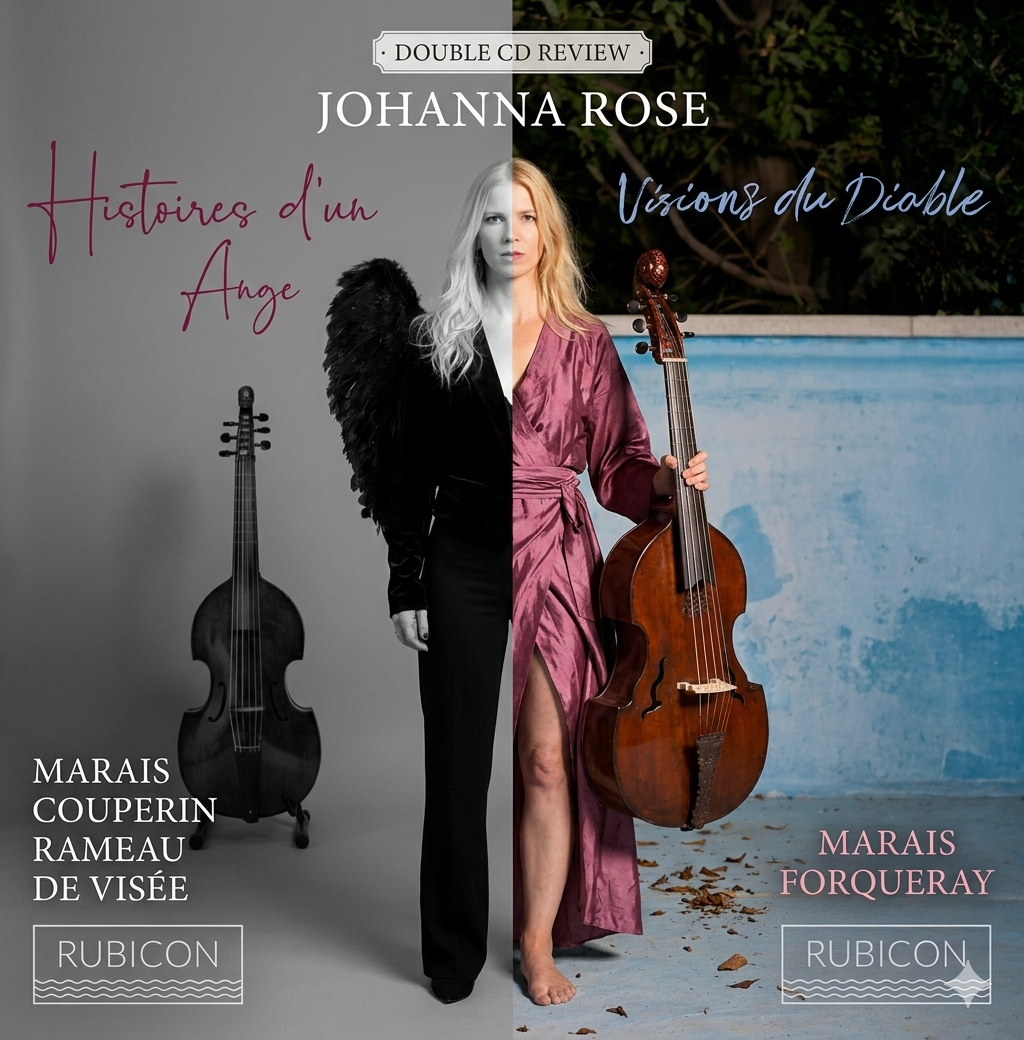
As the notes for the new album, Visions du Diable, communicate, this album is viewed as a second installment, if you will, from the artist’s earlier recording Histoires d’un Ange. The opposing characters are, of course, Forqueray (Devil) and Marais (Angel). The earlier 2019 recording was new to me, and I figured a double review was therefore appropriate.
Marais, Couperin, Rameau, de Visée
The first of the two albums on Rubicon includes quite a few selections by Marin Marais. The program is filled out with additional pieces by the composers listed above. Rose plays alongside theorbo and harpsichord, and her style comes across quickly. It was the same effect I had auditioning the just-released album—she offers a lot of personality.
It’s difficult to say which pieces by Marais are more famous today, but the one named La Rêveuse, which another ensemble has taken as their name, has to be near the top of the list. It’s one of the slower and more introspective pieces. Rose plays the phrases with somewhat pregnant pauses between them, and the piece becomes a series of utterances. Done this way, her playing feels more speech-like, as if the music is telling a story. It follows the Allemande La Superbe, which is performed with great dynamic inflection. Prior to that we heard L’Arabesque, a sunny piece that fights any notion of being formulaic. All three pieces form a mini-suite, pulled from the composer’s fourth book of viol pieces.
The sound comes off differently in the continuation of the “Goût étranger” suite from Book 4, with a March (track 15) and Le Badinage (track 16). I don’t know if I’m quite convinced of the tempo and approach with the second piece, which I’m used to hearing a bit more connected.
I think it’s an intentional choice; the final track is a far more cheerful affair, a Chaconne from Marais’ fifth book. The upper range of her instrument sings so well. I love how her personality leaps from the speakers. I can only surmise that all three musicians are having fun with this piece. It’s a great counterpoint to the earlier Passacaille ou Chaconne by François Couperin, track 9. Both pieces are smile-inducing, but the effort by Marais feels compositionally superior, perhaps dutifully affirming his nickname as an Angel?
Angels and Demons
The liner notes in the newer album speak to these names a bit; Antoine Forqueray and Marin Marais were both in the service of King Louis XIV. It was Forqueray who was protective of his music, choosing not to share or publish it. He famously didn’t get along with his son, who would later publish the works in harpsichord arrangements, claiming they were based on his father’s viol compositions. We might better get at the names by generalizing the character of their music and how they might have played: Marais, gentle and sweet; Forqueray more dramatic and powerful?
The opening suite in the new album, featuring Rose on the cover dressed in what—a nightgown? It’s her own arrangement of an A minor suite from the second book of pieces. Again, what pops out is her highly expressive playing (track 4 might challenge the moniker of Angel for Marais!). Throughout the suite, her playing is finely nuanced, with strong dynamic contrasts, using an instrument with a beautiful tone.
The sweetness is conveyed in the final movement presented, the Tombeau pour Monsieur de Sainte-Colombe. Those interested in another rivalry might turn to the film I enjoyed while in college that introduced me to this sound world. At any rate, I found this performance quite affecting.
Forqueray’s suite is composed of character pieces naming people, such as “Rameau,” “Guignon,” “Sylva,” and even mythical characters such as “Jupiter.” That music could embody the character of a person, idea, or anything else has always been interesting to me and a plausible way of thinking about composing music.
Rose’s interpretations of these pieces are sharp. There’s significant energy in the performances. The character of Rameau is maybe less kind than in other performances; the Boisson (not sure if it’s characterizing the effects of liquor or is a named person) is brutally sassy.
Thankfully there’s some ability to breathe and come down a bit with Rose’s performance of La Sylva before the energy most will probably know comes in Jupiter. Her opening is controlled, with the notion of a devil held in check. Hearing this with just a single continuo instrument (harpsichord) keeps the texture of this piece lighter. Fury does make itself known, however. While I have heard this piece played faster, the tempo here works well to provide even more dynamic contrast. There’s some suave playing, and in total, an enjoyable interpretation that I think contrasts well with others in the catalog.
The album ends with another famous work, for which an ensemble has taken their name—a kind of “last word” by Marais, a counterpoint to what came earlier in the program. Les Voix humaines here, like the opening suite by Marais, is played solo.
The reverb-heavy acoustic for this last track complements the music, but it feels as if we’ve gone to a new location. The notes for both albums indicate the recording location was a recording studio in Seville. I’m never a fan, for those listening via stereo, when the acoustic space where performers are playing changes on us. While I know recordings are not always made in a single take in a single space, I like when an attempt is made to at least let us think as much. After a more careful check with headphones, I think the differences I hear are brought about by the setup, with Ms. Rose playing solo versus in combination with harpsichordist Javier Núñez.
I could not quickly find references to the Sun King’s demands of his gambists, but one can only imagine that moving around Versailles, the acoustics would change depending upon the venue for music.
As noted before, the cover of this latest album features the artist, looking somewhat bewildered, sitting outside, barefoot. And is that a robe? The only explanation I could come up with is what the gambist may have looked like if summoned in the middle of the night to perform for the king in his bedchamber.
Conclusions
There have now been many attempts to program albums (or concerts) with two (or more) composers. The other devil-angel pairing that has been made is between Locatelli and Leclair. While others have attempted to record complete books of both Marais’ and Forqueray’s works (and that is appreciated), the concept here was to give us some of these composers’ best hits while offering comparisons within the period. I think both concepts work well.
The first album, focusing primarily on works by Marais, sonically is a bit wild and louder compared to the second; the first entertains the use of lute with the gamba, which is a sound that works well, with sympathetic playing by Josep Maria Martí Duran. Núñez also contributes from the keyboard in this album. Both musicians get a solo track on the first album: for Duran it’s the Robert de Visée, and for the harpsichord it’s a movement from one of Rameau’s Pièces de clavecin en concerts. While these types of one-off performances give musicians a break in a concert performance, I’m less convinced they work as part of an album. In either case, both here were well performed.
Both of these albums do well to showcase the star instrument, the viola da gamba. Under Johanna Rose’s command, we get highly articulated and dynamic performances. She takes us nearly to the edge of her abilities in Le Tourbillon in the first disc; in the second it’s with Forqueray’s La Boisson or Marais’ Gigue that showcases her talents at their most flamboyant.