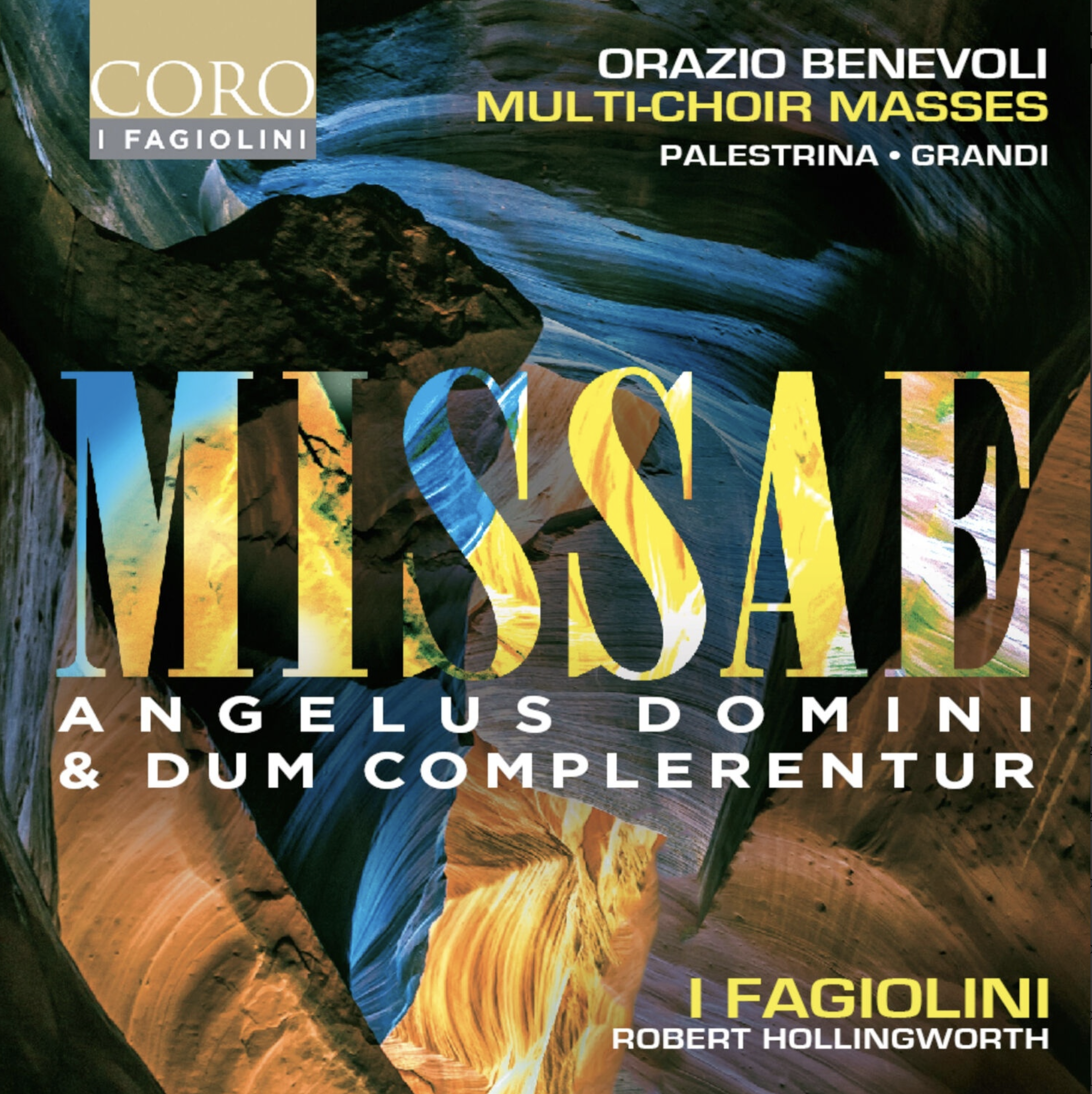
Missae Angelus Domini & Dum Complerentur • I Fagiolini
This is the third and final installment of I Fagiolini's series of Orazio Benevoli's mid-17th-century multi-choir masses, directed by Robert Hollingworth. The album spans the liturgical arc from Easter to Pentecost, opening with Alessandro Grandi's motet Plorabo die ac nocte — an emotionally intense Easter morning drama for four voices drawing on Old Testament texts interleaved with the words of the two Marys at Christ's tomb. This serves as the stand-in model for Benevoli's three-choir Missa Angelus Domini, whose lost motet source Hollingworth argues was almost certainly an Easter text. The second half of the album pivots to Pentecost, pairing Palestrina's well-known six-voice motet Dum complerentur dies Pentecostes with Benevoli's four-choir mass built upon it — considered by Hollingworth to be among Benevoli's finest works, notable for its increasingly forward-looking treatment of the model and a structurally dazzling Amen. Throughout, the ensemble sings without instrumental doubling, in historically transposed pitch, to recover the middle-heavy sound world of Renaissance voice types that Benevoli and Palestrina would have known.
Two organs are used in this album, alongside harp and chitarrone. The recording was made in a common location for recordings in London, the Church of St. Jude-on-the-Hill in Hampstead Garden. The sound is pretty close to the singers, striking a good balance of intelligibility without over-exaggerating a church sound. The instruments are there for support, not to be protagonists on their own.
The opening piece by Grandi, who was active in Venice, is Plorabo die ac nocte. It’s a gentle, solemn opening, appropriate for Easter.
The opening of Benevoli’s mass “Angelus Domini” is a grander affair. The booklet notes are well stocked with details about all the pieces, including pointing out how to hear the composer’s tone painting. The music, for this period, I think is old fashioned in concept; we have to consider that two years after the composer’s birth we had Monteverdi’s Orfeo, which was harmonically rich music. This is more in the style of his predecessors, the where the harmonic rhythm is far more active. Yet, in Rome, this may well have been what was expected for an Easter setting in St. Peter’s.
Benevoli’s predecessor was Palestrina, and while the texture of the Dum Complerentur is likewise not harmonically adventurous, it follows a similar style of writing, although Benevoli’s masses are obviously more complex. The performance here serves to introduce the musical material from which Benevoli took inspiration for the second mass.
I Fagiolini, as we might expect, present a very sonorous sound, and while I have heard clearer separation of voices, the amount of transparency is admirable any way you want to slice it. The voices blend well, too, with the timbre of female voices gently subsiding as a male voice comes in and matches timbre. While this may be unintentional, I find it difficult to believe that director Hollingworth didn’t specifically have this kind of high level perfection in mind with the selection of singers.
That transparency is important if we’re to come and appreciate the independence of each musical line and how the two choirs used intersect. This is the kind of album where getting stereo imaging done right with your speakers pays off well, as does the use of headphones (and for me, without using any crosstalk).
I think for many they may not choose to follow along with the Latin and instead take advantage of enjoying the very sonorous fabric that all these composer’s achieve in their writing across all the voices.
This album will appeal to those who want to hear how the early baroque musician Benvoli approached the format of a polychoral mass (say, compared to Lassus, who also wrote this kind of music), and it may surprise you in his solutions as they are clearly old fashioned but betray the past by writing music that very closely matches the text. And for those who do follow along, those are the rewards to be discovered.
I Fagiolini is not a group I often listen to, but they are a well-regarded British group (it might be easy to assume they hail from Italy), and I enjoyed the high quality of this production, even if the music for me isn’t as interesting as what follows in the next decades
For those who like this album, there are the two earlier releases (October 2023, October 2024) featuring Benevoli’s music in context with this time by the same ensemble. The quality of the production and singing is just as admirable in those earlier releases.