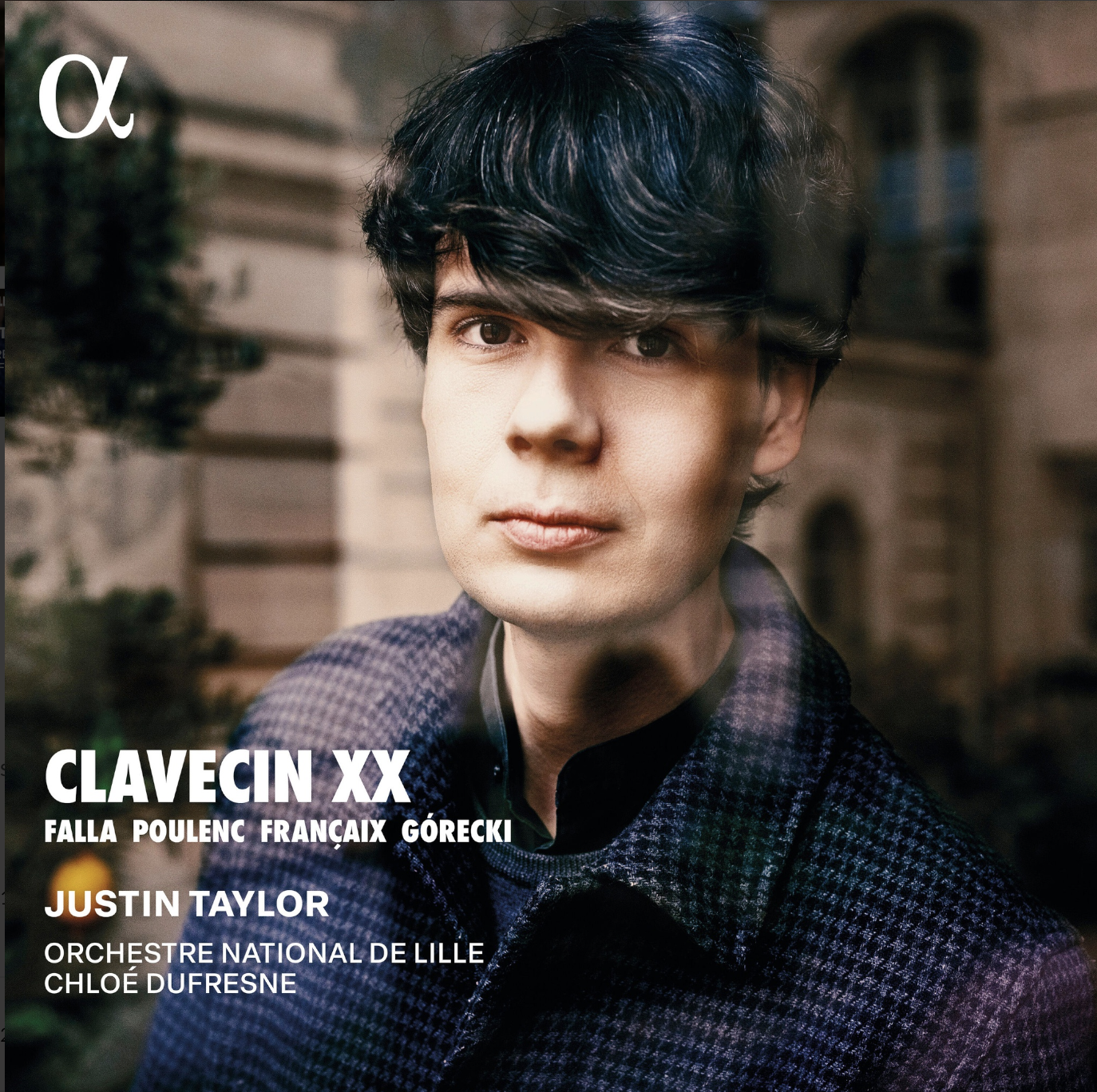
Clavecin XX • Justin Taylor
Early music specialists — as a concept — are people who focus on performing music from an earlier period of history. That may be all they do. And some of them have come to understand how to approach performance through an historical lens. I use HIPP here as a way to identify recordings made with this approach, even though there exists a variety of approaches and beliefs tied to historically-informed performance practices.
The harpsichord is the star of the baroque period, a keyboard instrument with a unique sound that seems totally out of place for the period when heard. Except that, of course, composers wanted to explore this instrument in the twentieth century. In some cases, they saw it as an historical instrument and wanted to evoke an earlier sound world beyond just timbre. Others, they embraced it all on its own, without referencing the past masters for whom the harpsichord was admittedly made famous.
Justin Taylor is an HIPP musician who recently has started to record music outside the baroque period. His earlier release of Chopin was on an early piano; here he turns to a collection of pieces for harpsichord from the likes of Bartók, Françaix, Poulenc, Górecki, de Falla, and Martinů. (The short piece by Béla Bartók, to be fair, was for the piano and the performance here is a transcription made by the artist.)
These composers, as it were, don't represent an historical style in the same way that Handel and Bach did. It makes albums like this a challenge because of wide variety of styles represented. I don't sit down to listen to a disc of Scarlatti sonatas just because I like the sound of the harpsichord; I like the consistent style of the music. But some of you may really like the sound of the harpsichord. And you're curious about how it was embraced by a number of composers, at least those alive at some point in the last century.
Taylor uses a Sidey instrument that he feels suits this music, a semi-historical model that uses a 16 and 4 foot combination of registers. For me, it has a bit more carry, perhaps? But it doesn't sound nearly as harsh as the loudest restoration instruments, some of which would have been the ones employed in original performances. The first major piece is a 1959 concerto by Jean Françaix (d. 1997) in five movements. The titles suggest a nod to the baroque: toccata, menuet, alongside andantino and finale. As well, his use of the orchestra is sensitive to the projection of the harpsichord. The composer specialized in neoclassical forms, after having studied with Nadia Boulanger. He was born into a musical household in Le Mans. The composer's well-known lightness and wit is conveyed in this performance, backed by the Orchestre National de Lille, directed by Chloé Dufresne. His language is tonal, but he doesn't play by baroque harmonic rules; it makes his progressions interesting, the result is very colorful harmonies. If you heard a small excerpt and assumed it was baroque? Your next suspicion would be that you're on something strong. Among the movements I liked the second one best, marked Toccata II.
The Górecki concerto, op. 40 is likely the better known of the concertos on this album. The first movement gives an active role to the harpsichordist but somewhat undermines the soloist's prominence with a competing role by the strings, who perform in unison. The style of the first movement is dark. It's not hard to connect the emotional weight of this piece to more popular uses of the harpsichord in older television shows, which often was used to evoke a sense of the past. For one, I am thinking of one of my favorite old CBS shows, The Wild Wild West.
The second movement switches to a far more happy mood, although one that is nearly as intense. The string playing by the orchestra is well-done, with tight playing. It's the type of piece that I feel no doubt would make for an unforgettable live performance. The second movement's intensity, however? It can't serve as pleasant background music. More like the soundtrack of a horror film? As difficult as a piece this may be, the performance is technically brilliant.
Poulenc's neoclassical (or neo-baroque) concerto is presented across three movements, the longest being the first. It also exists in a piano form. It was written for Landowska, as was the other concerto presented here, by Manuel de Falla. It was premiered in 1929. There's a clear effort by the composer to entertain us through this piece. He effectively uses the colors of his orchestra to bring us a number of dramatic scenes. The harpsichord operates as a kind of protagonist. The composer's harmonic language can be surprising, all because he leans just enough into older patterns, until he doesn't. For me this is the most interesting piece on the recording, not necessarily for the harpsichord's contribution, but the composer's virtuosity.
Harpsichord virtuosity comes in the final movement, if that's what you need. We're clearly put into the baroque mindset with first a quotation from Handel. Those familiar with the baroque style should very well feel the connection here is something the composer has employed to pull us in. The novelty of what he does with all of this continues through a series of dramatic scenes. Almost to the effect "Look, how clever I am!" Indeed, he was.
The De Falla concerto (1923-26) is written here for a chamber ensemble of flute, oboe, clarinet, violin, and cello. If the changing moods in the Poulenc were too jarring, there's less of that in this work. For me this piece was an easier listen in terms of following a musical idea from start to finish across each movement. Like the Poulenc, it leans into some neoclassical writing. The album also includes some solo works: the aforementioned Bartók from his Mikrokosmos collection, Bluesinuum by Stephane Gassot, a piece by Bohuslav Martinů, and the Maple Leaf Rag by Scott Joplin, which although for piano, is played here on the Sidey harpsichord. Taylor credits his inspiration as Elisabeth Chojnacka, who had recorded an album of Joplin played on the harpsichord.
The most interesting of these is the piece by Gassot, a friend of Taylor's, from whom he commissioned this work, an hommage to Ligeti's Continuum.
Conclusions
There's a case to be made here for those interested in musical history to trace the impact the revival of the harpsichord in the twentieth century and how composers responded with new and original works. In many cases here the composers couldn't let go of the world from which the harpsichord enjoyed its golden age. The most overt is explored in Poulenc's concerto.
Taylor is not alone as a contemporary harpsichordist exploring some of this repertoire. I'd go so far to say an even bigger champion is Mahan Esfahani. Esfahani famously combined the baroque and twentieth century repertoire together in his first DG Archiv release. Personally, I was less interested in hearing the revival pieces next to those from the baroque.
To be fair to the reader, I found this album interesting. Although it's not one I will go back to often. It helps that I be clear, I like baroque music. Yet I also get it, as a champion of the clavecin, it makes sense to explore other music written for it, as it directly connects us to how, today, we have historical instruments and a second kind of revival, the HIPP movement.
The performances here are all well performed. Kudos to Taylor for approaching music in adjacent styles to the music we normally see him perform. His friends joining him here are also to be commended.
And now it is time for me to turn the Górecki off. I need oxygen.