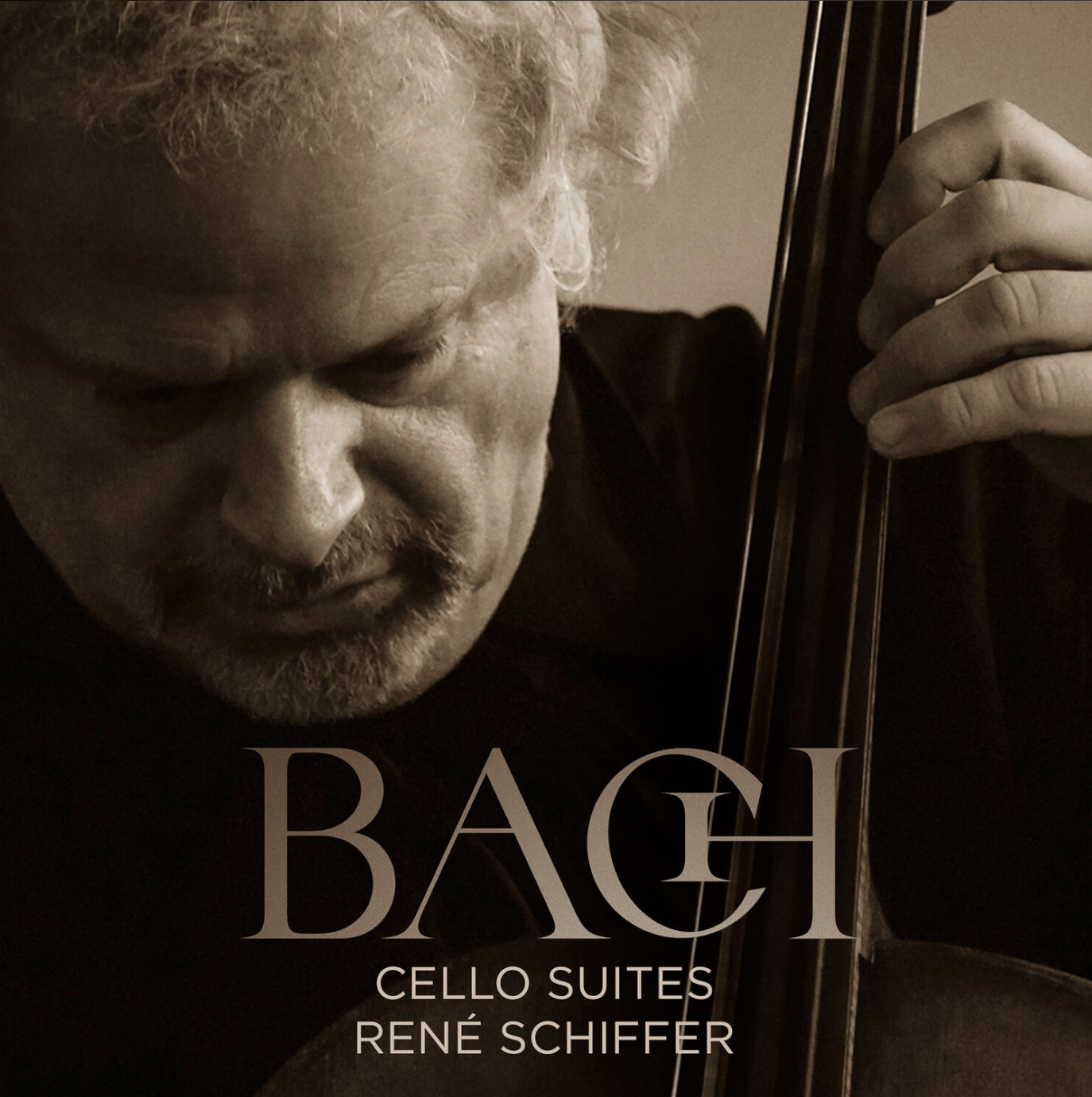
J.S. Bach: Suites for Cello • Schiffer
René Schiffer takes on Bach's solo suites here. A founding member of Cleveland's Apollo's Fire, he recorded the set in one of the area churches that has hosted the ensemble.
Schiffer makes some bold claims at the top of his liner notes. He leans hard on how little we know about the suites' origins — how they were played, how they might be played, and so on. The boldness is in the slide from "we know little" to, in effect, "we know nothing," when in fact we have some context, even if it comes wrapped in questions. And one can guess why: wipe the slate clean and you free yourself to please your own ear rather than defer to an authority on past practice. The notes are a good read regardless — partly for context, partly for Schiffer's contemporary references and his own brand of humor.
Still, how these pieces were meant to be performed is a fair question, and Schiffer engages it well. He argues that the suites grow progressively harder, which may point to a pedagogical purpose; he also speculates that Bach traces religious narratives across their sequence. It's a fresh take for me, and I enjoyed his perspective.
Two things stand out on first listen. Schiffer is happy to add his own touches — mostly ornaments and variation across repeats — and I like that a lot. He also plays the sixth suite on a smaller five-string instrument, which is unremarkable in itself; what's less usual is that he brings it to the fifth suite as well. He argues, of course, that we don't know what instrument(s) Bach intended.
I was less taken with the sound of this Avie recording. Recording in a church takes a sensitive setup. You want some of that sympathetic reverb — playing in a resonant space, hearing your own instrument up close against the far reflections, is part of the fun, and it can sound wonderful in the space. Reproducing that over a stereo pair of speakers, where the listener sits on the audience side, is another matter. To my taste there's too much of the reflective component here; certain pitches bloom over others, betraying the resonances the church favors. To be fair, my own listening room may be exciting some of those resonances too. The good news is that this album avoids the flaws I remember from some past sets — Bruno Cocset's, for one, which caught a distracting amount of finger noise on the fingerboard.
Schiffer's primary instrument sounds good; the notes attribute it to Fleury, 1768. He tunes to a=440, he says, not for historical reasons but because the instrument sounds best at the higher pitch. I appreciate the pragmatic honesty. On the piccolo cello he uses a C/G/d/g/c' tuning for the fifth suite and a C/G/d/a/e' tuning for the sixth — which required some arranging on his part.
The Gigue from BWV 1008 will serve as an example of some intonation that struck me as slightly off across the set — or that registers that way to my ear. On the viola I find it hard not to play in just intonation, leaning into the purity of octaves, fourths, and fifths and letting thirds and sixths fall where the instrument rings. You can't indulge that against a keyboard tuned to a tempered scale, and a player may carry a more tempered intonation into solo playing as well. What I'm hearing may simply be Schiffer doing that. I can't say for certain.
Schiffer is deliberate about articulation in ways the score doesn't always specify, and his solutions are good ones. The Courante from the third suite, BWV 1009, is a fine example: the phrasing sounds and feels right to me, and I'm glad the detail of his bowing comes through clearly enough on the recording.
The switch to the fifth suite, and to his secondary instrument, asks for some adjustment. The piccolo cello has a useful, more nasal voice with real cutting power, and the notes mention its smaller sound. What they don't mention is the accompanying drop in volume and presence. One adjusts soon enough, but it strikes me as a missed opportunity — the microphones might have moved closer to meet it.
It's in that suite's Prelude that Schiffer adds a few extra notes. I'm all for making the music one's own, and here it's tasteful and stylistically assured.
Perhaps the most profound moment across the suites is the fifth suite's Sarabande. How does one even play this? It's strange enough to make you question its mood. I'm certain Schiffer has tried it many ways; I like the quiet, even tone he settles on. The effect is one of searching — Bach tests our harmonic bearings here, leading us somewhere unexpected before he reveals his hand. And the elaboration Schiffer adds in the B section's repeat? Yes. More of that, please.
The instrument and its tuning are equal to the very particular sound of the sixth suite's pair of Gavottes. That timbre leads me to hear, instead of unbroken joy, an underlying sadness — humility, perhaps. Bach does something special in how he voices this dance. (I wasn't able to audition the suite's final movement, owing to an error with Qobuz.)
Finally, the most famous music in the set: the opening Prelude of BWV 1007. It shows much of what I've already described, plus Schiffer's openness to rubato and breath as a way of finding the phrasing locked inside the score. The close of the movement: chef's kiss.
I get the sense that Schiffer loves this music and has lived with it a long time. These performances show an artist intent on imprinting his own experience on the suites while plainly keeping his admiration for their composer.
Movements like the first suite's Courante carry a certain rustique. These aren't technical lapses but the rawness of his instrument's sound, and most of the time they sit well with the energy of his playing. Whether they'd register differently under a different acoustic, I can't say.
I'll point to another recording I meant to review and never quite did: the West Coast cellist William "Bill" Skeen released his set on Reference Recordings in March 2025. Like Schiffer, he turns to a five-string instrument for the sixth suite. To my ears the sound is preferable — closer, with more presence. There's less "lust" in Skeen's approach, but both make for thoroughly enjoyable listening, for all their differences.
With a bit closer presentation, this for me would clearly be a step ahead. I like being in the first couple of rows for solo Bach. This should, I think, be a no-brainer collector for those who have heard Schiffer live and in consort with Apollo's Fire.