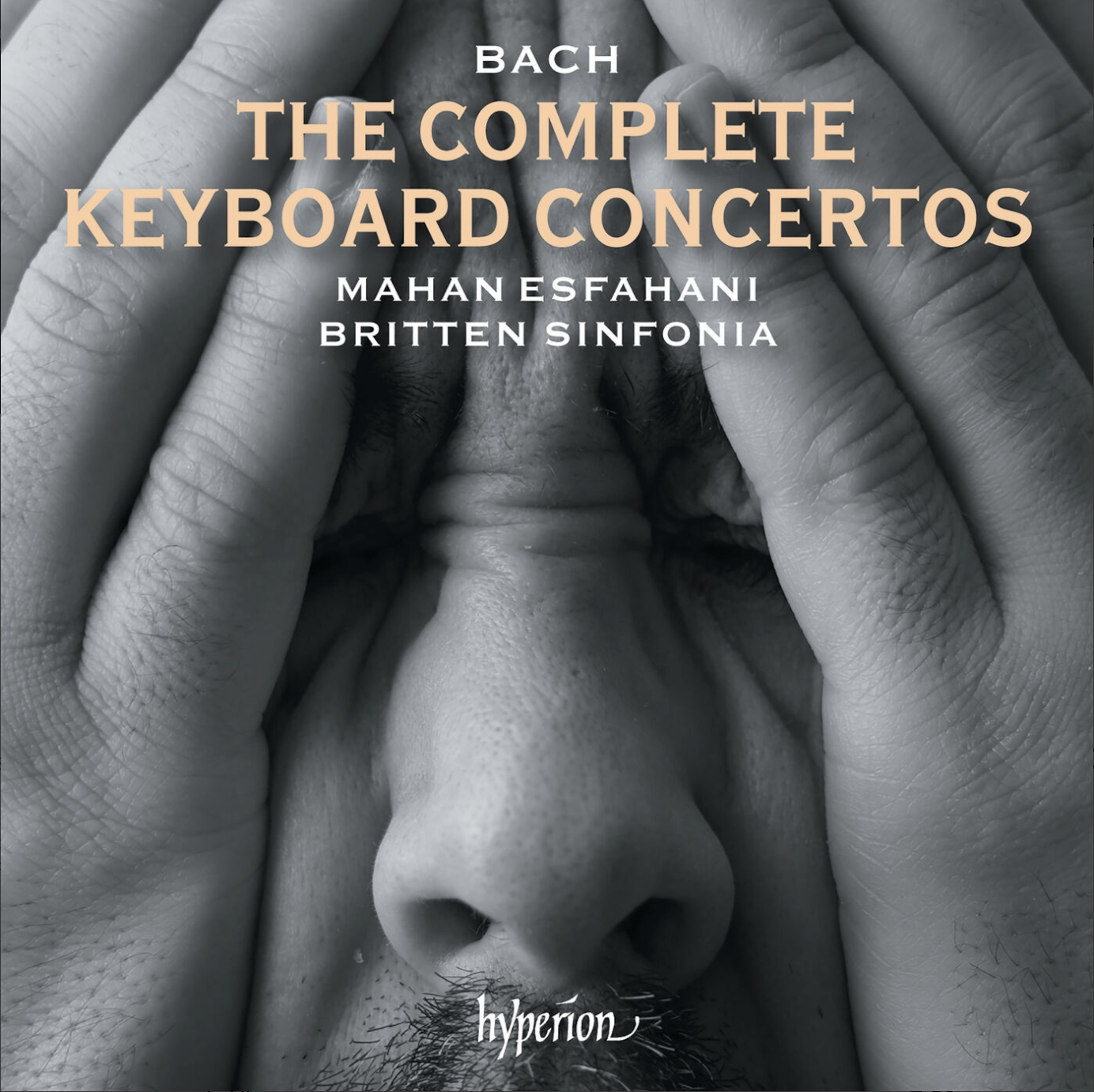
J.S. Bach: The Complete Keyboard Concertos • Mahan Esfahani
The keyboard concertos were my gateway into Baroque music. Our local library kept a small collection of borrowable classical CDs, and I have been grateful ever since to whoever built it; I suspect that the exposure to Pinnock’s Bach concertos is the reason I went on to study music at all. I mention it because it bears on the record at hand. Esfahani's case for these concertos—made at length in his booklet, and again more loosely in conversation with Gramophone's Martin Cullingford—is that they are public music. Keyboard playing in Bach's day was a domestic, largely private art whose audience was the player herself; the concerto dragged that private instrument into public company, which Esfahani rightly calls a socially provocative act. I am, then, the listener his philosophy imagines: someone who met this music in a public, accidental way and was won for life. Which is what makes it frustrating that the philosophy behind this particular recording leaves me, finally, outside it.
Esfahani has been putting out a steady parade of Bach discs, and for this one he partners with the British chamber orchestra Britten Sinfonia on a double-disc set for Hyperion—the culmination, he says, of a long touring relationship with these players in exactly this repertoire. The engineering, by David Hinitt, is good: close, dry and transparent, with a real sense of depth and placement.
At the center is the instrument. Esfahani again plays his personal harpsichord by the Prague maker Jukka Ollikka—“an enormous thing”, some three metres long, with a carbon-fibre composite soundboard and a 16-foot register that makes it genuinely loud. He calls it the “Queen Mary.” It takes a period Mietke as its model and then departs from it in every direction that serves carrying power and presence. He writes in the notes:
…the harpsichord used for this recording is, after all, a modern instrument and was designed to be adaptable to the full range of the harpsichord's repertoire.
The orchestra plays modern instruments throughout: a modern transverse flute in the Triple Concerto, BWV 1044, a modern oboe in the reconstructed BWV 1059, and modern strings with vibrato. The recorders in BWV 1057—the harpsichord arrangement of the fourth Brandenburg—I am guessing are modern too, with Michala Petri among the players.
So far, a coherent modern thesis, and Esfahani argues it well. His real defense is not the slogan the booklet leans on—"liberating the harpsichord from antiquity," a phrase he attributes to a friend after a concert and, in conversation, half takes back, conceding it could be said in a facile way. His real argument is about authority. The validity of an interpretive decision, he says, rests not on binary notions of correct and incorrect but on the integrity of the artist making it. He plays the harpsichord because he finds it expressive, and he names his Bach influences as pianists—Nikolayeva, Richter, Gilels, Pletnev. Why, he asks, should a harpsichordist be held to a historicist standard a pianist on the same music is not? It is a fair question, and the swipe he takes at authenticity—as though Bach were an authentic pasta sauce with one correct recipe—lands.
He has a historical argument too, and it is the stronger one. Bach in Leipzig ran the Collegium Musicum as a working laboratory, performing not only his own music but Handel, Locatelli, Heinichen, and his sons' symphonies—"totally conversing with new music," as Esfahani puts it. The concertos are Bach's contribution to that living discourse, so to treat them as current, breathing works is to honor the spirit in which they were made. The notes make the case grandly:
Bach's keyboard concertos are living, breathing works, and will be subject to every greater and smaller fashion for as long as there is a human civilization. This recording is based on the conviction that these pieces represent Bach's extraordinary prowess as a culmination of all that came before and a focal point from which music and its myriad conflicting discourses emanate.
The boldface is mine. There is a quiet elision worth catching in all this. The phrase keyboard concertos does some work: it implies the instrument is incidental, that one might as well imagine Bach at the organ or a modern pianist at the Steinway. But these were harpsichord works, written for the portable keyboard Bach had to hand—and his own playing keeps insisting on the point even as the language softens it. It is worth setting against the Justin Taylor album I reviewed recently, where the harpsichord was made to channel antiquity in repertoire that treated the instrument as an ancient thing—the mirror image of what Esfahani says he is after.
Here is my quarrel, and it is narrower and harder than the one I would have made a year ago. It is not that the recording is neither historical nor modern. It is that almost everything Esfahani does is historically grounded—and the instruments are the one genuinely ahistorical choice, doing no interpretive work the rest of the conception requires.
Consider what he actually does:
- One player to a part. This came from Reinhard Goebel—founder of Musica Antiqua Köln, no less—who told Esfahani the concertos should be played one to a part. Esfahani relays it as "not an authenticity issue" but a matter of hearing the harpsichord emanate from a consort texture in which the voices are essentially equal. But a conviction about how Bach conceived his part-writing is a historical judgment; declining to call it one does not change what it is. It is also applied unevenly, as Esfahani concedes: the equal-voiced texture fits the D minor, BWV 1052, but not the more soloist-and-accompanist F minor, BWV 1056. Even the historical rationale is selective across the set.
- Free, sometimes extravagant ornamentation. A Baroque expectation, not a modern liberty, although this in concept can be done in alignment with historical models or “anything goes,” but in this album, I found Esfahani’s solutions aligned with Bachian style.
- The reconstructed BWV 1059, whose slow movement Esfahani simply improvised in the session—two chords written out for the orchestra, Jacqueline Shave leading the players into the final cadence, the take kept as it fell and labelled Cembalo ad libitum because he does not pretend to know what Bach wrote. It is the most charming thing on the record. It is also extemporisation: about as historical a practice as exists.
- An interpretive manner aligned with the later Bach sound world—the one he shared with his sons. Esfahani imagines a son playing these works and Bach himself at the viola, and the playing leans that way.
Against all of that, the genuinely modern elements are matters of equipment and timbre: the modernized instrument, the modern flute and oboe, the vibrato in the strings. So the manner is historical and the sound is modern, and the two are not joined at the root. You do not need a carbon-fibre soundboard to improvise a movement, or modern winds to ornament freely, or vibrato to hear a consort texture breathe. Every living, immediate thing this recording does, it could do on gut and period winds—arguably better, since the historical practices and the historical timbres were built for one another. The modern instrument is not the engine of the interpretation. It is an aesthetic preference laid over a conception that is, underneath, thoroughly of Bach's world.
There is a name for what the instrument is, and it comes from inside the movement. In The End of Early Music (2007), the late Bruce Haynes—a hautboist who had worked in historically informed performance since the 1960s—sorts the copying of old instruments into three kinds: replication, which reproduces the original warts and all; imitation, which copies a style without every detail; and emulation, which copies with improvement. Emulation gave us Dolmetsch's large-holed recorders and, tellingly, Pleyel's steel-framed harpsichords—old instruments rebuilt to flatter modern players. A Mietke reconceived for carrying power, with a carbon-fibre soundboard, is an emulation instrument in precisely Haynes's sense. And his objection to emulation is precisely mine: to "correct" a historical instrument is to sand away the compromises that tell us what its makers and players actually cared about, collapsing the distance between their world and ours. The modern harpsichord does not merely sound different. It quietly throws information away.
For those who want to hear the split for themselves:
- Disc 1, Track 11 — the slow movement of BWV 1057: Esfahani's articulation, and the way he bends time in the solo line. I like what he’s doing for the most part here and elsewhere with rubato.
- Disc 1, Track 2 — the middle movement of BWV 1052: the rubato in the harpsichord's solo. It’s a departure from some HIPP discs, like the Pinnock I grew up with.
- Disc 1, Track 3 — several extravagant ornaments in the solo part, including a distinctive "hiccup" or pause in execution and, elsewhere, a repeated-note figure; note too his short cadenza, well made and not, in fact, ahistorical
- Disc 2, Track 7 — the opening of the Triple Concerto, BWV 1044: the vibrato in the flute
- Disc 2, Track 11 — the lute in the continuo, especially before the harpsichord's solo entrance (compare the opening of the final movement)
Which returns me to his fair question—why hold the harpsichordist to a standard the pianist escapes? Because the cases are not parallel. A Richter or a Pletnev playing Bach on a Steinway is making a wholesale translation onto an instrument with its own complete logic of sustain, dynamics, and pedal; the historical sound world is simply gone, and no one mistakes the result for a reconstruction. Esfahani is doing something stranger: historically grounded harpsichord practice—consort scoring, free ornament, improvised continuo—on a harpsichord deliberately engineered away from its own history. He is not, in fact, being held to a historicist standard he fails to meet. His manner already meets one. That is precisely why the modern instrument reads as gratuitous rather than liberating: there is no antiquity here to be freed from, because the playing is already steeped in it.
So, the judgment, kept apart from my preferences. The conception is coherent and serious, and it is largely historical; the one element at odds with it is the instrumentarium, and the recording never makes the case that it needs to be there. The seams I keep hearing are the seams between a historical manner and a modern sound the manner does not require. Rupert Darwall may well have liked what modern instruments and a harpsichord do in terms of liberation. And is that the reason we should be going here?
And my bias, disclosed so you can discount it: I happen to love the harpsichord set against gut strings and period winds, and that is a taste, not an argument. Esfahani's technique is not in doubt, his seriousness even less so, and a listener who shares his conviction—or who simply wants to hear a first-rate musician think aloud in Bach—may be more than satisfied. I would only ask that you come to it knowing what it is: not a modern Bach set against a historical one, but a fundamentally historical Bach playing dressed in modern clothes. You do not have to choose between the living and the historical. This recording is built on the conviction that you do.