Introduction
The performance of music is often subject to the application of rules or traditions that we can talk about as style or personality. We could make an analogy of two people from different parts of the same country (maybe the U.S., and someone from Washington state versus a rural area of North Carolina?). They can both speak English to one another, but to our ears, the two people sound different because of accent or dialect.
I’d argue they’re speaking the same language but the differences in the way they speak is a difference of vocal style. You might call it personality.
Some years ago, musicians began playing with an idea to play music authentically, although I’m not sure that term was actively adopted by musicians; it was certainly picked up by those marketing new recordings. And when the word “authentic,” which today many reject, was used, it was meant to bring us back to the original sound or interpretation of the music. In our example, one might prefer to hear that North Carolinian accent over the one from Washington. Actors in movies can adopt a Bostonian accent or Atlanta accent for a role. They’re reaching for authenticity by employing those accents even if they aren’t authentically speaking naturally as a result of living in Atlanta or Boston. But in the same way, musicians can adopt the “accent” or style that pertains to the music’s origins. Even if those go beyond geography and lean across time.
Despite an understanding that the same sonata played in London in 1730 might sound very different from the performance of that work in Rome or Amsterdam? Apply our analogy around regional dialects to time. Of course I’m talking here about music, and especially music that was composed between the years 1600-1800. The term used today is historically-informed performance practice or HIPP to describe an approach toward making the music have that, well, accent. Speaking like someone from Georgia has a lot of nuance. Were they born there? Did they live in the city, or out yonder? Are we imitating another famous Georgian? Or are we attempting to sound like something more generic, stripping away variances over time and across communities.
My question is why did this movement begin? And where are we today?
But before we discuss that, let me zero-in on music specifically. Accents only take us so far in trying to understand performance practice.
I play it this way. What do you think?
I like jazz standards. These are sung pieces that have become the fodder for jazz musicians to many times play without the lyrics: a classic example is a jazz trio, with a pianist, drummer, and bassist. They’ll play a piece like Autumn Leaves. The thing is the performance doesn’t really come alive on the music page. Nuances of rhythm, dynamics, interaction between instruments? And let’s not get started on an improvised solo! A recording would tell us a lot more about how one pianist might tackle the piece, versus another. Corea vs. Jarrett? Even if they were reading off the same basic chart, the results would be wildly different.
As a popular standard, my fave Mr. Jarrett has recorded Autumn Leaves more than once even across the same recording sessions with different results. Imagine an aspiring young jazz pianist coming to his lesson. “Teacher, I just heard Keith Jarrett play this, I want to play more like him. Can you show me how?”
Jazz is a style of music where doing your own thing is encouraged. Much more so than the classical, or should I call it the conservatory tradition? I enjoy watching masterclass sessions on YouTube. In many cases it’s a famous artist drilling into the student to play it their way. The young musician keeps going and going until they play it the way the celebrated artist does it. “That’s it, hear it? Yes!”
Early Music is not jazz. But these examples illustrate my point:
- as musicians we learn from other musicians and are encouraged to play music like our teachers
- the jazz tradition also engages in this, but ultimately, it’s a tradition that honors those who find their own voice, especially in the performance of familiar material
(I see you looking at me. Yes, classical pianists need to develop their own voice, too, but come on, not to the extent that we see in jazz.)
Imagine how we could convey how Keith Jarrett plays Autumn Leaves without a recording. We’d be pretty lost, I’m guessing. What gets left on the music score isn’t the same as the way the music is played. That’s a performance practice: it’s more than just interpretation, it’s the way Jarrett’s brain engages as he sits down at the piano, allowing him to generate multiple versions of Autumn Leaves. Similar, maybe, but still different.
When someone picks up a Corelli sonata they might wonder or wish: I wonder what this sounded like with the fingers and bow of Arcangelo? The answer is complex. We will never have a definitive answer to that question. But as musicians, we shouldn’t ignore that curiosity and hold it against others for thinking about it.
The origins
To talk about an historical performance practice or doctrine, we’re not speaking about a specific, agreed-upon set of rules. We’re talking about a general idea that has inspired many musicians. Two of the most influential Europeans in this work were Gustav Leonhardt, a Dutch man who studied at the Schola Cantorum Basiliensis where they were starting to teach musicology alongside performance. He makes a recording of Bach’s Die Kunst der Fuge upon the harpsichord. It started to resonate with others. Born a year later than Leonhardt, Nikolaus Harnoncourt became a cellist and it hit him that earlier music didn’t sound right on the instruments he was playing upon. Both musicians would later collaborate upon the first complete cycle of Bach’s church cantatas on period instruments, recorded for Teldec between 1971 and 1989, applying historical learnings to the way the music was performed.
But the start of this “movement,” which some call it, has earlier origins. Scholars will point to luminaries such as Wanda Landowska, who performed Bach on a harpsichord, even if it wasn’t an historical model. Arnold Dolmetsch, born in 1858 in France, became involved in creating reconstructed instruments. However his instruments were not historically precise. His writings were strongly moral in the sense that old music demanded old instruments. His 1915 book laid out these ideas.
One of the most important voices around historical practice was Richard Taruskin (1945-2022). He himself was a musician and expert on Russian music. He’s the one that put forth the idea that an historical performance practice isn’t so much historical as a modernist aesthetic. In his view, the claim to authenticity was a claim to authority that hid the fact that performers are always making choices. His ideas weren’t accepted by all.
Critics
Obviously, if you play Renaissance through Classical repertoire on historical instruments (copies included), you likely have some affinity for what has become HIPP. Some musicians play both modern and historical instruments, moonlighting with a baroque ensemble while earning a living as part of a contemporary orchestra. Ample vibrato applied in one setting, not as much in another. Different bowings.
Singers of course use their own bodies to make sound and there are performance factors for the voice just as there are for instruments.
One of the strongest criticisms against the movement is really two arguments that tend to get blurred together, and they’re worth separating.
The first is the moral argument*, and it’s older than the recordings: Dolmetsch’s claim that old music demands old instruments. That’s the one that gets under the skin of a pianist who wants to perform Scarlatti. “How dare you, good sir, tell me I can’t play Domenico’s music upon my Fazioli!”
The second is Taruskin’s, and it is aimed at the first. He didn’t tell the pianist to put the Fazioli away. His objection was to the word authentic: it presents a set of stylistic choices as obedience to the composer or the sources, when those choices are always a performer’s, and in his view the sound of the movement (brisk, straight-toned, unsentimental) said as much about the late twentieth century as it did about the eighteenth. Add in his criticism that the movement helped sell recordings, and you have a critique of authority and commerce, not of instruments.
Other critics reject the output of the movement, no matter its origins. When I wrote about HIPP in 1998 for a paper that was published in the Philosophy of Music Education Review journal in ’99, I had quotes from Pinchas Zukerman and Itzhak Perlman who rejected HIPP based upon the sound. They didn’t want to entertain the idea of a musician not using vibrato on the violin.
I just recently came across a review, if you can call it that, of a Haydn String Quartets CD from David Hurwitz of Classics Today. It was classified as a “CD from Hell!” Hurwitz doesn’t categorically reject historically-informed performances, but I don’t often find him embracing the movement and this CD is just one example.
Finally, even those who made their name within the movement, and I’m looking at you, Reinhard Goebel, now reject aspects of the movement. For Goebel, it’s the use of historical instruments. His claim is that music is made in your head, that the kind of instrument you use shouldn’t matter, but that using historical instruments was yesterday’s fetish. (I’m not using his direct quote, but it’s been printed enough inside of liner notes).
While his words are strong, his sentiment is at least shared, if not for pragmatic reasons, among other musicians trained within the HIPP culture or movement. Violinists Andrew Manze and Enrico Onofri, who rose to prominence as baroque violinists, now conduct non-HIP ensembles. To my knowledge, however, they haven’t spoken out against HIPP, they are just working on the other side of the divide.
The Divide
So historically-informed performance (HIP) has its fans and its haters. But what is HIP? You’ve picked up on some of it. It’s the application of extra-musical information that tells us how to play the music. It’d be like someone telling you “You know, when I used to play with Keith, he used to start Autumn Leaves like this…” and then the musician sings a bit, to give you some semblance of Keith’s tempo and the way he swung the notes. He might even sit down and imitate Keith’s left hand. So imprecise, of course. That’s what musicians applying HIPP are doing. They’ve read what musicians of the time said about performance and developed these concepts into actual performance norms. They’re maybe playing instruments that look more like the ones painted at the time than what you can buy from a Yamaha factory in Japan. Some people hear the results and, maybe unlike Pinchas Zukerman, love the result. Certainly Nikolaus Harnoncourt and his wife Alice did.
Some people adopt an absolutist mindset about these matters. They see the application of these ideas in black and white terms. Right versus wrong. No vibrato in sung Renaissance polyphony. (Why, it’s so written in the old texts!) Others may not even care about matters of historical authenticity and instead like the result. “Hearing Bach on gut strings is like an echo from heaven!” Or they may say they prefer the sound of Europa Galante over I Musici.
Of course, everyone is entitled to an opinion. I have received comments on my website (back when I allowed them) that criticized my praise for pianists (playing Bach). And I know of friends who claim they can’t listen to the harpsichord. That it hurts their ears!
Why today?
The ideas that started with experiments in how to interpret music through historical lenses have now become a mainstay in many conservatory programs, adjacently advancing in specialty schools like the Basel-based conservatory where this had a deep rooting. Add to that a profound awareness of what HIPP brings by way of recordings. Within seconds we can pivot from Bach played by Perlman to Bach performed by Gottfried von der Goltz (a baroque specialist). Recordings especially showed the public that you can have your music one way or another. And some of those very recordings had imprinted words such as “Authentic” to qualify them as something different. Maybe superior? Taruskin may have had a point.
In 2026, we have over 70 years of performance history with people thinking about how music used to be made when they set keys to a keyboard, when they open their vocal cords, or when they put a reed to their lips. This idea took legs and it likely will evolve further into the future, even if some musicians think the experiment (yes, a charged characterization) has run its course.
Shades of One Color
Of course I find the absolutist mindset interesting because HIP isn’t one, singular, agreed-upon thing. We have a canon of HIP recordings and we’ve got every which way to play Bach historically and gosh, what a range of interpretations! I use Bach here as a poster child example for HIPP. He tends to be among the most popular composers and is well-known for his harpsichord and organ playing.
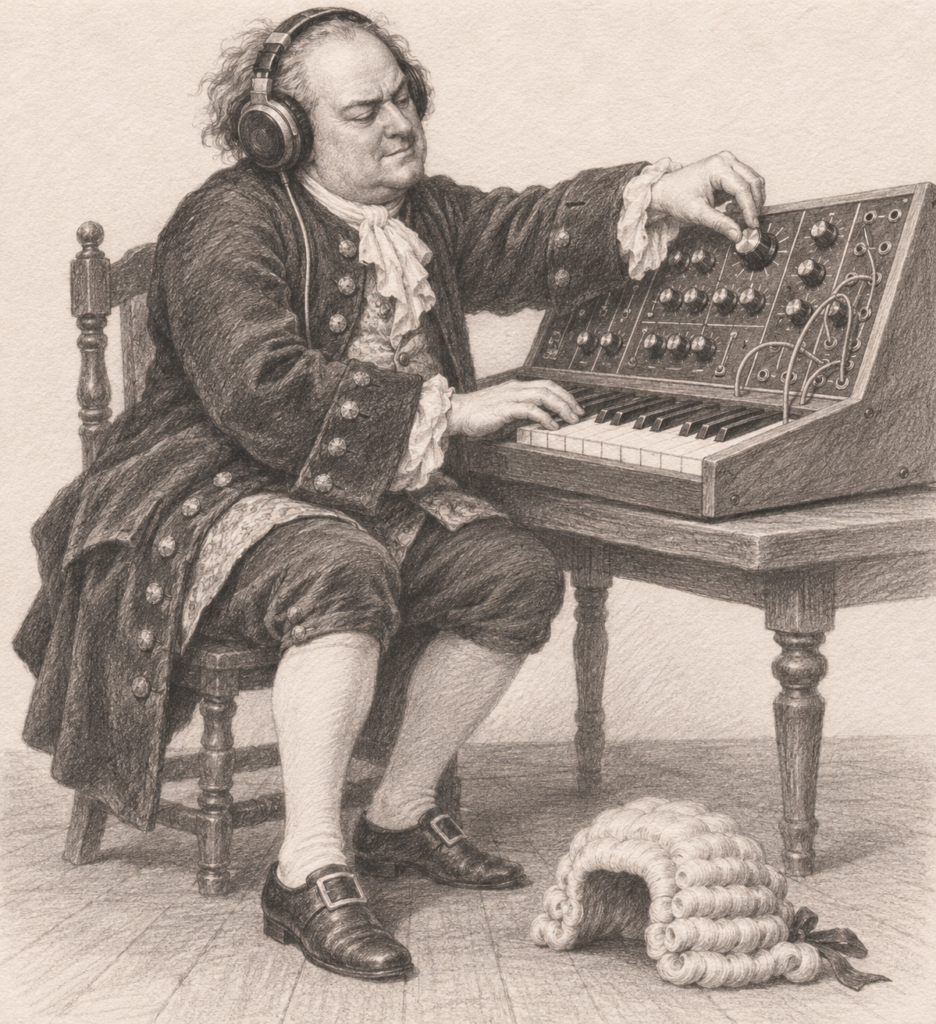
The truth is, it’s difficult to discuss historical performance practice as a single thing in terms of results or outputs. You can technically play Bach on that Fazioli piano in an historically-informed way, when it comes to tempo, ornamentation, and the like. No, Fazioli does not make historical harpsichords or clavichords. But with so many variables, and many of those variables without absolute values, being an historically-informed musician is something akin to a philosophical approach toward making music. Some might see it as I do as a kine of continuum. On one end, you’re Bach playing at St. Thomas’. And at the other, you’re Wendy Carlos on a synth.
And I see that as either caring about how Keith played Autumn Leaves or not giving a shit. And if I care, let me use that information that I can get my head around. And everything else, I’m afraid, is me.
Here I’m going to zero-in on my own thoughts about performance practice.
- I don’t believe HIPP is an absolute thing, not over time, and not in one point in time.
- I think wanting to know about how to play music in a tradition known by its crator and to try and adapt your own performance to norms they would understand is a normal human approach when someone has empathy for the audience and respect for that composer’s art.
- I believe old music can be made rewarding when a performance practice foreign from that composer’s time is employed. In essence, you’re choosing to ignore practices of that time or even adjacent to that time.
- I believe compromising between performance practices is the least interesting way to approach making early music come alive today.
Compromising for me is trying to pull off an imitation of the harpsichord on that Fazioli. I’d rather you maximize what that Italian instrument can do and arrest my attention with your highest creativity if you’re going to use a piano. That’s what Glenn Gould did. I might point to one artist I reviewed this past year, Francesco Tristano. Or Wendy Carlos. Or Brad Mehldau with his Bach-inspired recordings.
Conclusions
I want you to understand why I entertain music by baroque composers on modern instruments and on historical ones. The instruments used aren’t their defining differences; behind that is a set of performance traditions. Some of them we know well, as they were taught to us by those living in the moment. Others are educated guesses.
I can also understand the musician who doesn’t want to be limited by the old ways. They may be forging their own brand of authenticity in their performances, not beholden to their conservatory professor, but instead to the thoughts and feelings in their own head.
I write a lot about HIP and a lot of my reviews here are by musicians with background in HIPP. I hope this essay makes my understanding about this complex topic more clear.
I for one am interested in going back in time and eavesdropping on Bach’s apartment in Leipzig to hear how the music within that chamber is performed. And while it will never come to me, I am happy enough to entertain gifted, well-meaning musicians who share that sense of wonder about Bach’s amazing art.
Further Reading
- John Butt, Playing with History: The Historical Approach to Musical Performance (Cambridge University Press, 2002)
- Arnold Dolmetsch, The Interpretation of the Music of the XVIIth and XVIIIth Centuries (1915)
- Laurence Dreyfus, “Early Music Defended Against Its Devotees: A Theory of Historical Performance in the Twentieth Century,” The Musical Quarterly 69, no. 3 (1983)
- Ross Duffin, How Equal Temperament Ruined Harmony (Norton, 2006)
- Bruce Haynes, The End of Early Music (Oxford University Press, 2007)
- John Hendron, Taking a musical debate further. Philosophy of Music Education Review, 7(2) (1999)
- Nicholas Kenyon, ed., Authenticity and Early Music (Oxford University Press, 1988)
- Peter Kivy, Authenticities: Philosophical Reflections on Musical Performance (Cornell University Press, 1995)
- Richard Taruskin, Text and Act: Essays on Music and Performance (Oxford University Press, 1995)