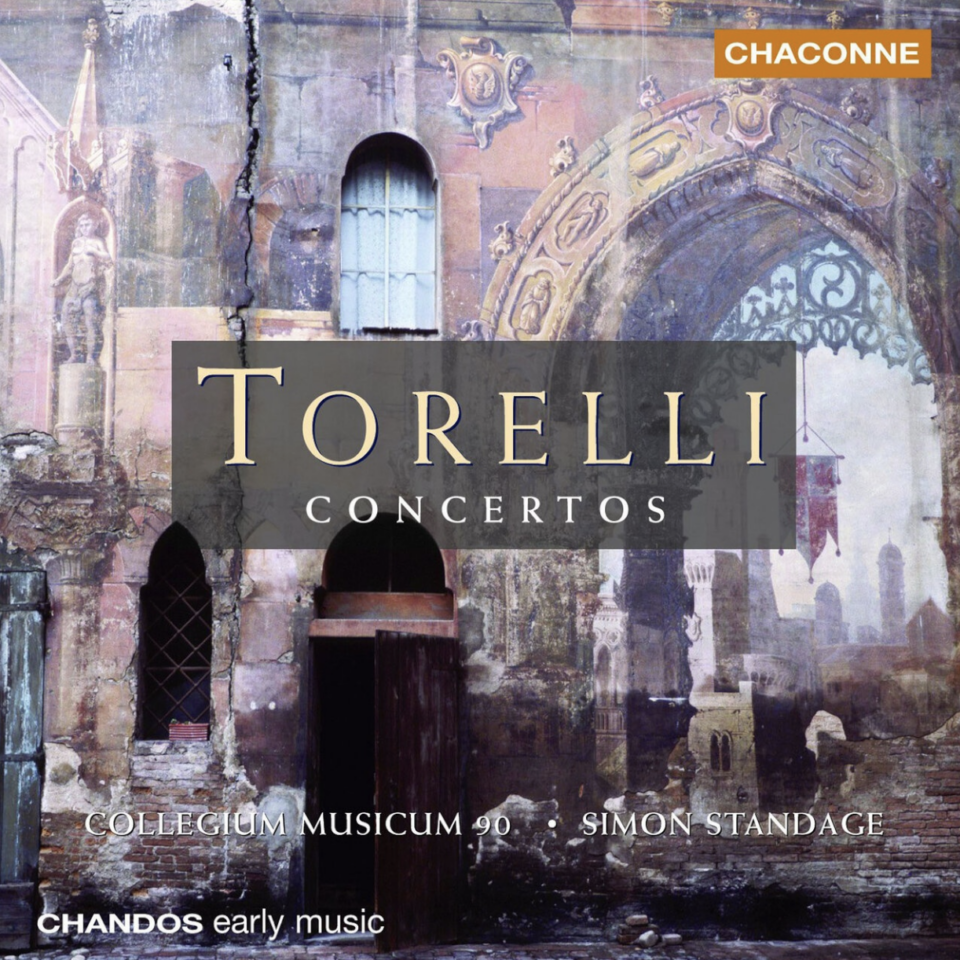
Giuseppe Torelli occupies an important place in the development of the Baroque concerto, particularly for his contributions to the emerging solo concerto and his writing for trumpet. Yet his music appears on recordings far less frequently than that of Vivaldi or Corelli. This collection of ten concertos, drawn from his mature Op. 8, offers an opportunity to become better acquainted with his work. Unfortunately, despite some accomplished playing, I found the results less compelling than I’d hoped.
Simon Standage and Collegium Musicum 90 approach these concertos with varying instrumental forces, sometimes employing a relatively substantial string ensemble of eight or more violins, and elsewhere reducing the number of players. It’s a sensible approach to a collection spanning some 77 minutes, and the contrast between larger and smaller groups provides some welcome variety. Nevertheless, I found myself wishing more of the music had been performed with one player to a part. Torelli’s writing often relies on straightforward musical gestures and clear contrasts between soloists and ensemble. Greater intimacy might have allowed those qualities to emerge with more definition and character.
My greatest reservation, however, concerns the recording itself. Made at All Saints’ Church in London, the production employs 24-bit digital technology, which Chandos promotes as a means of capturing greater natural clarity and ambience. Unfortunately, ambience is precisely what I hear too much of. The acoustic is excessively reverberant, particularly in passages involving the full ensemble, and the lower registers contribute a boominess that obscures musical detail. I initially wondered whether my headphones were partly responsible, but listening through my main audio system did little to change the impression.
The Fourth Concerto, featuring Standage and Elizabeth Weiss as opposing soloists, illustrates the problem. Their musical dialogue should provide an opportunity to appreciate the interplay between the two violins, but the reverberation softens the distinctions between their lines. Weiss also strikes me as somewhat angular in her phrasing and tone compared with Standage’s more polished playing. Elsewhere, passages involving simultaneous ornaments or trills become particularly indistinct. Whatever technical precision the musicians achieve is too often swallowed by the acoustic.
The balance presents another difficulty. The upper strings dominate the recorded sound, while the lower strings and continuo instruments lack the presence needed to provide a convincing foundation. One can hear the organ and plucked continuo, but their contributions are often blurred rather than clearly integrated into the ensemble. The resulting sound is curiously top-heavy despite the considerable reverberation in the lower frequencies.
Beyond these technical concerns, I have reservations about the interpretation. Torelli’s music is not always especially adventurous harmonically, and some of his musical ideas can seem rather predictable. That need not be a serious disadvantage. Baroque performers have considerable scope to animate relatively simple material through articulation, ornamentation, dynamic contrast, and the shaping of individual phrases. Indeed, music of this kind arguably demands a particularly imaginative approach if its structural repetitions are to remain engaging.
Here, I frequently wished for greater expressive variety. The slow movement of the Sixth Concerto, for example, features repeated chords alternating with a smoother, more lyrical line. The contrast invites a more pronounced differentiation of character, but the performance seems content to present the notes without fully exploring their expressive possibilities. The following movement offers attractive opportunities for ornamentation, yet once again the recording’s reverberation compromises the clarity of the execution.
The Eighth Concerto in C minor presents similar opportunities for the soloist to elaborate upon Torelli’s musical ideas. I would have welcomed greater freedom and imagination in these passages. Rather than treating the written material as a framework for expressive invention, the performers seem reluctant to venture beyond what is on the page.
This is not to suggest that the playing is poor. On the contrary, the ensemble is generally accomplished, with only occasional moments of uncertain intonation. The trumpet contributions from Crispian Steele-Perkins and David Blackadder are particularly enjoyable. Still, technical competence alone doesn’t necessarily make for a memorable performance, and I rarely found myself caught up in the excitement of the music.
Part of my disappointment may reflect the expectations established by other period-instrument ensembles. Groups such as Il Giardino Armonico and Europa Galante have demonstrated how rhythmic vitality, sharply differentiated articulation, and a willingness to take interpretive risks can transform familiar Baroque repertoire. By comparison, Collegium Musicum 90 sounds rather reserved. Standage has made recordings I’ve enjoyed considerably more than this one, but here I find his direction insufficiently assertive.
There is also the question of Torelli himself. His historical significance in the development of the concerto is considerable, but historical importance does not always translate into consistently engaging music. These works contain appealing passages, particularly in the exchanges between soloists and ensemble, yet I sometimes find his thematic development and harmonic language less inventive than those of composers who followed him. Vivaldi, for example, would develop the concerto’s dramatic possibilities with a flair that I don’t consistently hear in this collection. That’s not entirely a fair comparison across generations, but it does help explain why Torelli’s music may require a little more interpretive imagination to hold a modern listener’s attention.
Ultimately, this is a recording I find difficult to recommend enthusiastically. The musicians are capable, the repertoire is historically interesting, and the trumpet playing offers some genuine pleasures. But the combination of an overly reverberant acoustic, restrained interpretation, and music that occasionally struggles to sustain my interest leaves the collection feeling rather bland.
I suspect these concertos have more to offer than this recording reveals. A smaller ensemble, a more intimate acoustic, and a greater willingness to explore the music’s expressive possibilities might make a considerably stronger case for Torelli. As it stands, this release is respectable but rarely inspiring.