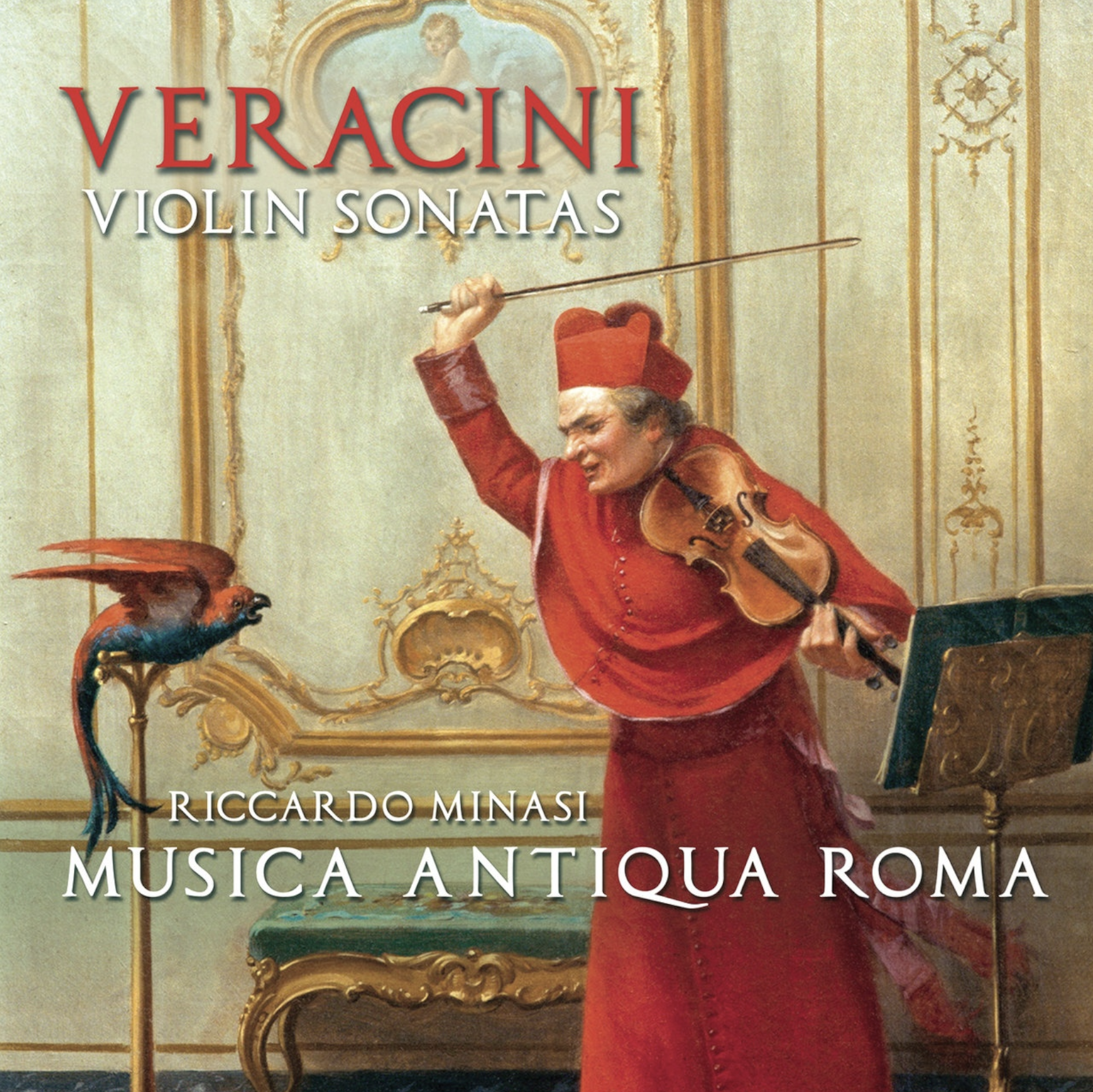
Veracini Sonatas • Minasi
I reviewed this album back in December of 2010. I wanted to revisit it, sadly, that Musica Antiqua Roma were a flash in the past. Minasi has moved on to more conducting than violin playing, sadly, as I was a big fan of his barqoue releases.
I’ve reviewed Veracini’s music before; he’s the late Baroque violinist who famously jumped out of a window and thereafter walked with a limp. The excellent historical notes in this release by Minasi and Musica Antiqua Roma (which includes Luca Pianca of IGA fame) underline the fact that Veracini was a well-traveled and likely well-lived man, another virtuoso violinist of his era. His music, however, doesn’t equal the richness of the story behind his life. What he left us is inconsistent: some of it is occasional music of no special merit. Other works, as demonstrated here—these sonatas for violin and continuo—have sparkle in their unusual themes or flights of virtuosic invention.
Minasi previously released a fine recital of Biber’s so-called Mystery Sonatas on the Arts label. Here, with an even richer continuo ensemble, he takes on his native Italian repertoire in a recording that falls short of the earlier release’s superb sound quality.
Given Minasi’s association with IGA, comparison with Enrico Onofri is inevitable. Between the two, Minasi is the less convincing aesthete. In Veracini’s academic sonata, the last on the disc, there is an almost rustic quality to Minasi’s tone. While he achieves color through alterations in timbre, his playing isn’t as elegant as Onofri’s in comparable recitals of earlier Italian works.
Yet elegance shouldn’t be the last word. Minasi is a strong player, and what he may lack at times in refinement he makes up for with bravura—the Op. 1, no. 7 finale being an excellent example. The bariolage demanded by Veracini’s writing is dispatched with technical brilliance, and Minasi proves himself a confident, if occasionally strident, performer.
This movement in particular encapsulates Veracini’s power as an extrovert composer, allowing us to imagine him as a performer. An earlier work on the recording, preserved in a Viennese manuscript, places the violin in an unusually high register and employs an unexpected continuo choice: harp. The use of plucked continuo alone is not without its critics. I don’t question its authenticity, but sonically a combination of bowed and plucked continuo might have been more satisfying, especially given the variety of players at hand.
In all, this is a strong recital, and one I admired considerably more than an earlier release by John Holloway, which I felt lacked drama and energy. Minasi and company are at their strongest in Veracini’s more extrovert fast movements. You won’t always anticipate where Veracini is headed with his melodic lines—he occasionally surprises—but he consistently offers his violin soloist ample opportunity to show off, or at the very least to engage in creative invention. I anticipate further releases from Musica Antiqua Roma.