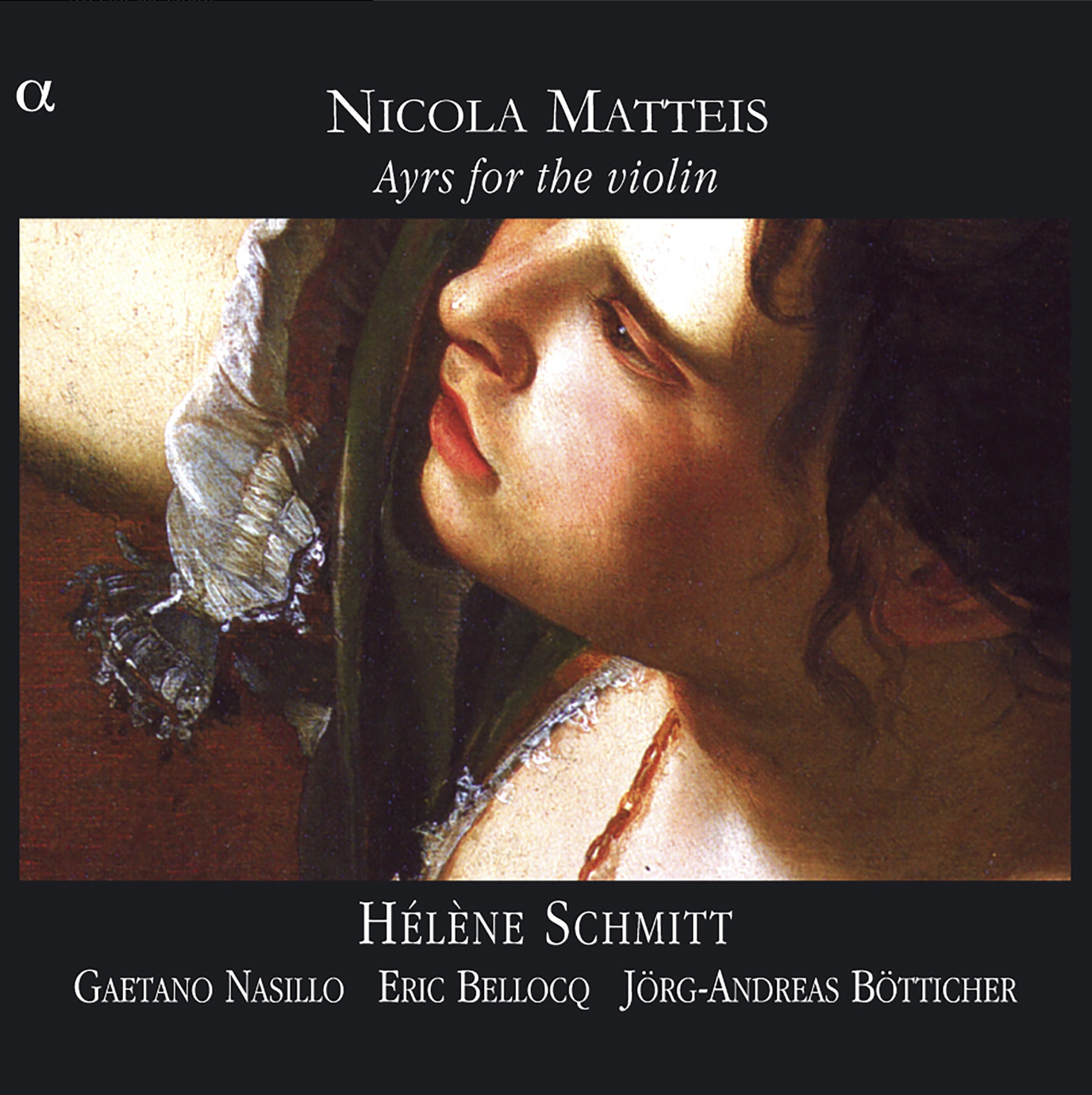
Matteis: Ayrs for the violin • Schmitt
Nicola Matteis was an Italian violinist and composer active primarily in the second half of the 17th century, best known for his influential career in England. Born in southern Italy—most likely Naples—he emerged from the Italian violin tradition at a moment when virtuosic, expressive string playing was beginning to travel beyond Italy. By the early 1670s, Matteis had settled in London, where he quickly attracted attention for a style of violin playing that English audiences found strikingly new: highly ornamented, rhythmically flexible, and emotionally charged, with techniques and bowing effects unfamiliar to local players.
Matteis built his reputation largely through performance and publication rather than court appointment. His four books of Ayres for the Violin (published between 1676 and 1685) were enormously influential in shaping English violin music, helping to accelerate the adoption of Italian style in England decades before Corelli’s music became dominant there. He spent most of his professional life in London, teaching, performing, and publishing, and appears to have remained there until his death around 1714. Through both his compositions and his playing, Matteis stands as a key conduit between Italian virtuosity and the emerging English instrumental tradition.
I'm fan of both violinists who have in recent years released collections of his "Ayrs" for violin and continuo. Amandine Beyer is one, and in this recording, we hear Hélène Schmitt with Gaetano Nasillo (cello) and friends Eric Bellocq and Jörg-Andreas Bötticher. Matteis was active not in Italy, but in London. His music has flavor, and while the spirit is indeed light and Italian, it's got an "ayr" of its own, having been popular with some of the amateurs that were taken with the new and fresh Italian style Matteis helped to import to England.
Schimtt, as usual, is well-captured on disc, with good balance with her colleagues on basso continuo. Thirty-five tracks, in all, are recorded over some 75.5 minutes. If we're comparing, Beyer takes the lot in 40 tracks at some 72 minutes, where we might guess she is slightly less lingering in the slower movements.
Where Schmitt, however, has the lovelier tone, Beyer owns the lighter, Italian style. She pushes the Presti faster, and overall has a lighter approach to the music.
That's not to say Schitt's reading is poor. Take the 33rd track, a Burlesca in G major. It bounces as I catch my right foot bouncing along. This is jolly music, for much of the lot, and that which is not, carries a sweet melancholy. And that's the thing about this music; at its heart, they are tasty morsels, little tapas of music. None of it is too serious, yet the flavor carries with it something just a bit exotic, and a lot that comes across fresh. Program this between the likes of French Leclair, Corelli, and late Italians like Locatelli, and it's definitely written from a different era. The first half of the baroque period.
As with her solo Bach, you can sometimes hear Schmitt breathe, audibly. It reminds me that a real person is behind the music making, and that personality comes through in every track.
If, however, I was asked to choose, I believe Amandine Beyer is the superior reading. But that's splitting hairs. Having both violinists from which to choose is a noble luxury, given the beauty of Matteis' music.