Tranquilles Coeurs
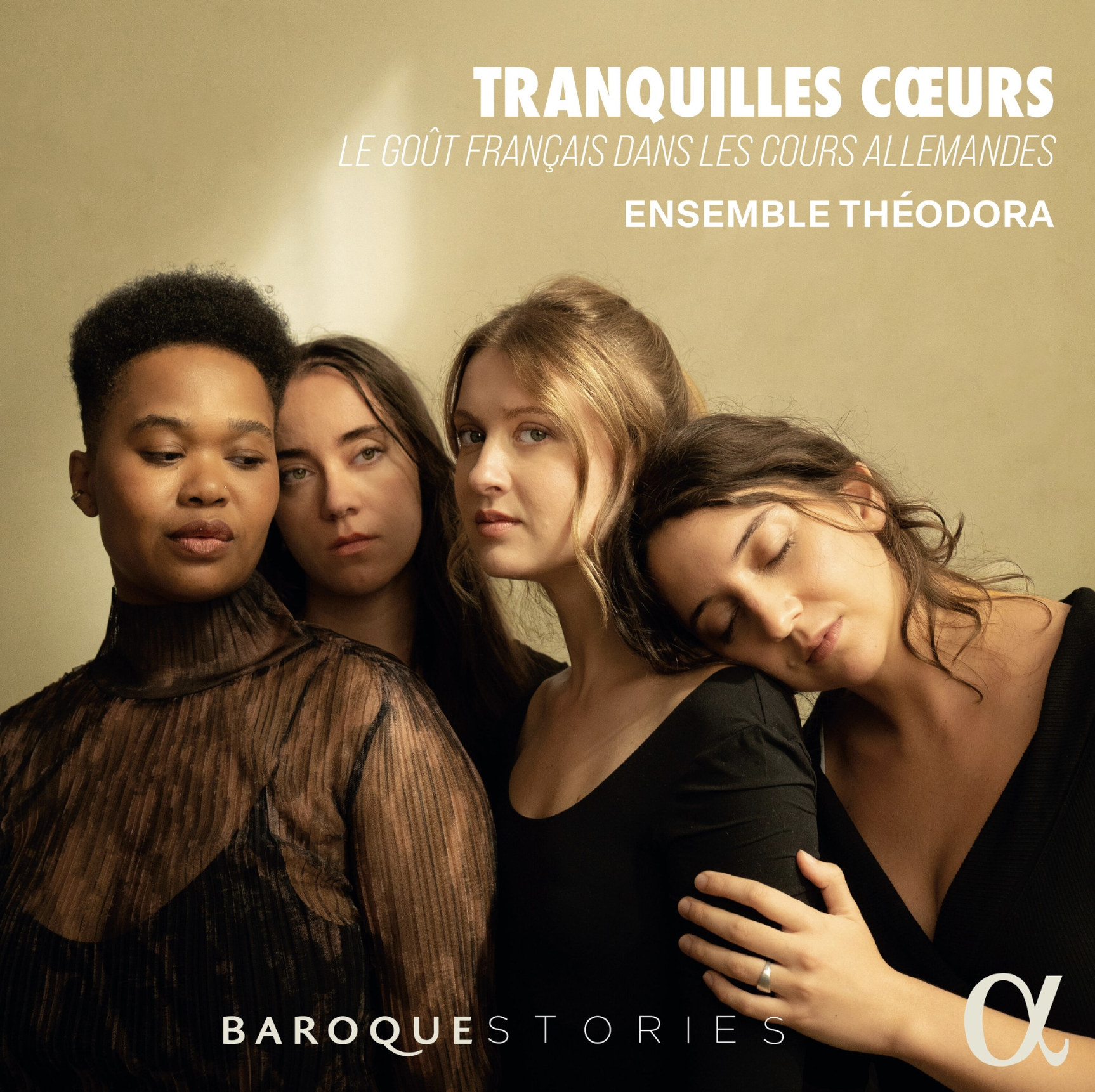
Ensemble Théodora’s debut album features German music written in the French style, or so that’s the idea, but the composers represented (with one work attributed to no one) includes pieces by Lully and Campra. The program pivots between instrumental pieces and those for voice. They are an expressive group and their album is captured in a generous space with ample reverb. The ensemble supposedly came about from a shared love of French baroque music.
The principal singer is Mariamielle Lamagat who uses a generously wide vibrato in her singing, although it’s not universally applied. The timbre of her voice I like very much, I am not as sure about the vibrato but it’s distinctive enough I think to potentially divide listeners. Over repeated listens I warmed to this vocal style, but I’m not enough of an expert in vocal music to say whether this level of vibrato was used during the period. It’s safe to say that opinions about vocal style varied in the past at least as much as they do today. She’s an expressive singer, you’ll find without doubt, and her performance of the Plainte de Cloris by Lully is very strong effort.
The program, honestly, is a hodge-podge of pieces, including one by Georg Böhm, Jacques Boyvin, a two-movement motet by André Campra, a eight-movement anonymous sonata, a Krieger piece Surgite cum Gaudio, a Johann Fischer trio sonata, and a series of selections from Lully. The players include violinist Louise Ayrton, gambist Alice Trocellier, and keyboardist Lucie Chabard. Additional players contribute where needed.
The instrumentalists across the board are strong technical players; the Fischer suite is enough to hear this clearly. The amount of reverb present should be too much, but the microphones are close enough to offer enough closeness and immediacy. I never knew Bach arranged a piece from François Couperin (BWV 587) which here is played on instruments rather than keyboard alone. The original comes from one of his Nations suites, L’Impériale.
The anonymous suite is marked “Sonata à 2” which isn’t really precise; it’s performed here on violin and viola da gamba with continuo support provided by theorbo and harpsichord. It’s nicely rendered, and I can understand why they included it, it’s a really good collection of pieces. The first three tracks lack labels, but starting on track 9, the suite’s fourth movement, we get dance names (Allemanda, Courant, Ballet, Sarabanda, etc.) with, yes, interesting Italian spellings, suggesting its origins don’t originate in France. The performance however comes with a strong French air. I especially like how violinist Louise Ayrton colors her sound as a type of ornamentation. I also get the sense that she’s aware of ensemble balance and how her instrument sounds in the performance space. Small details, but the come together here for a strong performance.
The Krieger cantata “Arise with Joy” is obviously religious, set in Latin. It’s setup for this ensemble, featuring instrumental lines for the violin and gamba. The text has been set by more than one composer; I can’t say what it’s function is, but I since it mentions a bridgegroom (in a religious context), I wasn’t sure if it would have been appropriate for a wedding? It’s been recorded at least by one other ensemble; I compared this recording to the one by Hamburger Ratsmusik, finding Lamagat a far better-equipped vocalist than the one from the 2003 album.
I like that solo tracks are provided for the gamba and harpsichord; it speaks to the desire to provide exposure to the core members of the ensemble and likewise variety to the program. The solo harpsichord piece, Sourdine d’Armide, adapted from Lully’s Armide is interesting, given the use of registration across two keyboards, the tuning of the instrument in parts is colorful, given the temperament. The gamba gives us a shortened version of the titular song, “Tranquil hearts” before we are treated to the sung version. I wish we had a more focused sound from the gamba but I can also appreciate each musician staying in position, given the recording setup.
Overall, while perhaps an uneven program in terms of the musical selections, it does well to showcase music with you’re likely unfamiliar. I am going to want to hear more from Ensemble Théodora. This is a great way to introduce yourself to the world. Their love for the repertoire comes across well.
N.B. This is the third time I’ve noticed Alpha Classics booklets are not available to us via Qobuz. They do allow access to their booklets with a website login, thankfully, but I am not sure why they’re not getting over to Qobuz. Also interesting in the booklet: there’s a spot to note the recording location but it’s been left blank.