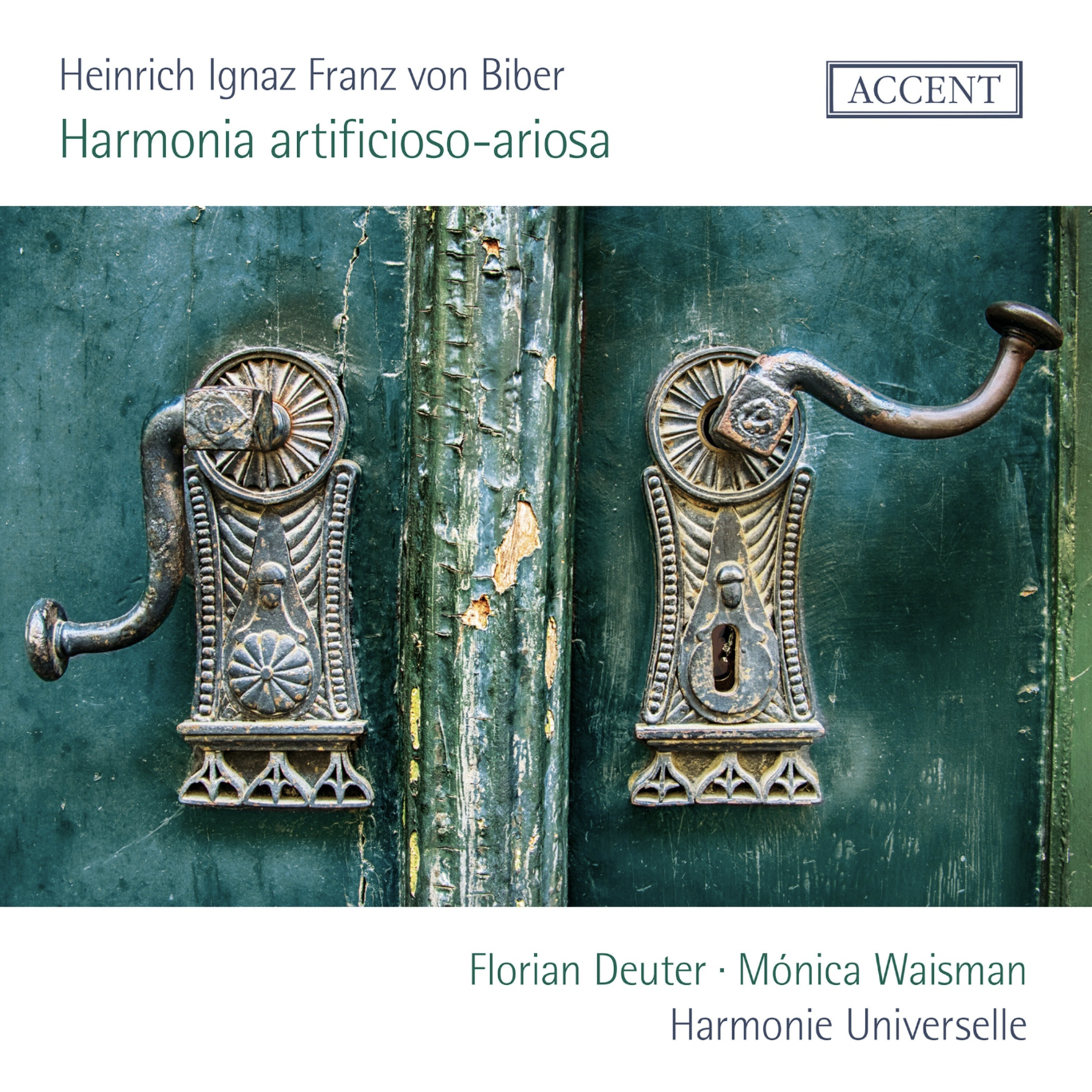
Biber: Harmonia artificioso-ariosa • Harmonie Universelle
I recently did a meta-assessment of recordings of this important collection by Heinrich Ignaz Franz von Biber. Perhaps I should have waited?
Florian Deuter co-leads with Mónica Waisman as usual in this production on Accent. Deuter of course played in his formative years as part of Musica Antiqua Köln, rising to leader when Goebel was dealing with the dysfunction in his left hand. I’ve long admired his ensemble, Harmonie Universelle, for offering clean and engaging performances without resorting to too much extravagance. This pretty much might be the way I’d describe Goebel’s former MAK.
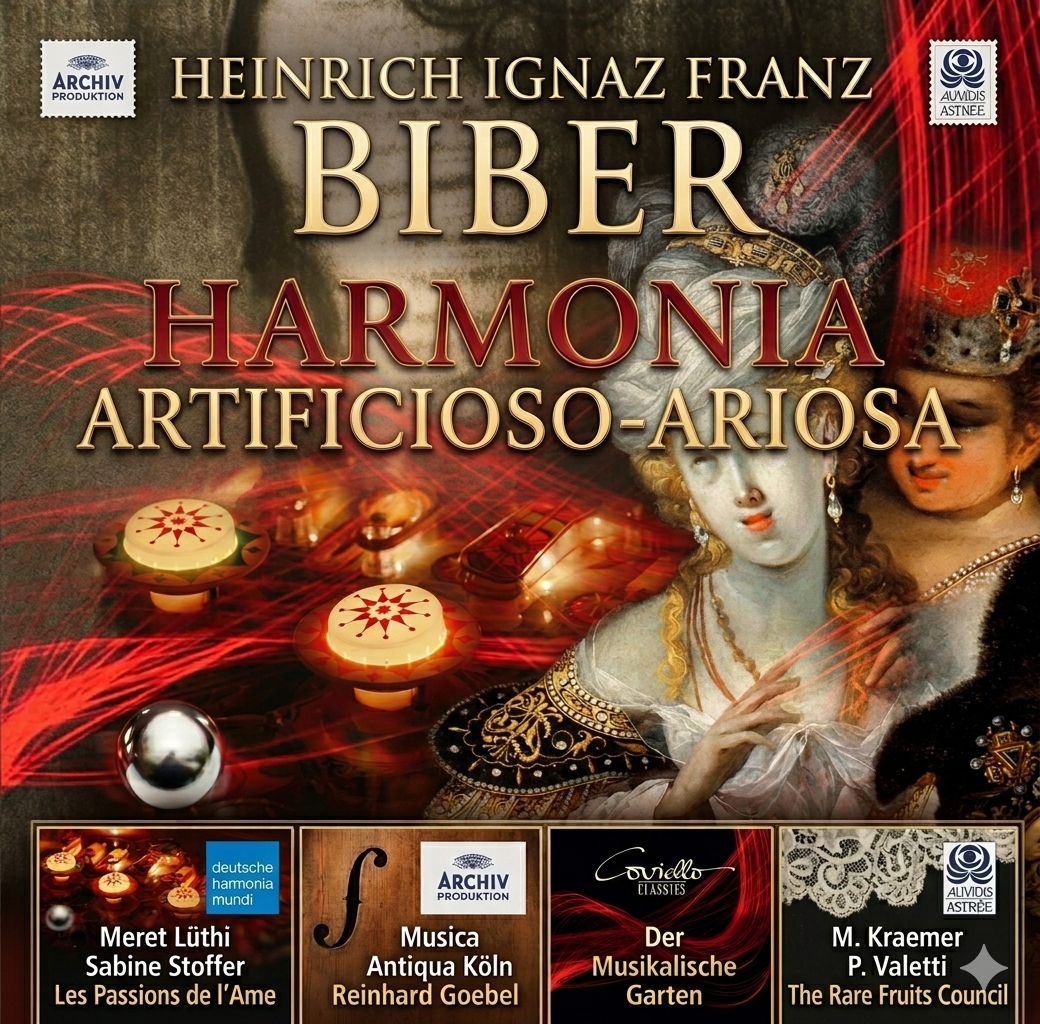
The other performance that speaks to MAK is Manfredo Kraemer’s recording which I discussed in the review linked above. How lucky are we to not only have a MAK version, but those led by Goebel’s former colleagues?
Biber’s collection, of course, is a set of seven partien many calling for scordatura. HU gives us images of the instruments used across the suites, which I thought was a great idea to allow us to conceive of the expense required to even perform this collection in concert. Multiple instruments are needed to accommodate the different tunings, if performed together. I’m guessing that in Bibertime that these would not have been performed as such, but that’s only a guess.
I started with my favorite, the ultimate partia, number seven in C minor. There’s an amazingly rich sound that comes out of the gate, especially with regard to bass presence. There’s also a great clarity among the instruments and the two leads. The recording is transparent for sure, without a lot of ambiance in the mix. In my system, there was generous width and depth to the soundstage, with particular sparkle in the sound of the harpsichord.
HU are no slouches when it comes to playing fast. They aren’t speed demons, per se, as if they turn up the tempo 20 beats just for kicks. The Allemande feels just right and the Gigue, marked Presto is, well, presto without reservation.
The Trezza that precedes the last movement has before benefitted from a little guitar strumming and HU offer us that solution here, which I think is the most extravagant thing they do across the album. It’s just enough without going into excess with style.
Lute grabs our attention in the opening of the beloved Arietta variata, signaling the rich complement of continuo instruments: Dane Roberts supports on the violone, Eduardo Egüez on lute and guitar, and James Johnstone upon the organ and harpsichord. Enough variety without going crazy with harps, psaltry, or other exotic options.
The approach with the arietta is pretty steady and slow, which allows us to marvel in the unique sound of the lead instruments, two viole d’amore.
When the tempo picks up everyone is ready. Their playing is super clean and articulate, well interlocked for the Deuter and Waisman. The support from Roberts on violone is especially satisfying. Phrasing from the faster parts into the slower? It’s all well-measured and paced.
The opening work, in D minor, presents us more of the same high quality musicianmanship that was evident in the final partia. What makes this work interesting to me is the call for double stopping in the violins. This harmonic component is played especially well, with long enough strokes to allow the instruments to sing. While this may not be the fastest presto on record, the tempo seems intelligently derived. Johnstone’s organ has enough character to it, too, offering a richness to this suite.
The feeling achieved in the Gigue, after all it’s dance, and we should feel that quality, is just perfect. To have that back and forth feeling across multiple players is intentional. It’s well done.
The final movement, another dance, the Sarabande with two variations, as with the gigue, is also well-measured in regards to pulse and tempo.
If you’re wondering how this new release may compare with others you’re already familiar with, a great place to start is the opening of the second partia in B minor. This opening is about contrasts, and in some performances, that soft, tender opening is met with especially heavy weight, players having to lean into the acoustic of their space with volume to get maximum impact. HU isn’t about that, I’m afraid, and for me, that’s okay. They play with dynamics without resorting to histrionics.
The last three movements are each performed at pretty fast clips. It’s that tightness they have in playing in perfect time with one another that makes the choice so satisfying. This is what MAK did at its apex. It’s so nice to hear it here, as it was honestly missing in many ways from MAK’s own release of this set on DG Archiv.
Finally, another favorite movement of mine is the Passacaglia from the G minor partia. Here Waisman leads on first violin and I think there’s just the perfect variation in sound and phrasing to make this piece hum. We can clearly hear each violinist on either side of the stereo spectrum, but the match in instrument timbre and bowing style is so close that you might be tricked into thinking this was all played by a single mind. This is of course a technical achievement but one that we admire in the polish of performance that can only come from musicians with experience, especially experience in playing together for so long.
That passacaglia is so satisfying.
Conclusions
It’s my opinion that this is the reference recording for Biber’s Harmonia Artificiosa. The technical polish and clean articulation used throughout is what every string player would hope to achieve, not just alone, but in consort with fellow musicians.
There are moments in the performances by Kraemer’s 1998 release with the Rare Fruits Council and the 2021 release by Les Passions de l’Ame which get more dramatic punch, but this performance is honestly satisfying without those extravagances of hand.
This release may be closer aligned in style to Der Musikalische Garten’s performance on Coviello Classics, but I’d have to give this new performance the edge because of just how well-integrated the sound and performance style is between musicians.
One rationale, beyond the relationship among the musicians represented here that make up HU, is the ensemble intent to use instruments from the same makers. The liner notes credit Matthieu Besseling, an Amsterdam-based luthier, for providing the six violins and viola, alongside Tilman Muthesius, a Potsdam-based luthier for the violas d’amore.
For fans like myself of the music of H.I.F. Biber, we have so much to enjoy in this new release.