Vivaldi 100 • Giuliano Carmignola
Vivaldi’s concertos are among the most recorded repertoire in early music, and opinions on whether the catalog needs more vary widely. This release marks what the liner notes credit as Carmignola’s 100th recording of Vivaldi concertos — a milestone that invites both celebration and scrutiny. Whether it earns its place in an already crowded field depends largely on where you already stand with this artist.
The album presents 13 concertos, several of them doubles, performed with I Solisti Aquilani — an ensemble that includes two cellos and double bass. Daniele Orlando joins as second soloist in four of the double concertos: RV 512, 506, 525, and 517. Carmignola also plays a newly commissioned instrument built by David Bagué i Soler after models by the Testore family, though its impact on his sound is less transformative than one might expect.
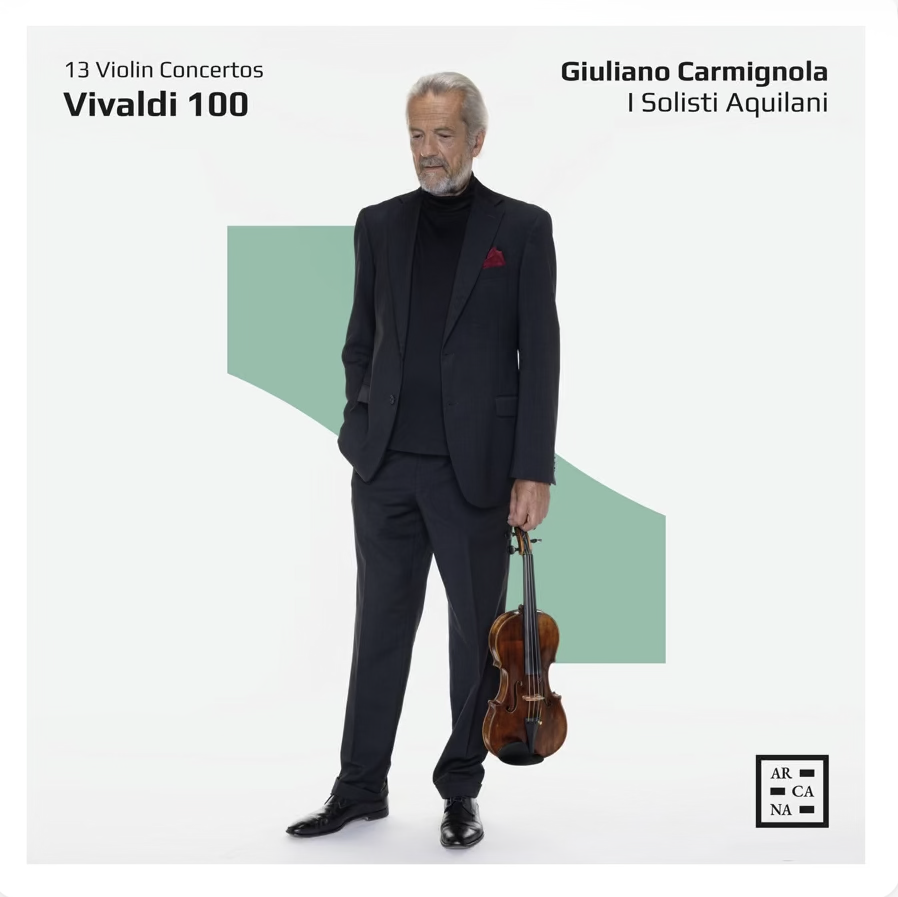
Carmignola studied violin with his father before going on to work with Nathan Milstein and Franco Gulli — a classically grounded lineage, and one that shows. He is not primarily a HIPP specialist, and while he has recorded extensively in baroque repertoire, his approach reflects that background. His use of vibrato is one sign; another is a tendency in slow movements toward a warmer, more personal expressivity than the rhetorical clarity the music sometimes calls for. In the middle movement of the F major concerto RV 282, for instance, he largely sets aside Vivaldi’s built-in gestural language in favor of his own interpretive path. The upper register of the new instrument has a particular sweetness — attractive, but not quite what gut strings in a strict baroque setup typically suggest. The liner notes and photographs (which show a chin rest and a long bow gripped well above the frog, albeit with a baroque tip) don’t resolve the question of how the instrument was actually prepared.
None of this is new. Carmignola’s style has remained remarkably consistent across his career, and this recording doesn’t depart from it. His outer movements have always had bite and dynamic presence, and that holds here. In RV 369, his handling of Vivaldi’s bariolage has genuine edge, contrasting well against the sweeter phrases that follow. The closing of RV 241 is efficiently dispatched — the solo writing isn’t among Vivaldi’s most inventive, but Carmignola navigates it cleanly, and I Solisti Aquilani provides stronger dynamic support than Venice Baroque did in his earlier recordings.
The final double concerto in C has a Locatellian flavor while remaining unmistakably Vivaldi — familiar sequential patterns, the two violins competing before converging in harmony. Both soloists handle the active passages well. The slow movement is less successful: Orlando doesn’t quite match Carmignola’s schmaltz and rather than offsetting it, and the movement might have benefited from a cooler hand leading the exchange.
For listeners who have followed Carmignola’s Vivaldi recordings and found value in them, this one will satisfy — the concertos here are drawn from outside his published opuses, and the playing is at his characteristic level. For those who have found his slow movements too indulgent or his style too distant from HIPP practice, this recording won’t change their minds. My own preferences run toward players like Alessandro Tampieri and, before him, Enrico Onofri, whose expressive choices are rooted more firmly in historical performance practice. That bias is worth naming. It shapes what I hear as reservations, which others may fairly hear as virtues.