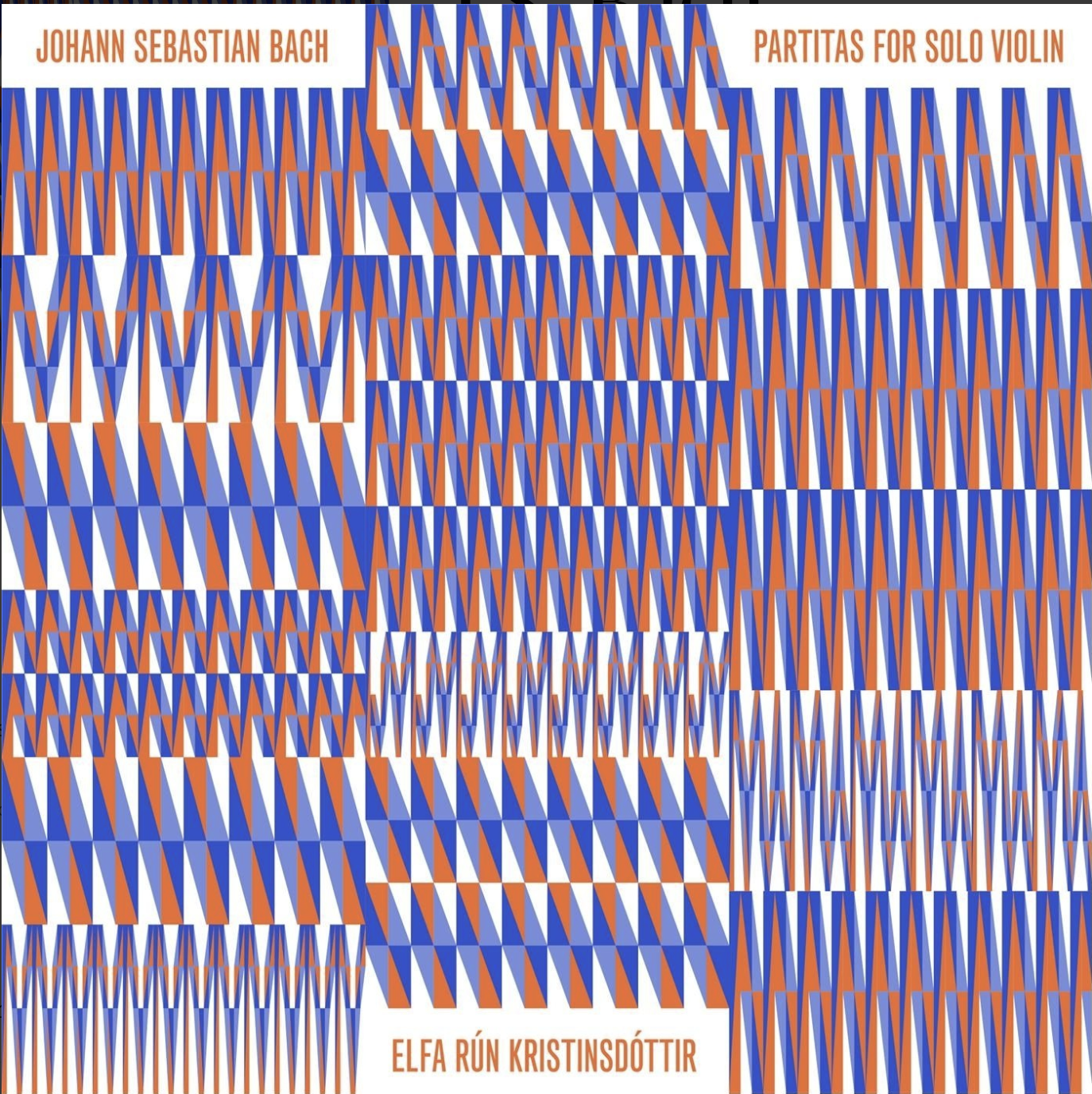
Bach: Partitas (for violin) • Elfa Rún Kristinsdóttir
I am coming to this album late, as it was released in March of 2016. To my knowledge, a companion recording of the sonatas has not yet been released. The Icelandic artist won both the audience and grand prizes at the 2006 Johann Sebastian Bach Competition in Leipzig. Elfa Rún has played with many ensembles, including Akamus.
I auditioned Elfa Rún's Telemann recording for my comprehensive look at his violin fantasias, coming to find her performance a strong effort. Then I spotted this album of Bach. Much of what I admired in that album is present here as well.
Readers should know that her playing is clean, well-articulated, and in terms of sound, there's a nice balance here between a close read of her instrument with just enough reverb. It's that ambiance that helps us understand the reach of her dynamic playing.
BWV 1002
Bach's construction of this partita is unusual (although none of them follow a set pattern) for its combination of dances and doubles. As such, it stretches the overall length of the set. These are a compositional challenge, I think, on how to take the thematic material from the earlier dance and weave something more developed. It still gives me chills to think about the genesis of these pieces, this partita in particular, given that Bach, while a violin player, was not, to be clear, a virtuoso at the level of Pisendel or the Red Priest, whose music he admired.
Elfa Rún approaches this partita seriously, I think, which may also owe something to the B minor key. The dynamics applied to short phrases comes across, but the first stand-out for me was the first Corrente, which benefits from nice articulation. The combination between the spaced notes with the legato is sublimely rendered. When it's done well, the Corrente's Double gives me goosebumps. Some violinists push this one hard and under her fingers, this one sounds relaxed. There's some benefit here for having a performance space offering reverb, and in this case, I think the tempo was well-chosen given the acoustics for this recording. There's just enough of that blurring that benefits the effect of the perpetual dance.
The ornamentation that comes into the Sarabande is quite nice. I heard a few embellishments in the E major partita, but after hearing these I want more. It's the curse, of course, of Bach supposedly saying at one point that his music didn't require embellishment. There's also a very real expectation held by some in the classical music world that you don't mess with the master's music. As I've written about this before, noting that some HIPP performers tend to embellish more in live concerts than on recordings, even this little taste made me smile. The embellishments here are tasteful and in no way compete with what Bach left us.
The double stopping in the Tempo di Borea is very clean. Technically clean playing is so satisfying, and here it's not sterile but we can feel the intensity. The Double is far lighter in texture, with an articulation that I found contrasted nicely with the emotional tightness of the earlier movement. As with the Corrente-Double, this performance is enhanced by the acoustic environment.
BWV 1004
This partita's showcase, as you may well already know, is the fifth movement, which again gives this piece its extraordinary length. For those wondering, she clocks the Ciaccona in at thirteen minutes.
It's in the Allemanda that I feel Elfa Rún really leans into the sound of her instrument. I don't have liner notes identifying the instrument being used, but the tone is attractive, although the midrange is strongest, with the upper register tapering off in brightness. It's nicely done. The Corrente is the wildest thing to come out of this recording, choosing a tempo that might have strained against the acoustics, but strong articulation helps keep clarity for the audience. Again, the use of dynamic contrasts elevates the performance.
In the Gigue the way she digs into the lower notes and how they resonate with a little bit longer pull is perfect. Despite the flight of so many notes, there's a real warmth to her sound. Articulation throughout is extremely clean. The most controversial thing for some may be the tempo at which the Ciaccona is performed; the opening does not take on a sentimental quality. I looked at a few favorite recordings, and the speed demon is Enrico Onofri (11:14); Gottfried von der Goltz clocks it at 13:40 and Fabio Biondi takes a bit more time at 14:02. As this single movement has taken on a life of its own, performers have given special gravitas to the work, and in some cases, that's meant slowing it down. If I go back to my original Sonatas and Partitas album, performed by Itzhak Perlman, he took 15:47. If Perlman represents the old school, it's no surprise that HIPP musicians push back against what they see as romanticization.
I think the tempo chosen here supports the music well. Those who like to look for performance clues in the score won't find wildly different tempo indications by Bach in the chaconne. There are clearly some different moods presented throughout the work. But Elfa Rún sets a momentum and sticks to it. All I'd ask is that you understand that recordings have a very strong influence on performance practice. Playing a piece, especially a well-recorded piece, differently is going to turn heads. The rationale here doesn't seem to be a parlor trick, but instead a response to presenting what was left behind by the composer to the best of one's ability.
Even I missed a slower tempo at around 10:25, but the speed doesn't really work against the emotional weight of the music. The effect is lightness.
BWV 1006
There's a lot of dynamic shading used to highlight the phrases in the opening Preludio. While fast, she resists the urge to power through the entire movement in an effort to showcase virtuosity. There's little question that virtuosity is there, and I think the use of a wide dynamic range here adds value to the performance.
The Loure can be a challenging piece for me, a movement that can fail to hook me at slower tempos. I found Elfa Rún's tempo here to be pretty good, avoiding this interpretive issue. It was hearing this again that I was reminded how, of all Bach's movements in the sonatas and partitas, this one has the closest stylistic affinity to the Telemann fantasias. I hadn't put that together before. What might surprise some is the tempo chosen for the pair of Menuets. They may be, in fact, too quick to dance to, but I like the tempo very much.
There's a good bounce in the Bourrée, and with the chosen tempo, I could anticipate how this might go south but she holds it together admirably, with technical assurance.
Across the entire suite there's a strong use of dynamics that intelligently help us hear the shorter baroque concept of phrase. Her control of these dynamics is outstanding.
Conclusions
There are many good performances of Bach's Sonatas and Partitas. In this recording we only get the Partitas, but one can hardly complain when they are played this well.
I have to step back and admit — while I have learned to play the violin, I am in no way a professional violinist. But that limited exposure gives me insight into how the instrument is played and how demanding certain technical passages can be. Intonation, articulation, dynamics, and phrasing all come together as the details that, under the artist's control, can elevate or detract from the written notes.
This is hard music to play, at least to play well. It's also difficult music to record, given the fact that this music has been so well recorded.
This is one of those recordings that stands out for me because those details have all been considered and worked out. This is why practice is so important — it allows you to perfect the consistent execution of those details. But it's another thing entirely when those details add up to something that genuinely enhances the music. This recording makes me feel that the artist has lived with this music and hears it very musically; it's a true gift to translate what's in your head into sound for an audience. For those that like details — changes in articulation, dynamics, how phrases can be differentiated from one another — this album is full of them, rendered very beautifully.
Yet it does this without forcing us to bow to the performer in awe of their power. At least that's not the sense I get; I am led to believe with my experience of this album that the artist only wants us to hear the extreme wonder and emotion inherent in this music. I found this album one of the most ultimately satisfying recordings of Bach's violin partitas. It's one of those albums that deserves your full attention. And it highlights for me an extreme talent at the violin that we need to hear more from. I anticipate strongly the artist's release of the Bach sonatas.