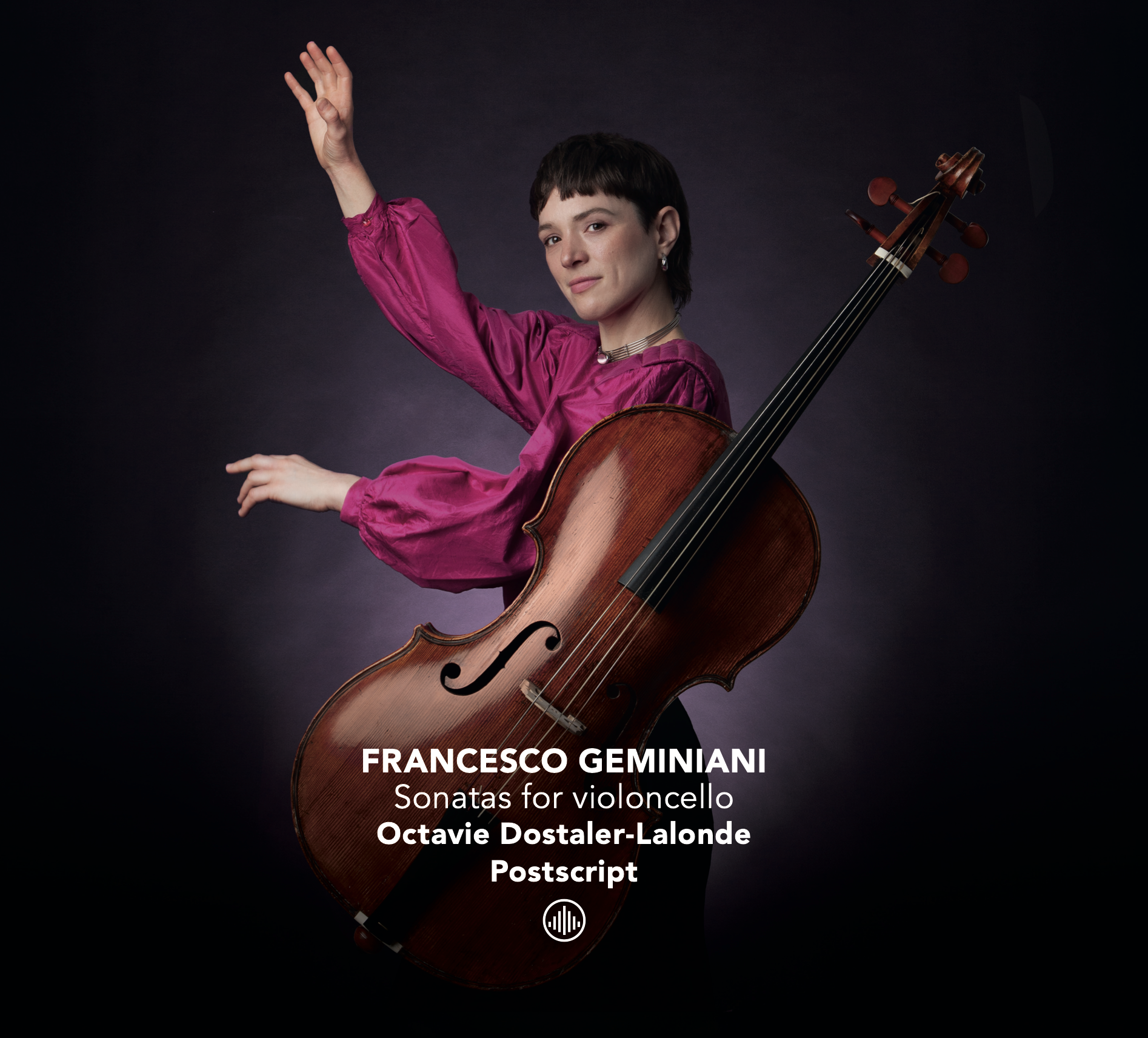
Geminiani: Sonatas for Violoncello • Octavie Dostaler-Lalonde
Francesco Xaverio Geminiani (d. 17 September 1762) was a Luccan-born violinist, composer, and theorist whose career traced an arc from the studios of Rome to the concert halls of London and Dublin. He received counterpoint instruction from Alessandro Scarlatti and violin training under Carlo Ambrogio Lonati in Milan before studying with Arcangelo Corelli — a lineage that shaped everything he subsequently wrote and played. His most enduring works are three sets of concerti grossi — Opp. 2, 3, and 7, forty-two in all — which notably introduce the viola into the concertino group, effectively making them concerti for string quartet; their dense counterpoint was calibrated for a London audience still devoted to the Corellian idiom even as the galant style had taken over the Continent. His Art of Playing the Violin (1751) remains an invaluable source for late-Baroque performance practice, covering vibrato, trills, and bow technique in unusual detail, and its prescriptions stand in pointed contrast to those of Leopold Mozart's contemporaneous violin treatise on questions of bow hold, vibrato use, and the rule of the down-bow.
As the booklet notes attest, Geminiani loved rubato and infuriated other musicians with his lack of consistent timing as a director. This recording explores 53 minutes of works by the Luccan-born composer featuring the cello. Dostaler-Lalonde leads the ensemble Postscript as soloist; in select works, the continuo is realized for cello alone (marked below with a star), a practice the performer has studied at length. The pieces included are:
- Sonata for 2 cellos, Op. 1, No. 2
- Sonata for cello, Op. 5, No. 3
- Sonata for cello, Op. 5, No. 2
- Sonata for cello, Op. 5, No. 1
- Sonata for cello, Op. 5, No. 6★
- The Art of Playing the Guitar: Canon★ and Affettuoso
The Op. 5 collection (1746) is the core material here, previously recorded by Pleeth and Hogwood, McGillivray, and the Four Nations Ensemble (Loretta O'Sullivan). The 2005 McGillivray release on Linn runs 74 minutes for the complete set. For those willing to forego the period instrument, Anton Steck also recorded the collection on CPO, on violin.
Of those earlier recordings, the McGillivray is well-done with a somewhat live acoustic; the O'Sullivan is less polished in sound. This new release improves on both. It also offers the double-cello sonata outside Op. 5 and the two shorter pieces from the guitar treatise — a wise programming decision that gives the disc its own identity.
The cello-only continuo, while applied sparingly (just the two starred works), is a genuine point of interest. Postscript elsewhere deploys harpsichord, theorbo, and violone.
Dostaler-Lalonde and Postscript — in either configuration — phrase slow movements as if by breath and bring expert technique to the faster ones. The final sonata from Op. 5 illustrates both: its opening uses rubato tellingly rather than excessively, and the closing Allegro moves at a comfortable tempo through a variety of musical moods across three tracks.
The two additional pieces come from Geminiani's Art of Playing the Guitar, presented here in arrangement. The Canon for two cellos (track 8) is the more interesting of the pair; the upper voice uses a cello piccolo, with its characteristic nasal, closed tone — an instrument built to penetrate in ensemble. It wasn't my favorite color on the disc, but the artist's cello in the C major sonata has a very attractive timbre.
For listeners who already have one of the Op. 5 sets, the real appeal here is the newly explored continuo solution using a single bowed-bass instrument — a legitimate scholarly angle, well executed. The musicians of Postscript are able and fully up to the task, and offer among the more attractive recorded sounds the repertoire has received.