Scarlatti: Keyboard Sonatas • Ogawa
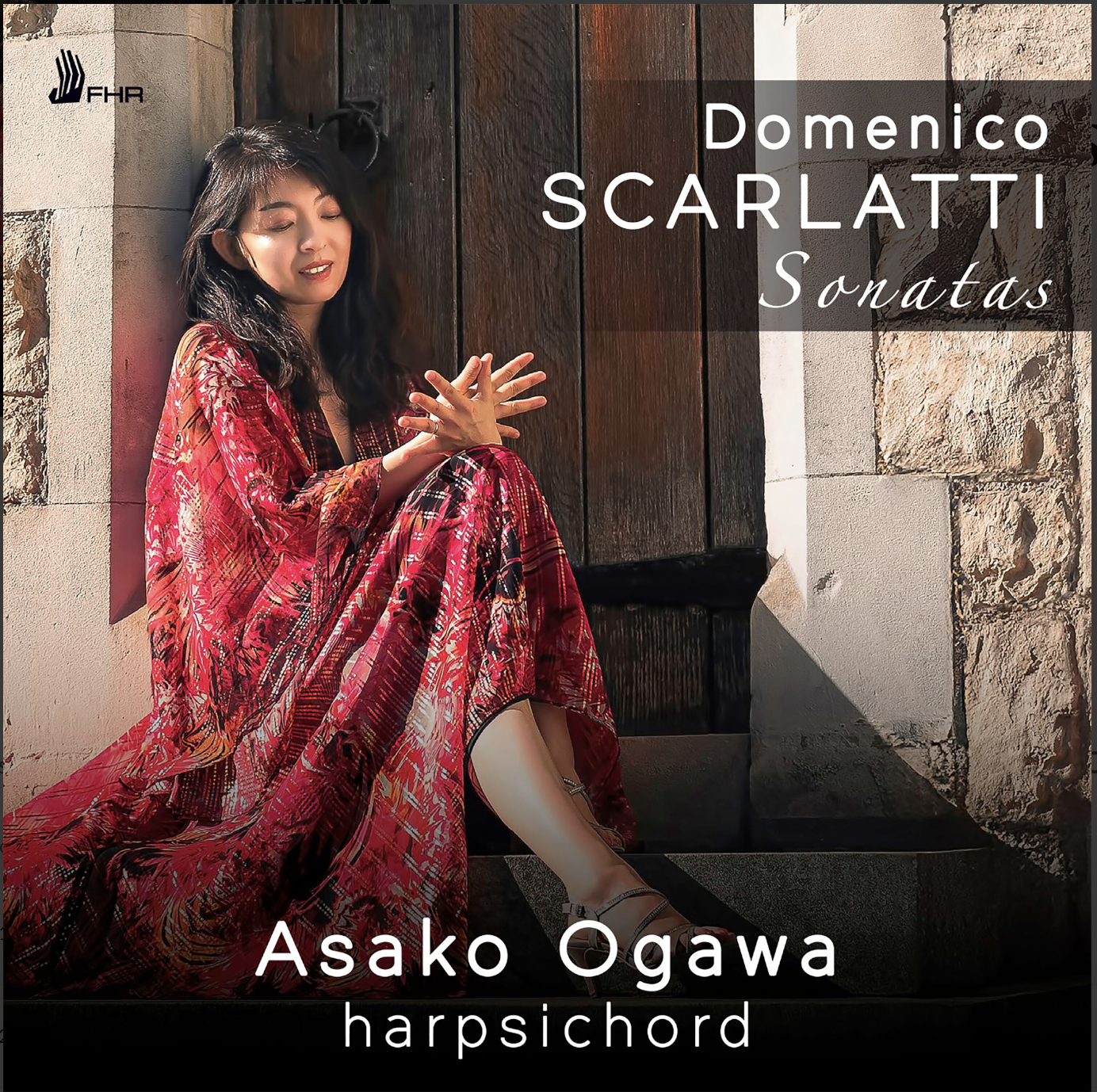
Asako Ogawa is a name new to me; this recital offers fifteen of Scarlatti's ~550 sonatas in a seventy-six and a half minute recital upon a single manual Clayson and Garrett harpsichord made in 1978, after a 1782 Florentine model. Previous to this on FHR, Ogawa has released a 2-CD set of Bach's Partitas and Handel's 8 "great" suites HWV 426-433; she's also released an album of Bach's Goldberg Variations.
The artist, who first studied piano and singing in Japan, later focused on historical performance in London at the Guildhall School.
The sound on offer here isn't the album's strongest component; it's a very clear and up-close album. I don't find the timbre of the instrument to be my favorite, but I think capturing a bit more of the room ambiance would have helped. In a slower sonata like Kk. 208, there's just a bit too much emphasis on the mechanical aspect to the instrument's sound. The recording also seems to put the upper register further from the lower, which at lower volumes isn't as noticeable.
Ogawa's technical capacity is never questioned as I enjoyed this album. Her conservative use of rubato helps in the D major Kk. 29 — a richly-composed sonata that responds well to careful phrasing.
Her technical ability is at the forefront of the popular and daring D minor sonata, Kk. 141. Again, small rubato influence helps the music sound more organic and less mechanical. The more intimate G major sonata, Kk. 146 also benefits from her strong technical skill. I was left to wonder what a listener would have made of the upward spiraling chromatic runs.
I also enjoyed the piece named "Cat's Fugue," Kk. 30. Despite the oddity of the subject, Scarlatti spins an interesting piece which again benefits from some care with phrasing, with Ogawa delivering.
What doesn't happen here is the artist slaving to present all the works with their keyed partner pair. I know there is some controversy whether or not Scarlatti envisioned his sonatas to be paired; in the case of the second and third tracks, we get two B minor sonatas, but their age and numbering suggest they must not have been conceived as such. Both are well-known sonatas: the first of this pair can be a challenge for finding the right pulse and mood, while the second is easier, interpretation-wise. The faster tempo works and as a pair, I think these two work too. It's Kk. 87, the first of the two B minor sonatas, that's played faster than I'm used to. It forces us to hear the work differently.
Michael Talbot, known for his Vivaldi scholarship, writes the liner notes and comments on this piece:
K87 is in slow tempo and triple time. Its meditative mood and effortlessly flowing counterpoint remind one of a Bach sarabande. Amazingly, it remains throughout in the home key of B minor, but passing feints at other keys impart a harmonic interest that compensates for the tonal stasis.
For me, this piece is great to convey the mood of a late, hazy-hot afternoon but that sentiment is lost in this interpretation. All that said, I think this faster rendition is an interesting interpretation that I am getting used to, the more I listen.
Ogawa does pair Kk. 466-467, both in F minor. The first is another Scarlatti favorite. This is one of the pieces that could benefit from different colors; on the piano this can be achieved with volume and touch. While touch is available to a harpsichordist, it's the kind of piece I'd try switching keyboards for a lighter sound in the repeats. While we don't get that, I found the interpretation solid. The second sonata makes a good pairing in my estimation for its quirky opening and contrasting (faster) style. It uses the same pedal point in the left hand as the first sonata, providing another link between the two. Ogawa's performance dazzles with this less-frequently performed sonata.
The album ends with a slower sonata, the Kk. 144 in G. It's an interesting piece for the harmonic shifts between major and minor made by the composer, which for me makes me think of changing views of sunlight and clouds reflected upon one's floor. The saccharine melodic material is enriched by these harmonic shifts, the texture pointing to guitars. The second half gets a tad more interesting, as we can see Scarlatti developing things. It's a clear sign he's foreshadowing classical sonata form.
Conclusions
This album for me does well to fulfill its intent, which I'm guessing is to help establish the musical strengths of the performer. Her choice to record "big" names, in Bach, Handel, and now Scarlatti, not only shows her serious intent, but also her love for the high baroque.
Ogawa's performances are not as dramatic as, say, Jean Rondeau's, but not everyone likes his approach. I am so glad she isn't aligned with — or content to be described as — a robotic or mechanical player, which can be how Scarlatti comes across sometimes on harpsichord.
Ogawa — without auditioning her other albums — is a player who listens and contributes her own hearing into the interpretation. She clearly is a talented musician and this generous album showcases her gifts through an interesting selection of well-known and less well-known sonatas.
While I often return to my Scott Ross collection for the full Scarlatti panorama, there's a strong case for the single-disc approach — Pierre Hantaï has made it work, and on the evidence here, Ogawa belongs in that company. This is a player worth following.