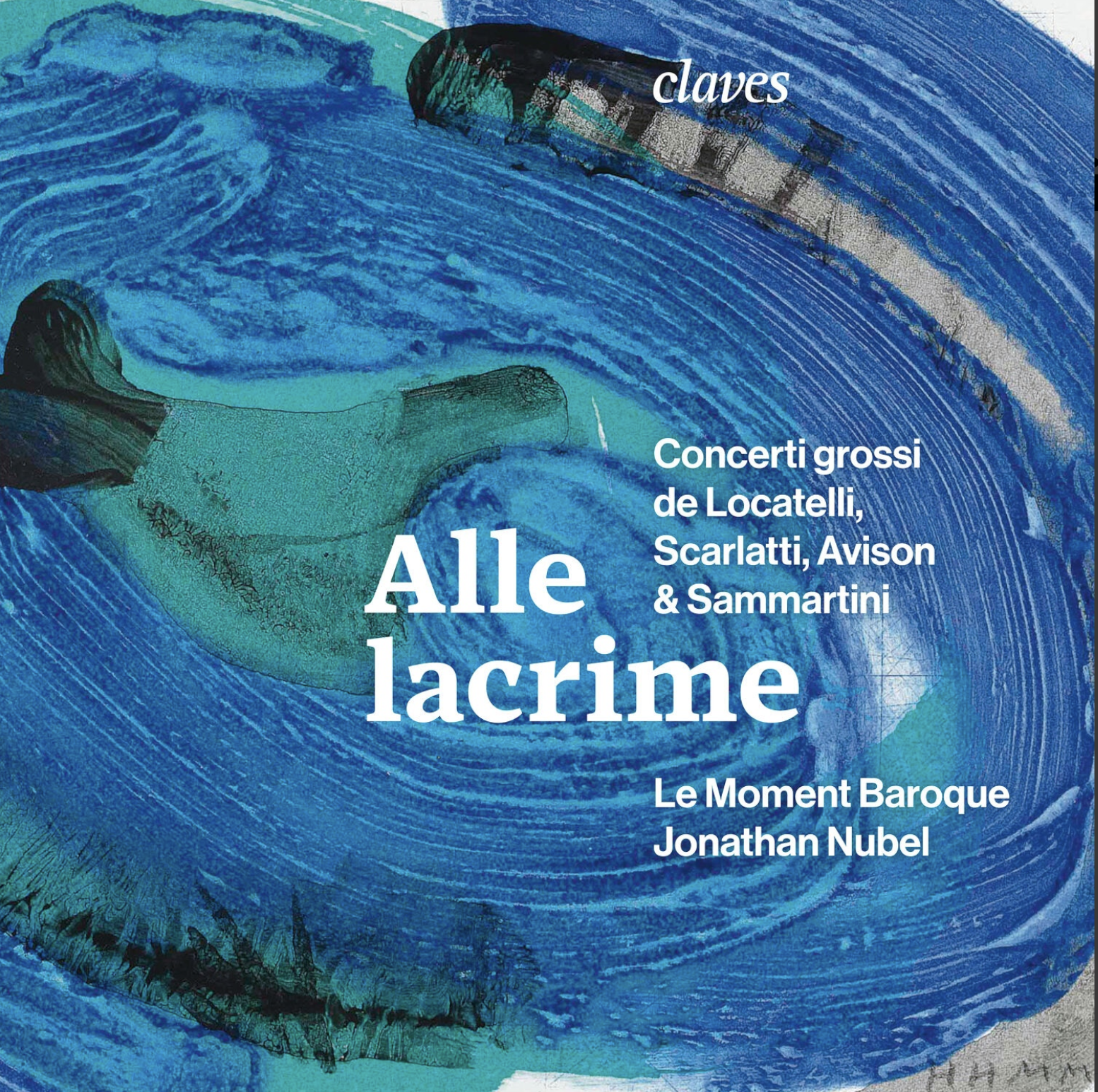
Alle lacrime - Concerti Grossi • Le Moment Baroque
Six concerti grossi here — multi-movement works for string ensemble whose solo passages differentiate the texture and set up a dialogue between players. The composers represented — Francesco Scarlatti, Avison, Locatelli, and Sammartini — each take their shot at the style Arcangelo Corelli made famous through the twelve concerti of his Op. 6.
The program is led by Jonathan Nubel on first violin. The title suggests tear-jerkers, but I read it as pointing to something larger: music's power to move us. Doing that through instrumental means alone was a defining ambition of what we now call the baroque aesthetic — composers setting out to challenge the voice's monopoly on the emotions.
The strongest contributions are the opening of Avison's D minor concerto, built from keyboard pieces by Domenico Scarlatti, and the closing Locatelli, his Op. 7 masterpiece Il Pianto d'Arianna — the retelling of Ariadne marooned on the rock. The famous setting Monteverdi wrote over a century earlier is here given to a violin. If ever a piece were built to argue for the power of instruments over the affections, it's this one.
Le Moment is a period ensemble, here eleven players. The recording, made in a Swiss Jesuit church, runs a touch too live for my taste, but producer Marie Delorme captures the concertino detail she needs to. The room amplifies a small band into a slightly larger sound than eleven musicians would suggest; on my system I hear more width than depth, though it's easy enough to settle into by the time the Scarlatti closes.
You likely already own these pieces, or could, across a range of recordings — but these performances hold up in that company. The violin playing is tight, the program well conceived as a survey of reactions to Corelli's model, and the inclusion of both harpsichord and theorbo was the right call.
I started with the sixteen-minute Locatelli, Ariadne's voice lent to Nubel's violin. My reference here is Concerto Köln's older Teldec disc; this one has the better sound, the theorbo's texture palpable enough to pull me in during a soft Andante. Nubel's playing is affectionate — some vibrato, strong dynamic contrast, nothing schmaltzy. The last movement is the hardest to bring off, the mood set for us to sit with the protagonist's plight, and here I wanted more, collectively, from ensemble and first violin alike. Fabio Biondi's 1995 recording is more direct and dramatic, the ensemble deployed as much as the solo line. Faust with Il Giardino Armonico (2023, Harmonia Mundi) takes the dynamic contrasts furthest of the three.
Many may think oboe when they hear Sammartini, and his A major concerto, Op. 2 No. 1, opens with writing that sets a stage with strings alone: big breaks of silence let the hall and ensemble establish what they can do together, the reverb tickling the ear before the second movement draws out the concertino.
The second Locatelli (Op. 1 No. 11 in C minor) contrasts nicely with the Op. 7 — a far more conservative four-movement design, its opening Largo giving the violin a singing line where Nubel's sound, intensified with vibrato, suits the dramatic backdrop. The remaining movements follow dances: Allemanda, Sarabanda, Giga. The Allemanda pulls hard from Corelli's harmonic language, and the ensemble finds a good groove; the Sarabanda plays with call-and-response between concertino and tutti; the Giga balances tempo and the concertino–ensemble division well.
The opening Scarlatti concerto is misattributed in my software to Alessandro — the elder brother, and of course Domenico's father. The F major concerto runs to five movements, and the liner notes untangle the attribution, citing a 2016 Talbot article that assigns it to Domenico's uncle Francesco. It has a cheerful, bright character with a Corellian scent, without his harmonic formulae.
Conclusions
The album does well to gather string pieces that carry Corelli's tradition forward. At just over an hour, I might have suggested opening with one of Corelli's own archetypes. There are, of course, plenty of fine Op. 6 recordings already.
Le Moment lean conservative here, which doesn't mean dull. Many will find these interpretations just right, in the Goldilocks sense — and rightly so: these aren't vehicles for a soloist, and you don't want show-offs in the ensemble. The formal structures that make a concerto grosso are observed and communicated cleanly.
The sound sits on the cusp of too live, but its virtue, as I said, is immersion. On headphones the effect was stranger — I felt seated at the center of the ensemble, an odd trick of the mind that held my attention for a while. On speakers the sound is generous, and the concertino violins have just the right transparency and focus.
I hope for more from this ensemble. Many will already own some of these pieces, but the disc works as a program, and these performances — the Avison above all — stand on their own legs.