Mozart: Complete Flute Quartets • Besson
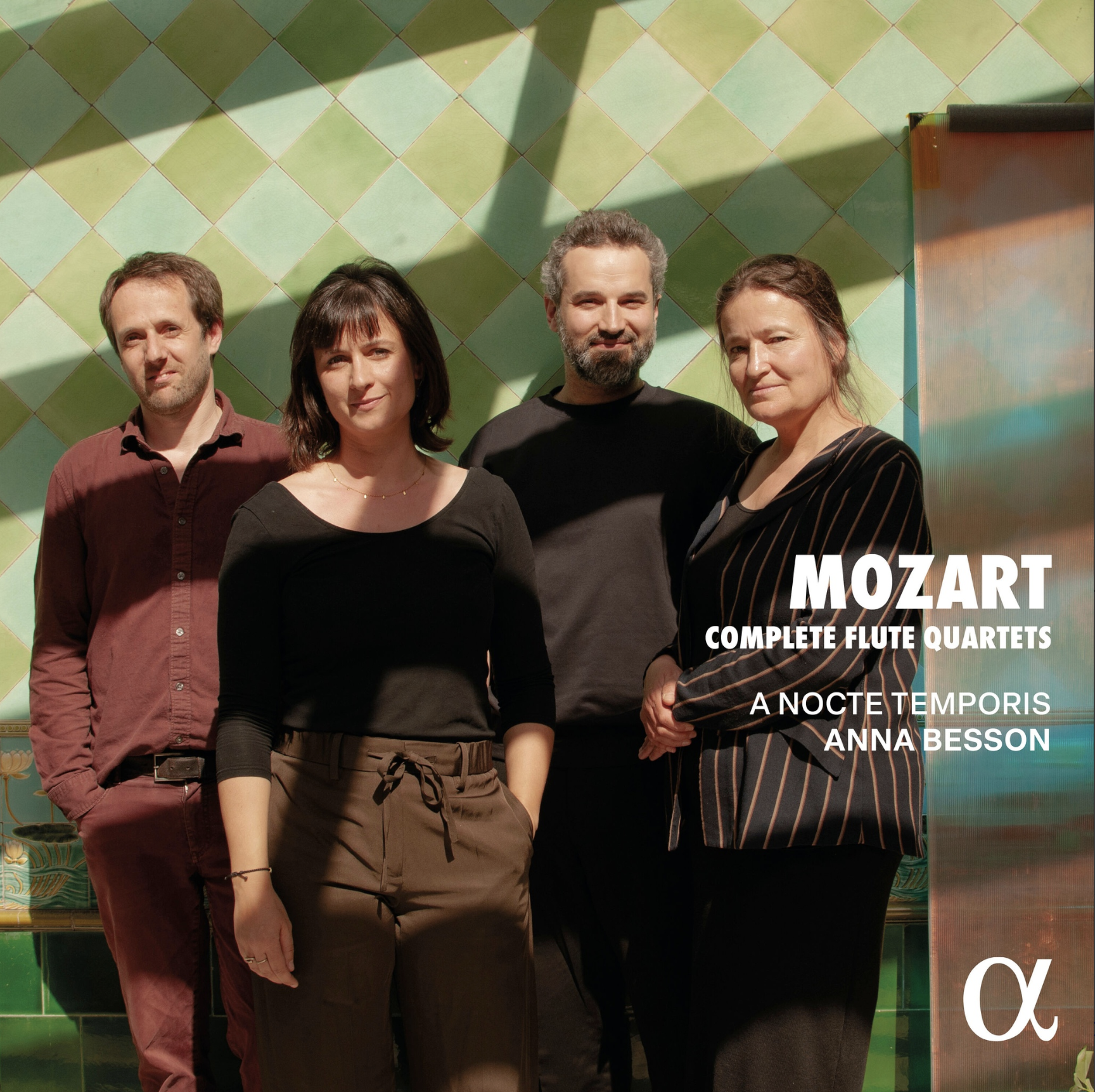
Mozart's "Complete" flute quartets may be a misnomer, as we may not have everything he wrote; what's offered here are 10 tracks' worth, with a bonus of an arrangement made by Hoffmeister of one of Mozart's piano sonatas. The nearly 70-minute program is led by Anna Besson, one of the foremost period flautists. She's joined by Louis Créac'h (violin), Manuela Bucher (viola), and Ronan Kernoa (cello), who together make up A Nocte Temporis.
The liner notes by Nicolas Derny are excellent, offering context for these five works. The sound presented is ideal, for me — I feel as though the four musicians are with me in my living room.
The C major work is written in two movements: the second, the longest track on the disc, is a theme with variations. The music has a lightness to it, suggesting occasional use. Besson mentions first playing these pieces on a Nile River cruise at a young age; one can't help but see the music in service of an event or as entertainment. For me, the music has clever moments but never rises toward something profound, despite being finely written. The variations thankfully don't all lead with flute; the opportunity for other players to pop from the texture was a smart compositional move by Mozart. It's the first work on the disc and showcases the great balance among the quartet.
The A major work, too, opens with a theme and variations, setting up the texture straightaway, flute in the lead and strings accompanying. The flute part suggests this piece is for a somewhat more advanced performer. It still conveys much of the stylistic imprint of the C major work. There's that element of cleverness that makes Mozart so irresistible, present again in his cavalcade of variations. It's quite a departure from the baroque aesthetic, but it's nevertheless the equivalent of aesthetic fashion rendered in sound.
The opening movement is followed by a menuet-trio and then a rondeau. The flute still maintains the limelight through the light dramatic shifts offered by the composer.
The Hoffmeister arrangement, we're told, was included for its slow movement. It's the most rhetorical of the pieces here, and it's presented gorgeously. Going back and forth between the piano original and this arrangement, the quartet version is an improvement!
I really got into Besson's tone and the personality that emerges in the third movement. Hoffmeister shows his own strong compositional abilities in how he trades phrases between the flute and violin. It's difficult to hear this as an arrangement — it works so well as played here.
The opening of the D major work, wrought in three movements, reveals a bit more of Mozart’s higher art. This one made me think a bit more of his string quartets in the opening Allegro’s formality and structure.
In the end, I can't imagine these pieces sounding better or being better performed. The tempo choices, the blending and balance, and the dynamic range all serve the music well. For me, auditioning other recordings on a modern flute robs the music of some of its charms. A period flute offers a warmer, more palpable sound, one that ultimately blends better with strings.
For all these superlatives, much of this music is, for me, a tad light on depth. There are moments where Mozart develops the thematic ideas, but — as with the opening work — the results are not profound.
Mozart had the capacity to write deeper, more interesting music. The D major work, K. 285, is likely the most finely composed, a step away from entertainment and toward higher art. While we may not be certain of the function of all of these pieces, they are remarkable for their style and elegance.