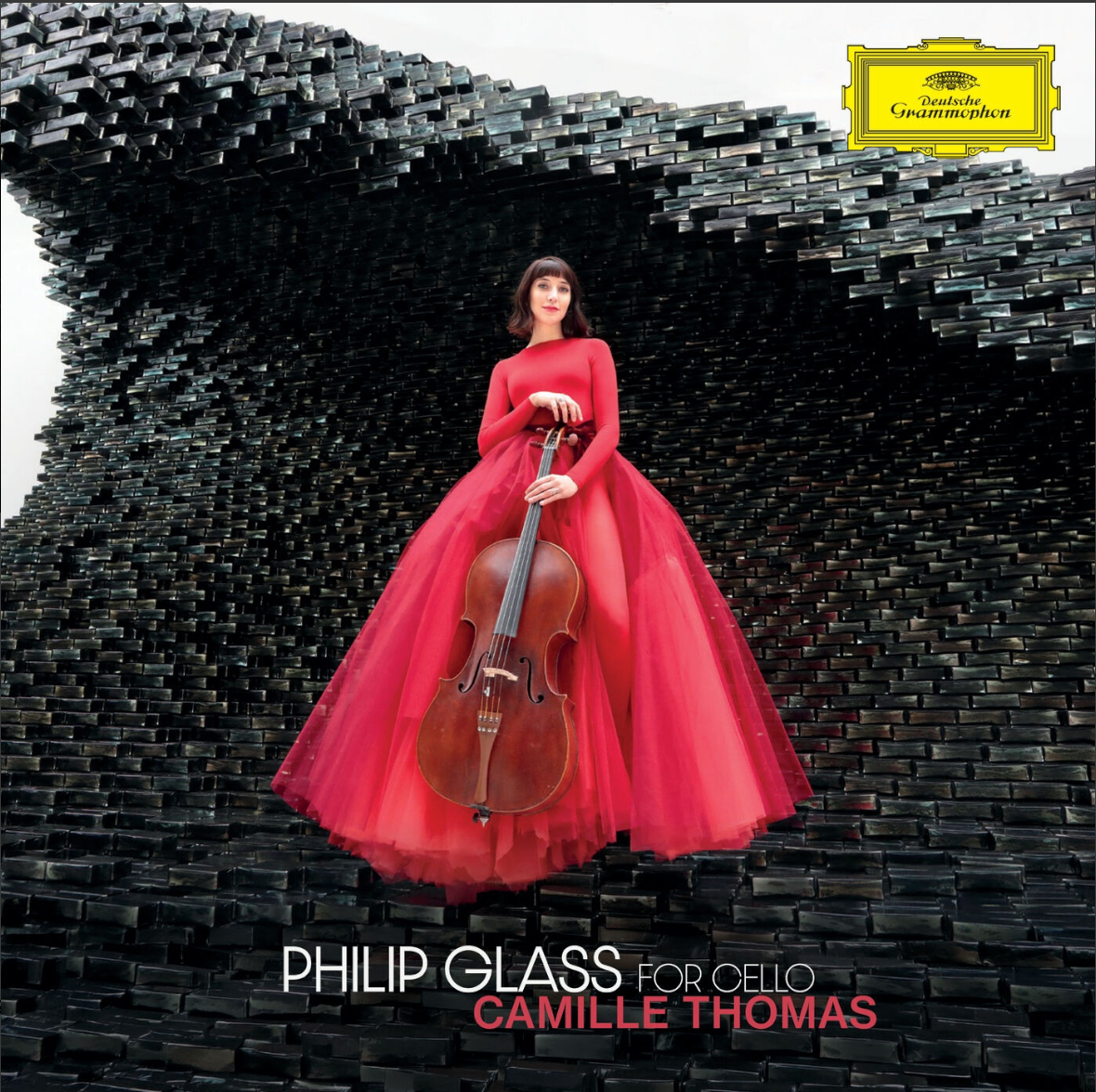
Philip Glass for Cello • Camille Thomas
The music of Philip Glass includes a substantial body of work for cello: a concerto, a second concerto drawn from his film score to Naqoyqatsi, the Songs and Poems for Solo Cello, Orbit for solo cello, and likely others I'm forgetting.
This double set — 21 tracks, 1 hour 43 minutes — presents the cello in many guises. A good deal of it is arranged: The Poet Acts from The Hours, several of the piano Etudes, Truman Sleeps. Both concertos are here, backed by the Brussels Philharmonic under Oscar Jockel.
Several things recommend the album. It spans a wide range of Glass's output and so serves as a representative portrait of his style. For cello lovers, every track features the instrument, and Symphony for Eight — Elias Arizcuren's octet arrangement of Glass's Third Symphony, approved by the composer and premiered in 1999 — piles on still more of it. The orchestral playing is fine and well captured. And the sound throughout supports the music with a wide dynamic range.
The Cello Concerto No. 1 opens on track 19 of 21, and you may not immediately register it as Glass. It was written in 2001 — commissioned to mark Julian Lloyd Webber's fiftieth birthday, and premiered that October at the Beijing Music Festival with Lloyd Webber and the China Philharmonic under Yu Long. The repetition is there, as it always is with Glass, but the formal structure is more complex to our ears. After the opening, a new section takes over rather abruptly and the signature style emerges. Percussion and brass break through the orchestral fabric. Thomas competes well for attention against the orchestral forces, applying a lovely tone through the upper register with a singing vibrato. The middle slow movement recalls the spirit of Glass's film music, and more of that gorgeous tone follows when the spotlight lands on the cellist. Glass brings in more percussion; the triangle sparkles as it did in the opening movement. The finale, marked fast, takes some time to take off. Brass again adds texture where the cello part is mostly mechanical in nature. It's a nice buildup of energy.
Etude No. 2 is arranged here for solo cello and eight celli. I'd say this version betters the one for piano. The players blend well, with the soloist — Thomas — emerging from the texture. The sixteenth Etude is scored for the same forces and is, for me, less successful; it's the one track where I wanted less vibrato.
The Naqoyqatsi concerto is spread across 11 named movements and takes nearly 41 minutes. I've never seen the film, though I recognize it as part of a trilogy, and I can still remember seeing the first and best known of them, Koyaanisqatsi. I prefer that music to this, but in both cases the music survives without the visuals. (Do see the films if you've never put yourself in the way of something that marries Glass's music to a similar spirit in image.) The success of this piece rests with the orchestra, if you ask me. Jockel and the Brussels players capture the spirit of Glass's music well, with a great range of dynamics and real low-frequency energy in the recording. Massman (track 4) is a favorite movement, for no better reason than that the chord progression reminds me of something out of a Bond film. The “suite” as I’m calling it has quite a bit of variety throughout which should help maintain interest.
Conclusions
If you don't like Glass, skip this album; no further explanation required. For Glass admirers, it's well performed by all involved. Even if you know some of these pieces, the arrangements — the piano Etudes, the selections from the popular film scores —offer a new take.