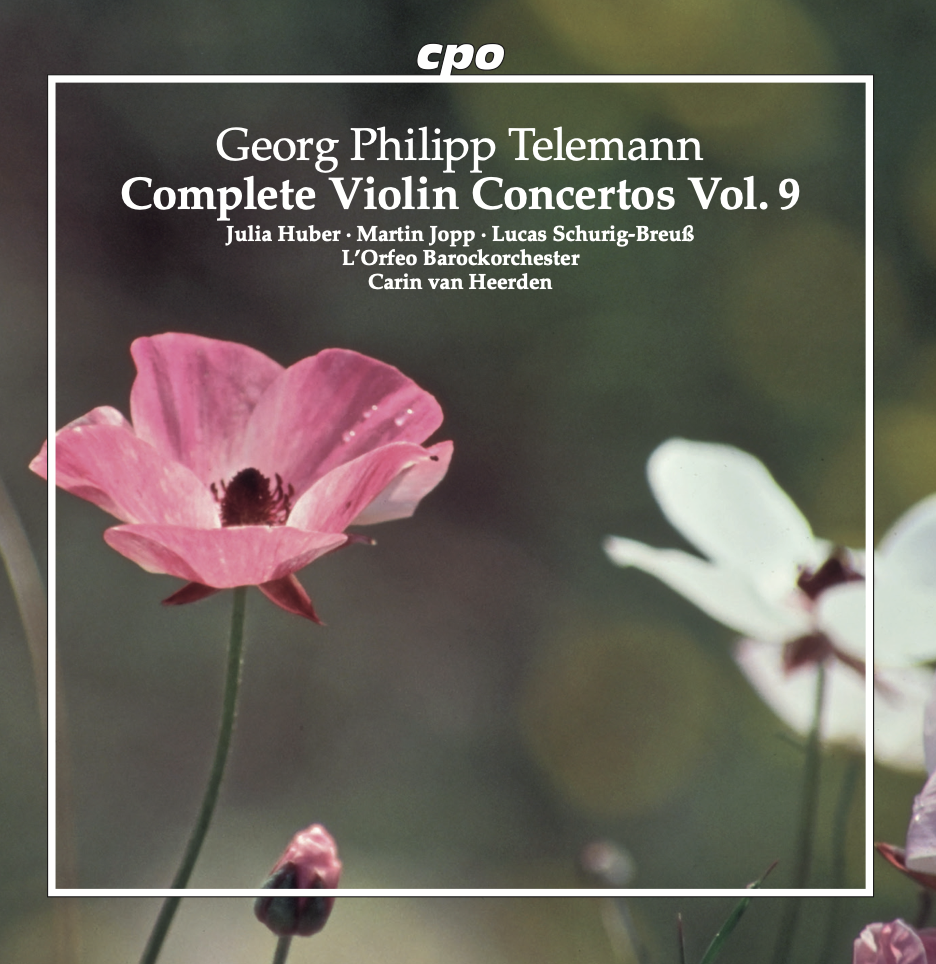
Telemann: Complete Violin Concertos, opus 9
I have collected a number of recordings that belong to CPO’s Telemann collection; like the Vivaldi effort on Naïve Classics, the Telemann recordings have featured different ensembles. In this case, L’Orfeo Barockorchester continue with the last installment.
The effort this time around includes more than violin concertos, including the famous G major concerto for viola, TSV 51:G9. The soloist here is Lucas Schurig-Breuß who does an admirable job. The third movement I might have preferred a touch faster, but his tone left nothing to be desired, offering a great example of how to phrase without vibrato to an effective end.
The remainder of the works include violinists Julia Huber-Warzecha and Martin Jopp. The two play together in the opening concerto in D, TWV 52:D3 for two violins. Telemann’s concertos, for what it’s worth, are always interesting for their departure from the three-movement Venetian models that were adopted by Bach. In so doing, for me, I find them sometimes a bit surprising in approach; this concerto that opens the CD is an excellent example. The second track, marked Vivace is full of energy and a nice combination of the two instruments, but it’s all over within the span of two minutes!
Telemann by large liked four-movement concertos, and this recording includes TWV 52:C2 and A2 which are written in three movements, in addition to the Quartet in E minor, TWV 43:e5. The major concerto’s opening includes a strong rhythmic motif that dominates over purely melodic material. The flavor to me is not exactly Italian, nor French, which the composer is oft to visit stylistically. Huber and Jopp are both fine players, maybe not as dominating as Reinhard Goebel was in his recordings of Telemann, especially so the earlier ones, which I often found to be exciting and finely detailed. I found the slower movements here lacking imagination from the soloists: the Adagio from TWV 52:C2 is set in the minor mode, with a lot of exposure left to the two violins. There’s good playing, supported with sensitivity, but I just wanted a little more drama, either in terms of ornamentation or dynamic expression.
The opening of the concerto in G minor, TWV 51:g1, labeled as a concerto grosso has some surprising harmonic landings, which are great on their own, but I’d be looking for ways to exploit the surprises a bit more? The Largo made me think of a Corelli trio sonata, Telemann however breaks away from the pure Corellian chord progressions, offering some nice surprises, dramatic inflections in doing so. The violin writing is nice, the parts are well-played again, but given an opportunity, I would have pressed for a bit more inflection with dynamics to punch up the dissonances and their resolutions.
What becomes consistently clear is that L’Orfeo, directed by Carin van Heerden, excels in the faster movements. The ensemble in total has a great sound and I thought the recording caught the details well.
For those interested in collecting the entire set of violin concertos by Telemann, the booklet includes the complete listing of recordings across the nine volumes, the previous volumes featuring the Australian violinist, Elizabeth Wallfisch.