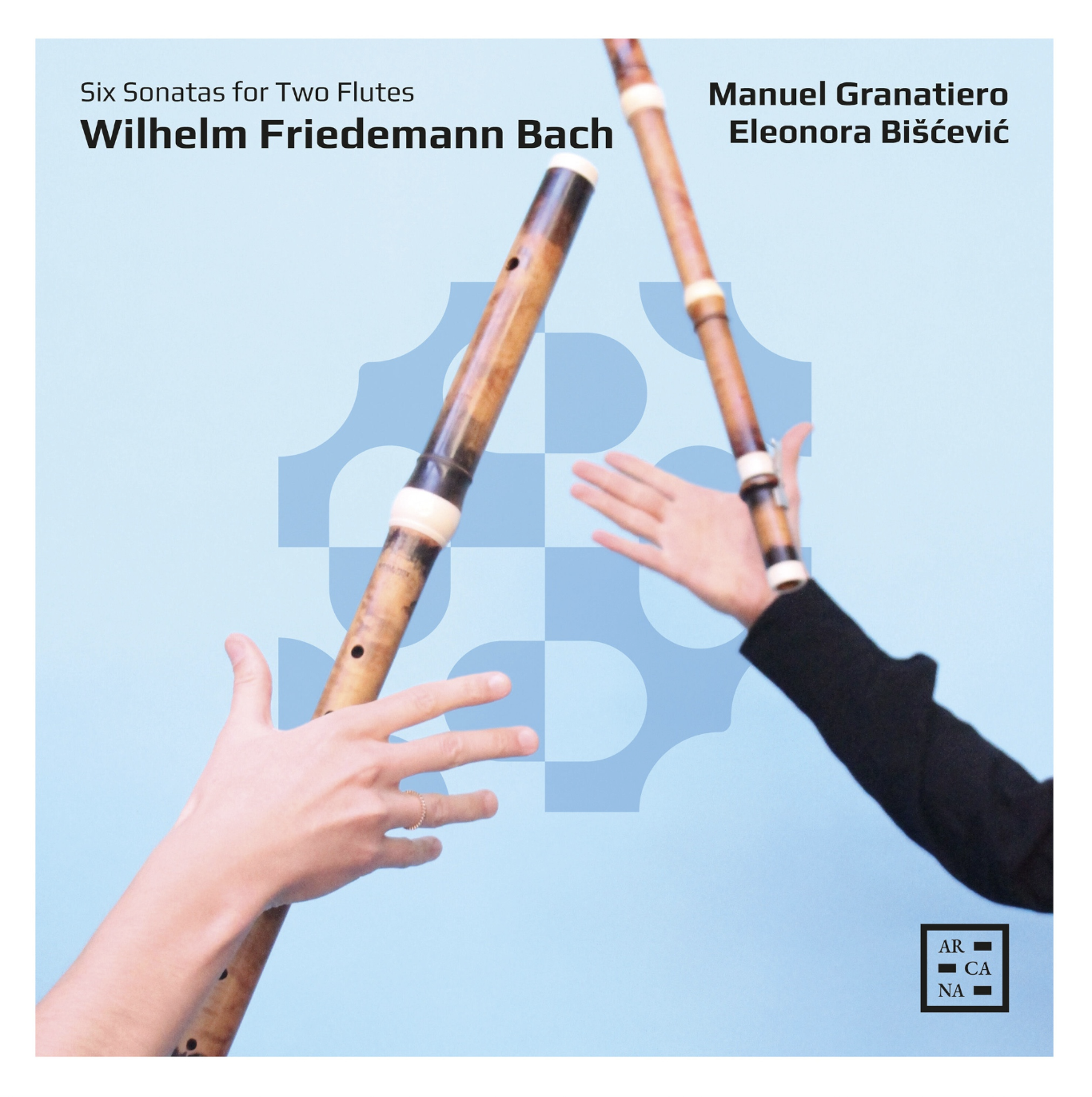
W.F. Bach: Six Sonatas for Two Flutes • Granatiero & Biščevič
Before auditioning this release, I was not familiar with W.F. Bach’s flute duets; the liner notes provide a good historical perspective, suggesting he was inspired by Telemann’s collections of duets. The pieces are described as challenging, and there are a number of challenges that are immediately audible, however the performances overall are outstanding, overcoming these challenges. The foremost is where and how to breathe! I tend to agree with this assessment: “This is music for virtuosos to play and for connoisseurs to appreciate.” The pieces exploit a strong dependence upon counterpoint. They’ve only been available since the first half of the twentieth century and their ultimate function or patron is unknown.
Five of the pieces presented here are in three movement formats; the first is presented in four with a large scale opening fast movement. The opening of the F major sonata (BR B4) immediately showcases the strong affinity of sound between the two flutes and players. The tone, articulation, and style of playing is so close I might have been convinced that each part is being played by the same person, using multi-track. Manuel Granatiero and Eleanora Biščevič make good musical partners.
The rising figures in the F major sonata about 2:40 in exploit harmonic tension; Bach does the same in many of the slow movements, passing the same musical material between the two parts in a deliciously connected way. In some cases you may marvel, as I did, in this sonata, how economically he creates a piece with a small amount of material. The way this is done is to pick short suggestive motives, those that seem to mimic human expression, then to repeat these, almost like two cats chasing one another in dance like fashion before us on our floor.
The same sonata’s slow movement again is built upon harmonic tension, with those chromatic colors offering a tasty flavor. It’s the type of piece that invites us to consider our tone and instrument timbre as players; as listeners its a journey to a dark and interesting place, one where we can take comfort in the soothing sounds of these instruments alone and how they support one another together. The sound reproduction is well done, I think, capturing enough of the closeness of the players with audible breathing but the environment in which they perform makes for a supporting backdrop.
The E minor sonata opens with a fast movement that made me think immediately of one of Willhelm’s dad’s inventions for two hands. That comparison isn’t quite fair; J.S. Bach’s son does more to take that format of exploiting the possibilities of a good theme and extends that idea into a more fully-developed composition. The concept of chasing and cat mischief comes back again. I can’t say with any authority that Willhelm Friedemann was thinking of playing animals in his writing, but it’s too easy for us to visualize the integration of the two flutes with visuals through his use of rhythmic pattern and repetition.
These same elements come into play in the last sonata (BR B3), in the ultimate movement (track 19). The juxtaposition of short notes with the longer is a simple rhythmic trick, but as simple as it may appear, the effect comes off to me as clever. Again and again throughout this recording, it’s highlighted how impressive this music is when it’s played by two musicians with similar and high levels of technical talent.
The opening track, which opens the G major sonata BR B6 for me gets a bit more expressive treatment from the musicians. It’s interesting how Bach builds this kinetic energy in the opening figure that we get multiple times with the music’s repeats. There’s certainly no shortage of notes, offering us a rich harmonic foundation without the use of a continuous bass.
The recording released back in 1993 by the Ricercar Consort featuring the same sonata features great stereo separation between the two flutes, with very competent playing; I’d go so far to say this newer recording surpasses it both sonically and in the way the two players are even more tightly aligned in sound and style.
These pieces were also explored by musicians on different instruments; the recording released in 2023 by Cho and Ham on oboe and flute is interesting for the contrast in timbres, but it’s played on modern instruments and for me, loses a bit of the color brought forth with period flutes.
I’m confident in saying this recording serves as a strong new standard reference for these pieces, showing no technical imperfection. Supportive sound and transparency only goes to help it earn a place on your top shelf.