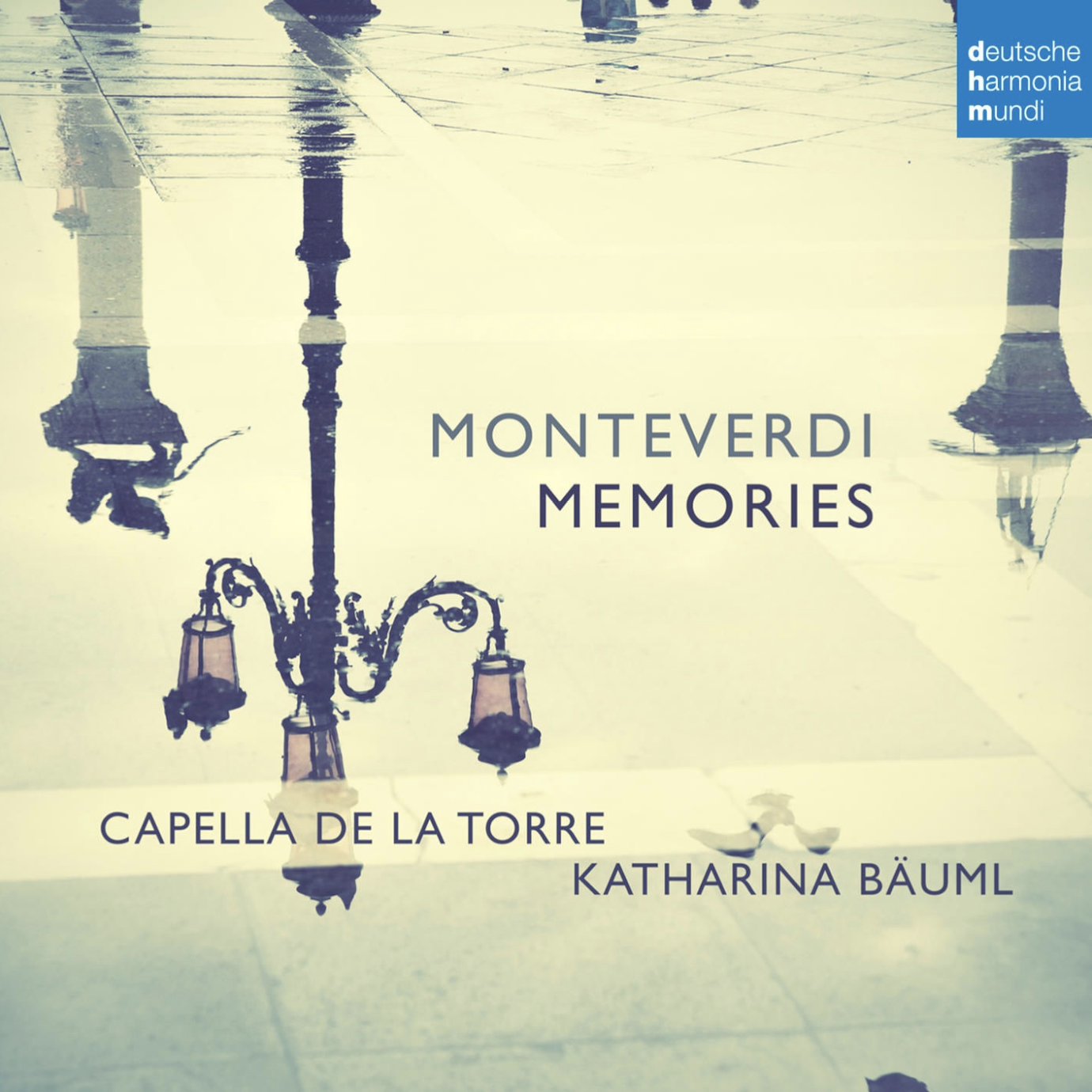
Monteverdi Memories • Capella de la Torre
Katharina Bäuml founded her ensemble, Capella de la Torre, featuring winds with continuo, back in 2005 and have become, in my eyes, a kind of similar ensemble one might set in the same genre as Pluhar’s L’Arpeggiata. The difference is, given their recordings, is that Capella de la Torre has been focused on earlier music than the repertoire performed by Pluhar.
In this release focused on the music of Claudio Monteverdi, featuring a small group of singers, the ensemble uses a number of colorful instruments, including cornetto, shawm, recorder, sackbuts, curtal, percussion, two violins, and continuo in the form of theorbos, organ, and violone. The recording was made back in 2021 in a Dresden church, and released in May of 2022.
In some cases, the pieces are “dressed up,” with the available musicians, offering more color or affect with percussion that may have originally come down to us from the composer. In the case of the Sonata sopra la Sancta Maria from Monteverdi’s Vespers of 1610, the voices are stripped completely. In Beatus vir, SV 268, a jazzy vibe comes to the fore with the addition of percussion. I’d characterize this album then, titled as “Memories,” as one we should expect the musicians to play a little loose with the most extreme measures of historical “authenticity.”
That said, this is a period ensemble, one that uses an appropriate vocal style for this repertoire, alongside period instruments. The opening percussion in track 15’s Giovinetta SV 241 provides a great signature for their recording space, which is spacious but also keeps a good bass kick in the way the instruments are captured. All these pieces wouldn’t have been performed in a space such as St. Mark’s in Venice, but the recording is close enough to the musicians to find a good compromise.
Il ballo delle ingrate comes from his collection of love and war madrigals, published in 1638. The opening music, clearly a dance with the strong beat, isn’t overly decorated. For a more “strait” performance, you might compare this to the recording from 2012 by Alessandrini’s Concerto Italiano. The German ensemble uses the repeated bass of this piece to provide a cavalcade of colors throughout the course of the piece.
One of my all time favorites of Monteverdi is his duet for two tenors, Zefiro Torna, a piece that very likely would have come across as very fashionable, using a dance ground bass to serve as the foundation for the two singers. Here, instruments play a larger role, and the singing part is realized by two sopranos. Given the subject, and my own recollection of Botticelli’s La Primavera, with the winds represented by females in that painting, I think this rendition has a lot of admirable character.
Another “guerreri et amorosi” themed madrigals is included, Volgendo il ciel per l’immortal, originally scored for 5 voices with 2 violins and basso continuo, but only the short instrumental introduction. There’s a very contemporary flair to the playing despite the instruments being used. It speaks to the ensemble’s commitment to move today’s audience, again, in much the way I’ve noticed L’Apreggiata evolve over time in a similar pursuit.
The difference here—I think—is that Pluhar usually capitalizes upon very strong soloists and highlights above all else the vocal numbers; this release directed by Bäuml is a bit more even in highlighting instruments alongside the sung pieces. Yet I found this album of “Monteverdi Memories” to be both well-played and an engaging listen while not straying too far from its historical roots.