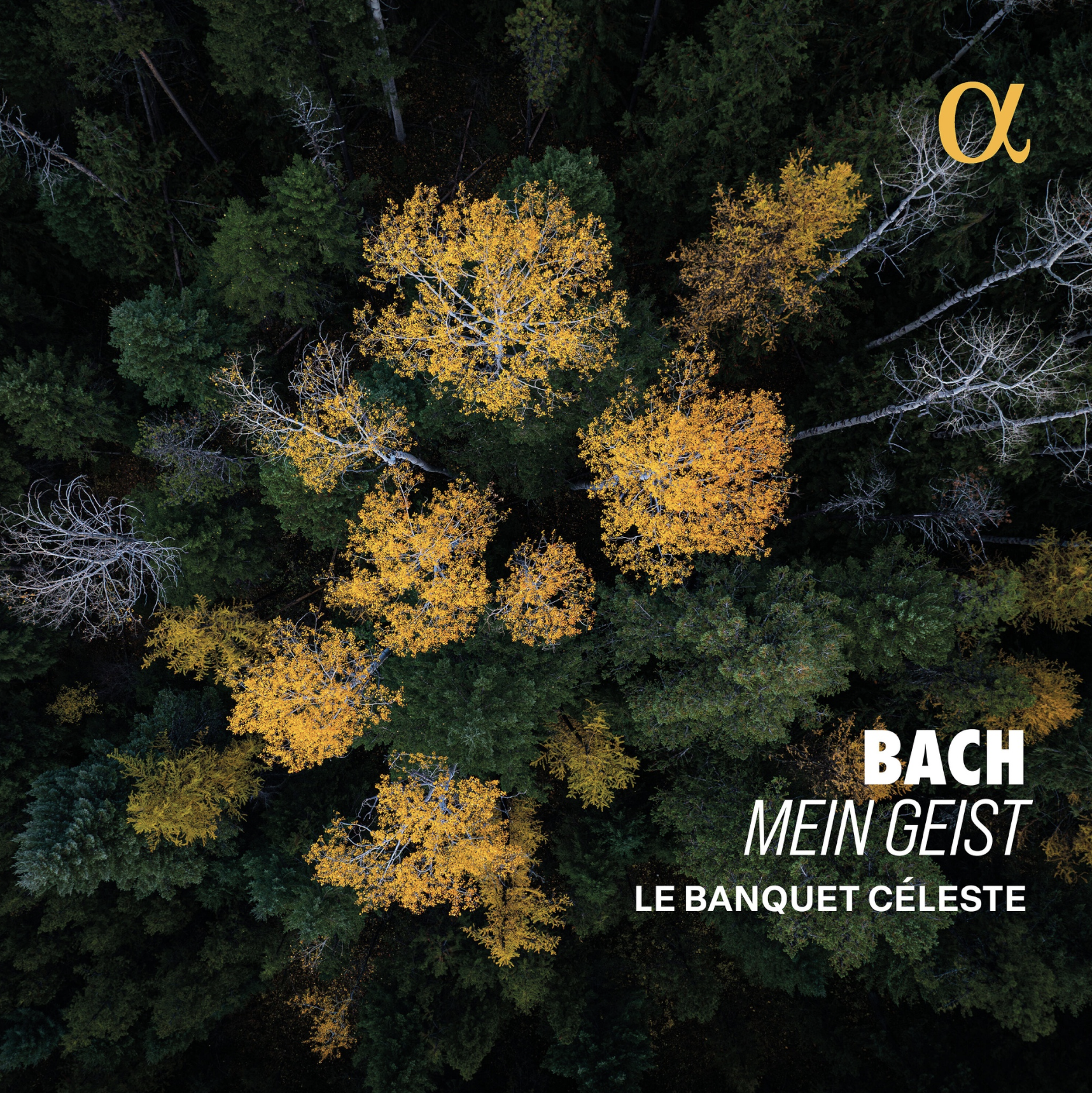
Bach - Mein Geist • Le Banquet Céleste
In the most recent review I did of Bach’s three works performed on two smaller cellos, one four-stringed and one five-stringed, I was a bit influenced by the commentary in the liner notes of this release: two cantatas featuring the violoncello piccolo and a performance of Bach’s sixth cello suite. It may seem an odd pairing, cantatas and the secular suite for cello, although the artists don’t necessarily see the suite as a completely secular production. One can argue that as pervasive as religion was in Bach’s society, a distinction between sacred and secular may not have really entered into one’s mind.
The cello suite is performed well by Julien Barre; I’d have liked to have heard both the Allemande and Gavottes a bit faster. The instrument used has a great tone, making the use of a 5-stringed instrument a convincing choice. This may not eclipse my favorite performance by Pieter Wispelwey, but it’s nicely done and the tone he pushes out of the instrument is quite nice throughout.
The vocal soloists in this production include Céline Scheen, soprano; Alexander Chance, alto (son of Michael Chance, whom I got to hear at the Boston Early Music Festival); Thomas Hobbs, tenor (whom appears frequently in Bach recordings); and Benoît Arnould, bass. I am not the biggest fan of Hobb’s voice, in his use of vibrato specifically. The album adheres to a one-per-part association for the voices in lieu of using a choir.
Arnould opens with the first aria in BWV 85 and too uses vibrato; the second aria featuring the cello is sung by Chance, who too uses vibrato. The most successful of these for me is Chance, where it comes out in the longer notes offering some warmth to the sound of his clear voice. The tenor gets a recitative and aria, and I listened multiple times to try and identify why the voice bothers me. I think its the rate by which his voice vibrates, which is just a tad faster than the other men. In any case, the voices mix well in the two choral movements.
The opening of BWV 115 is colorful, with inclusion of double reeds and flute. The balance in the recording between the instruments and vocalists is good, but I don’t know how that would translate to sitting within a practical church environment. For instance, I can’t really say if the vocalists are in front of or behind the instrumentalists; they sound integrated, which is nice.
That balance is broken a bit in the first aria, sung confidently by Alexander Chance. His approach is an affective one, holding back vibrato enough on key words, using the vibration to intensify the text. The approach with each solo, starting with this one, is to put the soloist out front, the effect being that the voices have more bite and clarity than the instruments. The third movement’s recitative by Benoît Arnould is well done.
This cantata’s star movement is the duet between flute and cello in an aria for soprano. I’m not used to hearing this aria performed this slowly. In faster performances the flute part takes on a jazzy feel sometimes, that’s left behind here. I think the tempo used here doesn’t steal anything from the charm of the piece. The dark tone of the flute, played by Jean Bregnac against the violoncello piccolo makes for a great sonic pairing.
The final chorus brings back the blend of instruments and voices tightly integrated.
The felt this album suffers a bit with considerable “air” audible before the musicians are heard. It doesn’t really detract from one’s enjoyment of the music making, but when listening with headphones it does inject a bit of distance between us and the music, a layer that would I have preferred be absent. To the credit of this recording, which I compared with other performances within my collection, the benefits of a one-per-part performance in terms of purity and clarity came across clearly, certainly making the case for why one might want to own another version of these two cantatas. The layer of “air” in the sound wasn’t as nearly profound in the capture of Julien Barre on the cello. In that performance we are quite a bit closer to the artist. Some may prefer to hear less of the fingers slapping the fingerboard, but the effect, at least, is less forward than it was on the earlier recording by some years made by Bruno Cocset. If I had to choose, I’d like a close and personal account rather than one made from the back of the hall or church.
I’m not sure I liked this release as much as I did with their earlier recordings under the direction of Damien Guillon. For better or worse, they continue a tradition of presenting Bach’s cantatas alongside other works. If you liked those earlier productions, this one, despite an updated look to the cover, follows in the tradition. The instrumental contributions are always strong, and the one-per-part approach with voices offers the ultimate in vocal transparency.