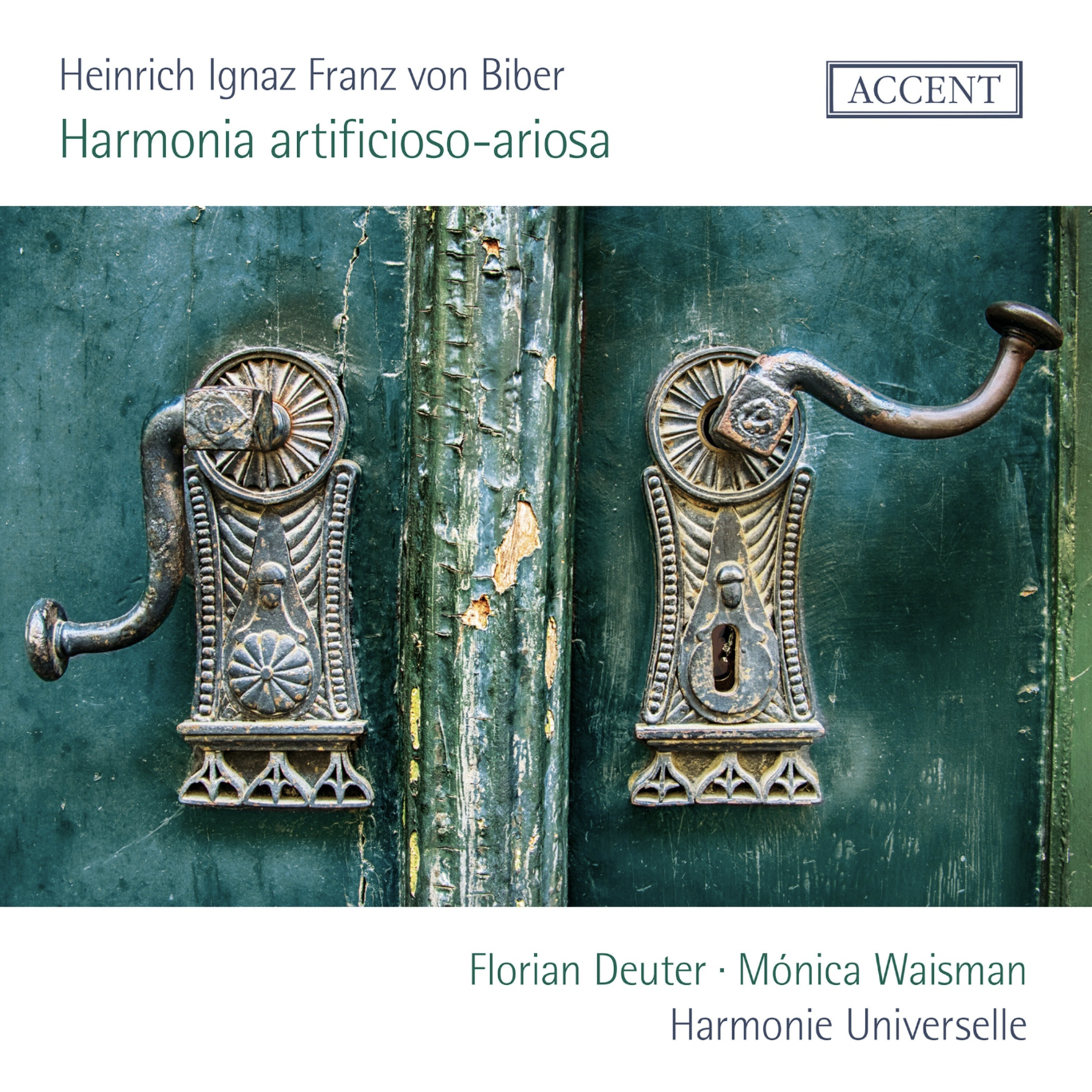
Revisiting Biber's Harmonia Artificioso-Ariosa
Introduction
This music was published in modern times (1956) as part of the Denkmäler der Tonkunst in Österreich, a red-bound series I encountered in the Kulas Library at CWRU during my graduate days. The collection consists of seven pieces called Partias, a term later used by Bach as well (though he spelled it partita), essentially meaning a suite. The modern edition presents the parts at sounding pitch rather than written scordatura notation, which is helpful for analysis. The original collection was published in 1696 in three partbooks.
The collection is remarkable, not only for its inventive variety of themes and rhythms, but because it is clearly music written to showcase the talents of two strong protagonists.
The first suite is written for two violins in scordatura with basso continuo. The violin parts are virtuosic, requiring extensive double and triple stopping, and the piece is constructed with a great deal of contrapuntal writing—not only between the violins, but also with the continuo. The following movements qualify as dances.
The second suite is again written for two scordatura violins and continuo. Like the opening of the first piece, there are repeated figures for the ensemble, delivered emphatically and likely intended for rhetorical effect.
The third suite continues with the same scoring and devices. The fourth changes instrumentation, replacing one violin with a viola; both instruments remain in scordatura. The fifth and sixth partias return to two scordatura violins. It is in the seventh and final suite that Biber writes for two viola d’amore in scordatura. This conclusion is unusual both for its instrumentation and for the way the collection culminates in this distinct sonic world.
Among all the movements, the one that stands out is, of course, the final Arietta variata from the seventh partia. Built upon a ground bass, it belongs in the pantheon of great ground-bass compositions, surpassing even the Passacaglia of the “Guardian Angel,” and while less complex than J.S. Bach’s C-minor Passacaglia for organ, it remains a profound piece of music. It serves as one way to differentiate between the various recorded versions discussed below.
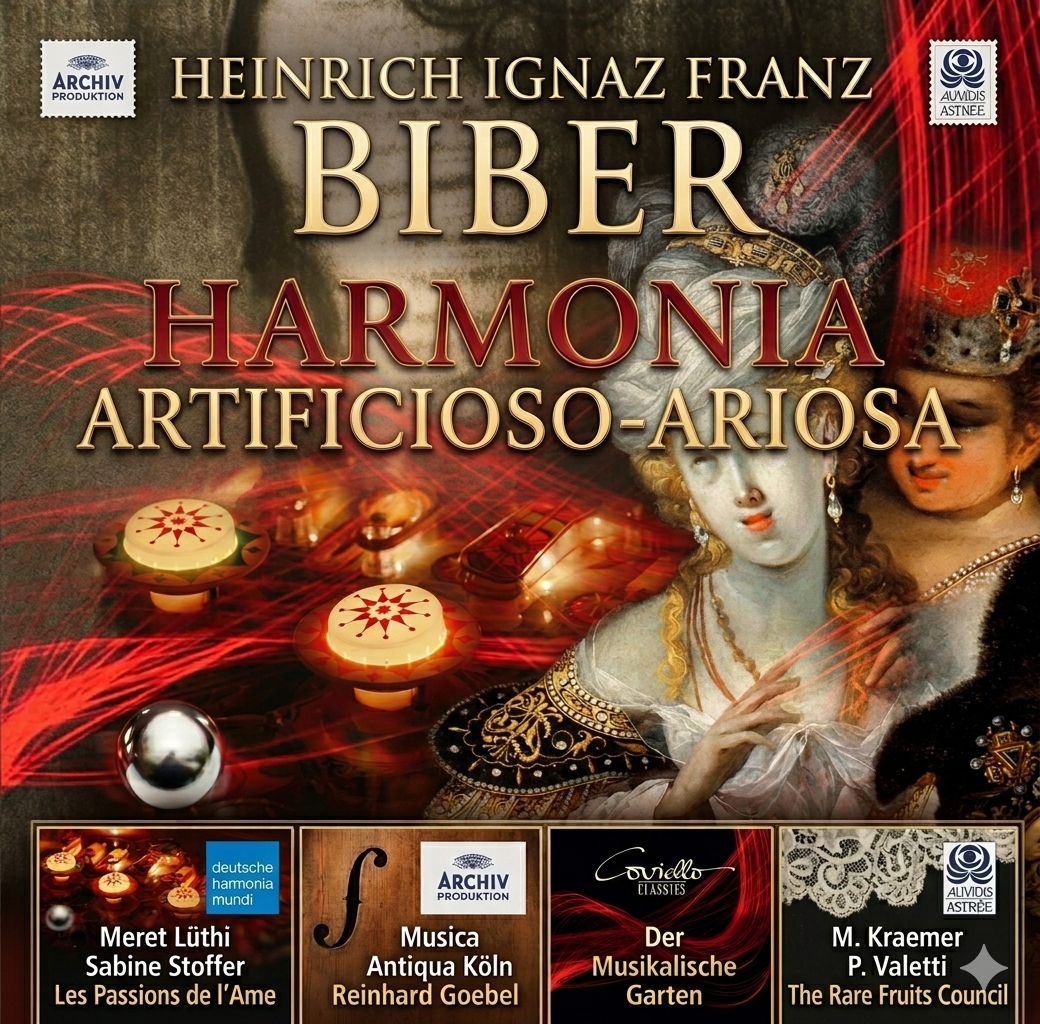
My introduction to this collection came by way of the recording on Chandos Chaconne by the Purcell Quartet (1994). The recording was not bad, but there is a cautious component to the performers’ approach. Some might call it polite. Other major recordings include performances by:
- The Rare Fruits Council (Astrée Audivis – 1996)
- Musica Antiqua Köln (Archiv – 2004)
- Der Musikalische Garten (Coviello Classics – 2020)
- Les Passions de l’Âme (Deutsche Harmonia Mundi – 2021)
- La Tempesta (NoMad Music – 2015)
- Tafelmusik (Sony Vivarte – 1994)
I’ve been listening to the MAK version in my car for a week now, reacquainting myself with both the work and Goebel’s performance, following my extended familiarity with their recording of Mensa Sonora, another ensemble collection by Biber. While the MAK recording of Mensa Sonora has, in my opinion, no peer, their 2004 recording of this work—released just three years before the ensemble disbanded—has aspects that feel less comfortable.
In his liner notes, Goebel argues for specific choices regarding tempo, repeats, and continuo forces, leaning into the idea that “simpler is better.” He argues that no clear contemporary sources call for multiple continuo players, and accordingly uses cello and harpsichord for most of the work, and solo harpsichord for the last partia, which he suggests aligns with the composer’s original intentions.
My assessment of Goebel’s version is that some movements feel unnecessarily stiff, forcing the music awkwardly into the chosen tempo. Yet there remain remarkable moments of enjoyment despite these reservations.
For many years, my next go-to recording was the remarkable version by the Rare Fruits Council, founded by former MAK violinist Manfredo Kraemer. The ensemble seems very capable of digging into the drama of the work, allowing their ears and hearts to guide the interpretation in ways the Purcell Quartet did not fully achieve.
The version I am least familiar with is Tafelmusik’s. Right out of the gate, the recording’s wide stereo image is appealing, although we never get especially close to the musicians. Their approach has an appealing lightness.
More recently, the recordings by Der Musikalische Garten and Les Passions de l’Âme have been exciting additions. Patrick Bismuth’s La Tempesta offers interesting interpretive moments, but the acoustics make it a difficult listen.
Comparisons
Rare Fruits Council
Among the recordings, these players are speed demons, performing the last movement in 5:20. The fuller basso continuo adds weight and presence. Their playing is technically sharp, and sometimes comes across as masculine and edgy. I like that.
Tafelmusik
This version clocks in at 6:05, right in the middle. It is competent but misses some of the work’s dramatic depth.
Purcell Quartet
Opening solemnly and lasting 7:18, this is a version I enjoy when I want to relax in a dark room. The performance lacks dynamic contrast, though there is nuance in the upper parts. Each return to the bass alone, however, feels like a missed opportunity to terrace the rhetorical drama.
Der Musikalische Garten
This is a strong companion to the Purcell performance. The bass is articulated with more space, unlike Purcell’s legato approach. They also benefit from a quicker tempo at 5:56. The continuo maintains smoothness while the upper parts gain shape, dynamics, and expressive affect. There is particularly impressive playing around 2:30–2:45.
La Tempesta
This performance lasts nearly seven minutes. There is audible clicking at the opening—possibly from the organ, though I cannot be certain. Bismuth is among the most dramatic Baroque interpreters, but the large acoustic space and distant microphone placement make appreciation difficult.
Les Passions de l’Âme
Meret Lüthi’s ensemble clocks in just seconds faster than La Tempesta. Their continuo is far richer, employing multiple harpsichords, organs, various lutes, dulcimer, and percussion.
The opening of the Arietta is solemn, but the music gradually gathers energy. The addition of violone provides depth. The performance is dynamic, and yes, even fun.
Musica Antiqua Köln
The opening, lasting 7:03 and performed on solo harpsichord, feels slow after hearing other versions. Goebel’s tone remains extraordinary, enhanced by his instruments. While I admire the upper voice, the performance falters somewhat until around 4:20, when articulation improves and the ensemble coherence strengthens.
Conclusions
We know enough about Biber to recognize that he was among the finest string players of his day. What cannot easily be captured in written accounts of performance is preserved in his compositions. His music is extraordinarily demanding, requiring not only exceptional technique but also interpretive insight.
There is much to admire throughout the collection beyond the final Arietta variata. Among the recordings discussed, each offers something valuable. But if I were to recommend a reference version, the 2021 recording by Les Passions de l’Âme stands out. Despite the odd pinball artwork, it offers richness, interpretive imagination, and superb recorded sound. Whether their elaborate continuo aligns with Biber’s original intentions is uncertain, but the results are compelling.
The Rare Fruits Council and Der Musikalische Garten are excellent runners-up. Those seeking the ultimate Arietta performance may also wish to explore Il Giardino Armonico’s recording of the seventh partia. Goebel suggests the final work may have been composed with Biber’s daughter in mind—a convent musician and virtuoso in her own right.