Empfindsamkeit - Music for Piano and Flute • Arnaud de Pasquale
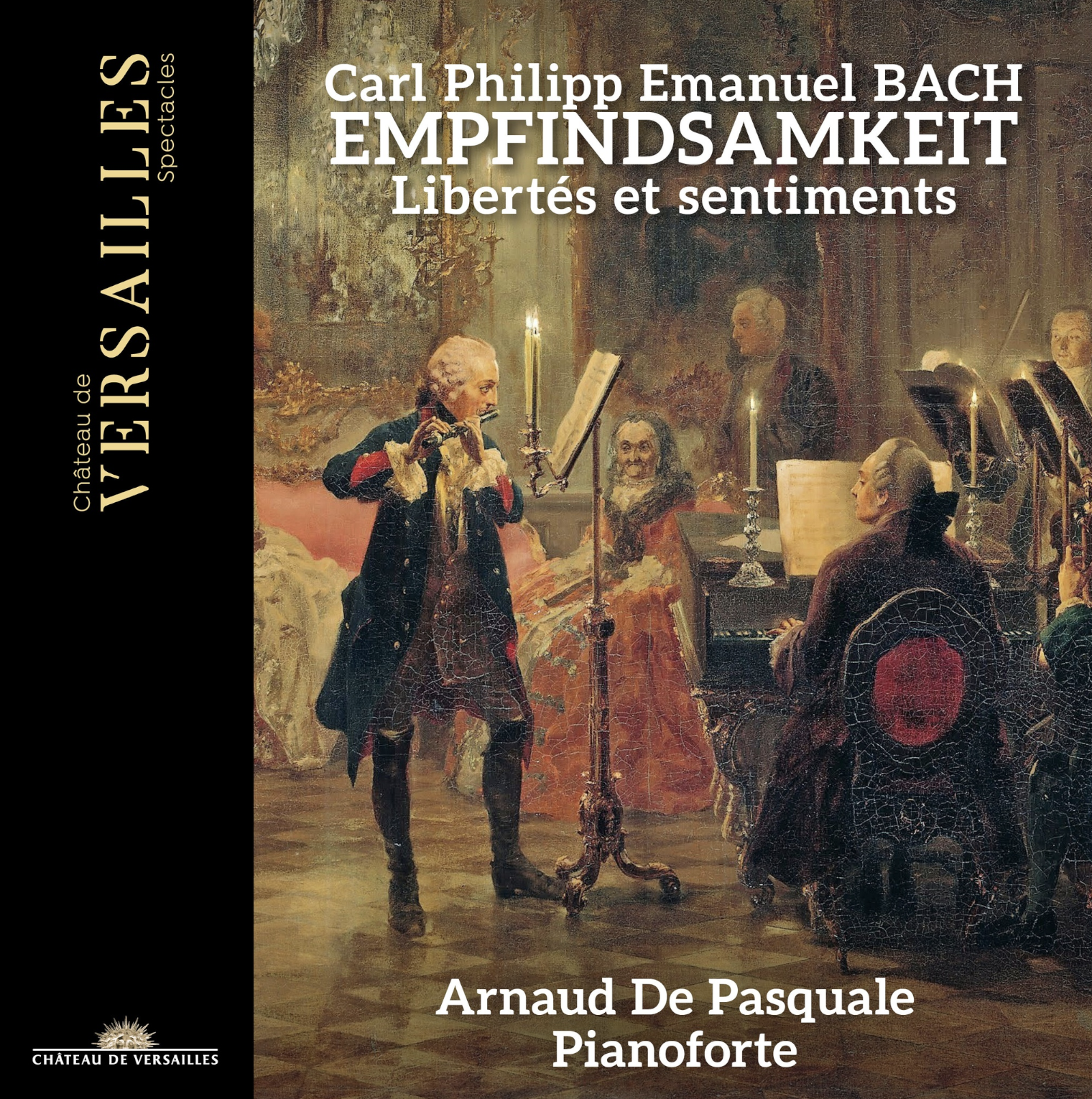
This new album featuring a copy of a Silbermann piano, including two works for piano and flute, takes its title from a sentiment embraced by Bach’s son: Empfindsamkeit. Anne Thivierge contributes as the flautist and the piano is commanded by Arnaud de Pasquale.
The Empfindsamkeit—roughly, "sensitiveness" or "sentimentality"—that Carl Philipp Emanuel Bach made his own occupies an uncomfortable middle position in music history, sandwiched between the contrapuntal architecture of his father's high Baroque and the formal elegance of mature Viennese Classicism. Where Johann Sebastian Bach built emotional worlds of enormous structural integrity, every affect held in sustained tension across a movement, C.P.E. Bach fragmented that world deliberately. His music pivots without warning—a singing phrase interrupted by a sudden rest, a chromatic lurch into an unexpected key, a dynamic that drops to nothing and then surges. These are not imperfections or lapses in craft; they are the point. Empfindsamkeit took seriously the idea that the soul speaks in sudden impulses, not in balanced periods. The target was the listener's nervous system—what contemporaries called Rührung, being moved, almost physically. Mozart's classicism, by contrast, absorbed these emotional disruptions into a new kind of formal control: surprise is still present, but it is domesticated within phrase symmetry and tonal resolution. C.P.E. Bach wanted the surprise to remain jagged. His best slow movements feel less like architecture than like overheard confession — provisional, restless, never quite resolved.
The two flute sonatas, Wq 124 (in E minor) and Wq 83 (in D major) are beautifully rendered by Thivierge with a palpable tone. The balance between piano and flute sounds natural, even if the piano dominates when listening with headphones. The structure for the first is slow-fast-medium (the last movement written as a minuet). The second is rendered in a more familiar fast-slow-fast framework. The middle movement of the E minor work has a continual sequence of notes that makes me think of C.P.E. Bach’s dad’s writing. Sometimes finding a place for a breath is a challenge, but these players never take us to a point of worry about the flautist passing out. The final movement has a haunting quality about it, the writing with suspensions working affectively.
Bach’s style develops some between these two pieces, the D major being later. The style is a far departure from his dad’s, but it’s difficult not to think of Bach’s violin and keyboard sonatas, with how J.S. Bach formed a trio sonata texture with the right hand, flute, and left, offering a basso continuo function. The sentimentality aspect of his writing is less disruptive in the sonata’s opening; however the repetition of themes between the piano and flute help to elevate the affective power of each. The counterpoint between voices is again at work in the middle movement, which ends up again putting the dissonant notes on the downbeat, continuing the affective nature of his writing with that feeling is leaning into resolution. It’s been a part of musical writing for a hundred years before this piece, but it’s just so nakedly utilized here with great effect.
Several pieces on this album are short, and they take the form of character pieces in the style of the French clavinistes. The opening track, L’Aly Rupalich is bound to get your attention. The instrument used here has an option to maintain sustain, while the timbre matches closely to that of a harpsichord. It’s an unusual sound for us today, but that’s one of benefits of using historical instruments. I might find this timbre tiring after some time had it been used throughout the album, but thankfully de Pasquale doesn’t keep it engaged throughout. It does bring a particular character to this piece, which at one point, it’s noted, that it was called “The Bach.” We don’t know which Bach that is!
The Fantasia in C is a late work, from 1786. The form allows for the exploration of Empfindsamkeit with its telltale changing moods. Bach’s writing in this piece feels very direct, pulling us along in some unexpected ways. He can pivot in different ways, on of the simplest and maybe most profound is with a single note. The way de Pasquale punctuates with a single note speaks to his understanding of the music but also the extraordinary quality of his piano.
The third track, a “sonata” in D minor (Wq 65) references the opening of his father’s sixth partita (BWV 830) and I wonder the purpose—did he reference that opening for the benefit of the King after his father’s famous visit to Berlin in 1747? This piece I don’t think would nearly work so well upon a harpsichord, although the composer may not have differentiated it as purely a piano piece, but there’s something notable about this instrument’s sustain that makes it feel perfect, realized on an instrument with more dynamic capabilities.
The Rondo in D minor (Wq 61/4), also a later piece, showcases some of Emmanuel’s personality, I think; the opening is nearly clever in how it develops. The repeated rhythmic gestures are something he most certainly got from his father. But as we said, instead of keeping that momentum going, he pulls back, offering us a different idea altogether. The rondo form is perfect for revisiting ideas and making them all the more moving through contrast. This piece falls short of being profound, but it comes from a profound thinker who not only understands musical concision and economy but someone who is dead-set on getting a reaction from the audience.
All around, I found de Pasquale’s interpretations to be sensitive and dynamic. As far as instruments go, the one used here has a colorful palette. It’s dynamic range is limited, but it’s a treat for us to hear an instrument that would have been known to Bach but did not sustain as a predominate style into the classical era.
Bach was known primarily as a keyboard expert, especially so after publishing his treatise on keyboard playing. This recital’s pieces, alongside the flute sonatas, do well to showcase the composer’s own voice and dedication to a style that, during his time, was designed to capture the listener’s attention with contrasting human emotions. I think both musicians took the time to understand these pieces before committing them to a recording, and the recording itself does well to capture the nuances of the instruments used with good sound and natural balance.