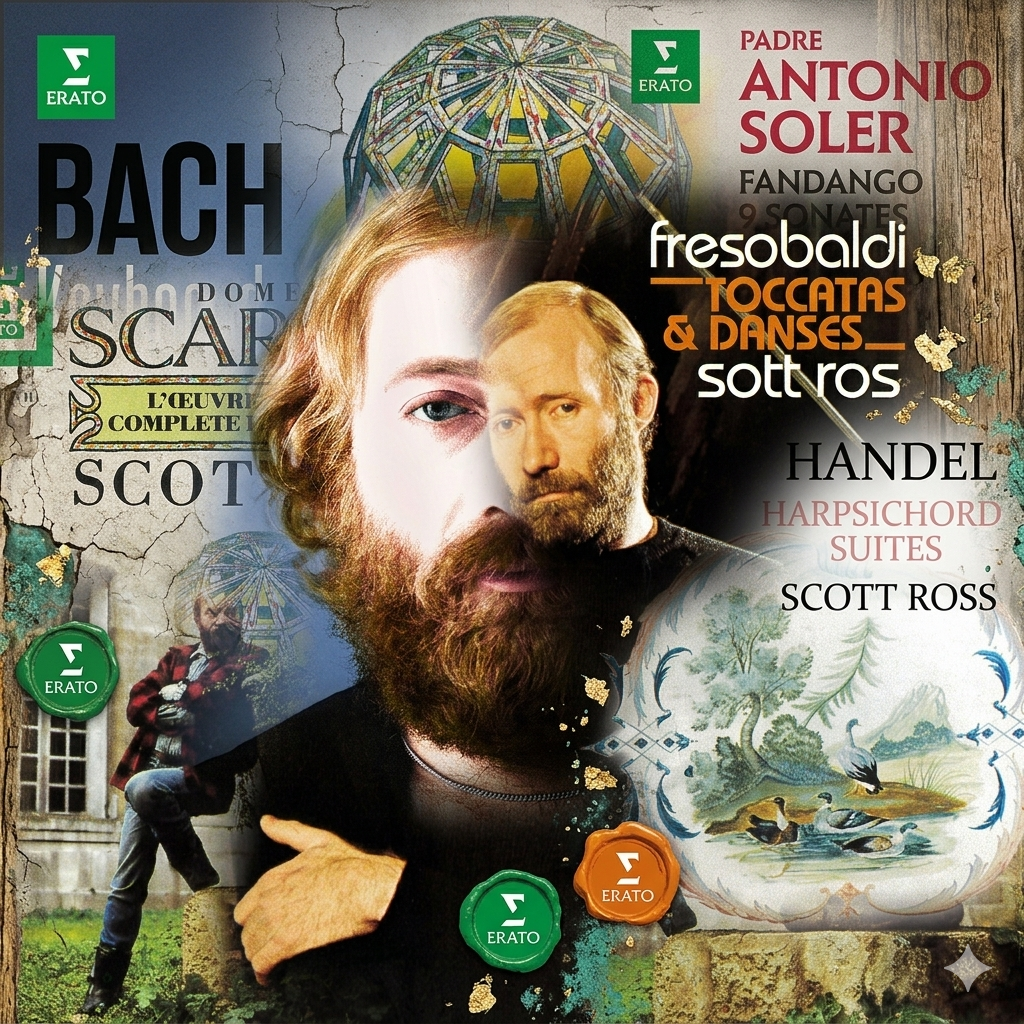
Scott Ross - A Retrospective of Erato Discography
Scott Ross was born in Pittsburgh (1951) and early on studied piano and organ. His father died early in his youth, followed by a move with his mother and siblings to France, where he began to live "on his own" at the age of 13. That alone might set the stage for beginning to understand the import music had for the young Ross. His mother killed herself when he turned 19. He returns to North America to teach in Québec and then eventually returns to France, where upon an extended sabbatical from teaching, he starts recording for Erato, with the centerpiece becoming his recording of all of Scarlatti's 555 sonatas. He succumbed to AIDS in 1989.
There's a lot more you can read about Ross, although his biography is not extensive; for one, he seemed to carve his own path, showing up at concerts in jeans and casual clothing. My own interest in Ross first came to light when I saw his large Scarlatti set for sale in a record shop in Cleveland during my high school years. I knew some Scarlatti but the complete set seemed financially out of reach. I was gifted the set many years later in the Erato reissue. In enjoying that set, I came to want to know more about this American artist who had obviously also recorded other Baroque masters. My interest was roused again when Jean Rondeau's Vertigo album was released, made in the same château where Ross had found refuge to record so much music.
His recordings for Erato have probably been best-circulated, and under that label I wanted to revisit those recordings in this post. Just this past week Erato re-released his Handel "great sonatas" CDs; while upsampled to 96kHz, there's no mention in the booklet — which comes with the original liner notes — of remastering. The original recording was digital.
- G.F. Handel: Suites
- Frescobaldi: Toccatas and Danses
- Padre Antonio Soler: Fandango & 9 Sonatas
- Domenico Scarlatti: The Keyboard Sonatas
- Bach: Keyboard Works
What makes these recordings extraordinary to me is that they were all made within a short period of time in the 1980s, when the artist already knew he was ill with a fatal disease. It may well explain the impetus to learn and record all of Scarlatti's sonatas in a record period of time — a project that, by one account, required over 8,000 takes. One can only imagine a man pressed to prove his worth, knowing he would not have long to make his mark as a musical artist. It's difficult to say with certainty, and it may be reductive to conflate his health with his abilities or his drive to record.
Frescobaldi
This composer has a very direct, approachable style — coming early in the Baroque period, his music still fragrant with Renaissance harmonies. Ross's playing suits this composer well: his instrument bright and ripe, captured in a very dry acoustic. It's the kind of recording that can grate at high volume, but at the appropriate level, he's in your living room. The tuning of his instrument — or mistuning, I might add — provides not tarnish but a bit of charm. I'm guessing the original release was two discs, as it clocks in at 70 minutes (my research suggests it was originally a Virgin Veritas release issued in two installments).
I've listened to enough Frescobaldi without close attention to titles or original sources that auditioning this recording for the first time was a pleasure — familiar pieces surfacing as I went. Ross is very deliberate; he's a precise player, and even when Frescobaldi offers him runs, the pulse is always felt. The Partita sopra l'aria della romanesca — I hope you can feel the same thing I experienced on first listen. The same can be said for the Corrente quarta (track 22).
Overall, the recording stands up well. It may not have the ultimate virtuosity and colorful tuning of Pierre Hantaï's 1997 release, roughly the same length, but it is difficult to find fault with Ross's approach.
Scarlatti
Ross was not the only artist to have set about recording all of Scarlatti's keyboard works (to be fair, the set also includes some chamber music), but he was the first. Pieter-Jan Belder (Brilliant) has a more recent complete collection, as does Sergio Ciomei (Challenge). Ross's playing is brilliant in many ways, though one can wonder where things might have ended up had the pressure of time not been a factor. The Sonata in F (K. 99), for instance, sounds a bit out of tune. The Sonata in D minor (K. 52) feels a touch barren — perhaps missing the accoutrements that come from living with a piece longer.
I very much enjoyed the releases by Jean Rondeau and Pierre Hantaï as comparisons. Even so, there is something to admire in Ross's stamina and breadth. And for the Scarlatti connoisseur, having access to every piece carries its own value.
Then there are performances where he really stands out. The Caccia, K. 96 is especially strong. Those not interested in the complete set should know that Erato also released several "sample" volumes, presumably of the composer's best-loved sonatas.
Bach
The Bach album is, I believe, a re-release of several volumes: the total timing runs over 12 hours. I'm also not certain they were all originally released under Warner's umbrella. Included are the six partitas, the Italian Concerto, the Chromatic Fantasia and Fugue, the French Overture, the duettos, a series of organ works, the Goldberg Variations, the Well-Tempered Clavier I/II, and a number of additional works.
I am most familiar with Bach's keyboard works, and Ross's performances can sometimes be surprising. Sometimes it's a disappointing surprise — "Oh, Scott! You didn't milk that phrase as much as you could have, did you?" In some ways I'd have loved to invite Ross alongside Lilian Gordis and Ton Koopman for a recital. Can you imagine? Both Gordis and Koopman are artists of exceptionally strong interpretive personality — the mutual influence would have been something to witness.
The other kind of surprise is how hard he can push Bach. A good example is the Dorian Toccata and Fugue, BWV 538, on organ. The opening movement is played far too quickly given the church acoustic — but it's also exciting.
The Goldbergs included in this set come from two recordings: the first, a 1985 live recording at the University of Ottawa, where he plays some repeats with rich ornamentation; the second recorded in 1988 at the Salle Blanqui in France. The live recording's sound isn't ideal; the later recording is far nicer, though as usual with Ross, a bit dry acoustically, which highlights the mechanical sounds of the harpsichord.
Handel
The liner notes for this album, by Harry Halbreich — the Belgian musicologist who died in 2016 — seem intent on highlighting Handel's genius in the shadow of Bach's. In doing so, they imply Bach had an easier path while casting Handel as the superior musician. His keyboard suites, published in 1720, may have been composed as early as 1705. The style is of course very different from, say, Bach's Six Partitas — but the comparison of the two sets seems fitting nonetheless.
The Ross recording is again acoustically dry, with that precise, detail-oriented approach. The 2024 recording of the suites by Michel Kiener offers a good departure: his instrument, a Dowd copy of a Blanchet, carries more character, and the greater presence of room sound is welcome. The album also benefits from a more modern recording treatment with a bit more atmosphere.
In some spots Ross again feels like he's not fully exploiting what's on the page — something Pierre Hantaï rarely leaves on the table. Yet there are anomalies: the F major fugue, HWV 427.4, shows Ross's clear affection for the piece. So does the final movement of the D minor suite, HWV 428, which we also know as part of an organ concerto. The presto is technically assured and wonderfully articulated.
The Gigue from HWV 432 in G minor, however, doesn't fare as well. Nor does the concluding Passacaille, which just doesn't seem to get the Ross kiss of love.
Soler
This album came out after Ross's death. There's an affinity for Scarlatti in Soler's music, which seems fitting for a composer who knew Domenico Scarlatti well. Ross's strong technique serves the music, even if he doesn't fully lean into the dance flavor of Soler's writing.
The Fandango is the composer's most famous piece, built on variations. Hearing it today, I can't escape the feeling that castanets might be coming out — sangria on the table, the pavement still hot from the day's sun. The piece is filled with interesting harmonies and rhythms, offering something both foreign and exotic. It clearly references guitar and dancers. Ross doesn't lean hard into those references, but offers a convincing performance nonetheless. His technical ability is enough to impress.
Conclusion
It's easy to argue that American harpsichordist Scott Ross was not the world's best — however absurd a suggestion that might be for anyone. He was, for reasons not fully covered here, a controversial figure: anti-establishment in bearing, a harsh critic of others, and outspoken about the historical authenticity movement. He wore leather and smoked. He might start a concert late, roaming among the audience to reach the instrument rather than appearing on time from behind a curtain.
Auditioning his recordings, however, has not made me doubt his technical command or his ability to engage a listener. And his interpretations weren't especially anti-establishment — at least in context today, many years after his untimely death.
In writing about his Erato discography, I wanted to bring some exposure to a perhaps forgotten voice in Baroque keyboard music. Some of these performances are genuinely worth your time. Ross's artistry was a brilliant flame — and when you consider how much repertoire he covered before turning 38, the loss is felt all the more.
His career started just before I entered elementary school and his career ended before I graduated high school. Since discovering his Scarlatti set, I've enjoyed revisiting the trail he blazed.