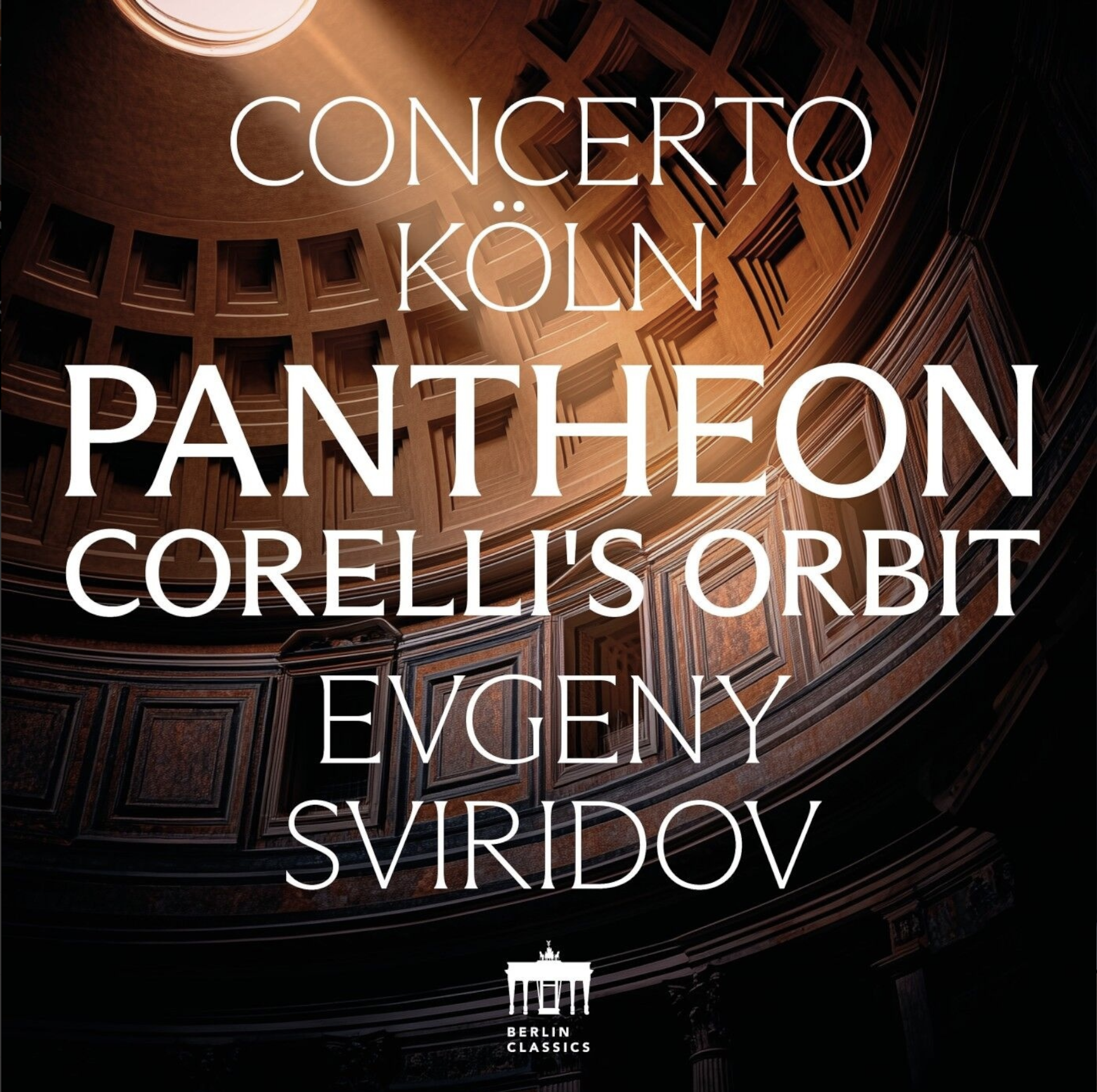
Pantheon - Corelli’s Orbit • Evgeny Sviridov
Pantheon - Corelli’s Orbit • Evgeny Sviridov
A friend just recently attended a performance featuring Concerto Köln, led by Shunske Sato. He told me it was one of the most powerful sounding baroque ensembles he’d heard, that they’d brought real intensity to their playing. He was impressed.
This new album led by violinist Evgeny Sviridov, an artist that transitioned to baroque performance after a classical Russian training, is focused on concertos in a program that lasts 61 minutes. The stand out addition to the production is the inclusion of percussion which adds color and weight to some of the pieces. Sviridov has been associated with the ensemble since 2015.
The agent for the ensemble said this about the album:
With Pantheon – Corelli’s Orbit, Concerto Köln presents a musical panorama surrounding Arcangelo Corelli and his European network of pupils, admirers and rivals. Together with concertmaster and soloist Evgeny Sviridov, the ensemble explores works by Giovanni Battista Somis, Antonio Caldara, Pietro Castrucci, Giuseppe Valentini, Antonio Vivaldi, Michele Mascitti, Henry Purcell and Corelli himself – composers who, within a dynamic field of admiration, rivalry and individuality, shaped their own musical “pantheon”.
The album’s concept and the pieces chosen was well done, I think, offering up an interesting combination of pieces that aren’t “old standards.” The album's sound is good, but is not the most transparent. Bass presence is good.
I have to agree with my friend’s assessment, CK are still sounding as tight as ever. The sixth track, from one of Castrucci’s concertos, is a great example to showcase the ensemble’s abilities. Sviridov brings command to the solo parts, although his sound is well-integrated into the ensemble’s texture. He’s not out in front, as many soloists appear in recordings. I think this balance is more natural and authentic in the sense that the soloist is leading the orchestra, as he does here.
The third movement of the Somis concerto cracks in the opening. The resulting solo passage carries the same intensity from Sviridov.
The Valentini concerto is a concerto grosso, offering opportunities for CK’s director to break away from the ensemble, but while the technique is an evolution from Corelli’s own concerti grossi, the style here is definitely evolved. You might sense a bit of Locatellian flavor in the first Allegro. It’s a fascinating work for how much it eschews being formulaic in the Vivaldian vein.
Corelli’s fourth concerto is the one presented from his opus 6. After the exotic presentation from Valentini’s pen, this performance feels like a homecoming. The strong support from the basso continuo team shines in this performance. The violin playing all around is strong as well.
The Vivaldi concerto is a short one from his opus 7. It’s one I didn’t really recognize. The playing is again tight and Sviridov’s technique is admirable.
The piece by Mascitti includes a long passacaglia. Here’s where the percussion adds something palpable to the evolution of the piece, providing highlight from below and above. I don’t know if the percussion was originally part of the composer’s score, but if it wasn’t, it’s intelligently added here to elevate the texture of this music, which includes parts for two oboes and with bassoon, forms a double reed choir.
This program was chosen to provide a panorama, we read, around the influence of Arcangelo Corelli, the Roman composer who was celebrated via many men’s pens. The Qobuz version I used for this review did not come with a booklet, so I can’t speak more to how Corelli interfaced with these personalities chosen for this concert.
Nevertheless, it succeeds as an excellent concert program and recording too, I think, because while many of these pieces will be unfamiliar, they are all mature, high quality pieces with their own sets of virtues. More so than their soloist, the strength of this ensemble stands out first. It’s a fitting testament to this ensemble which is now entering its forty-first year.