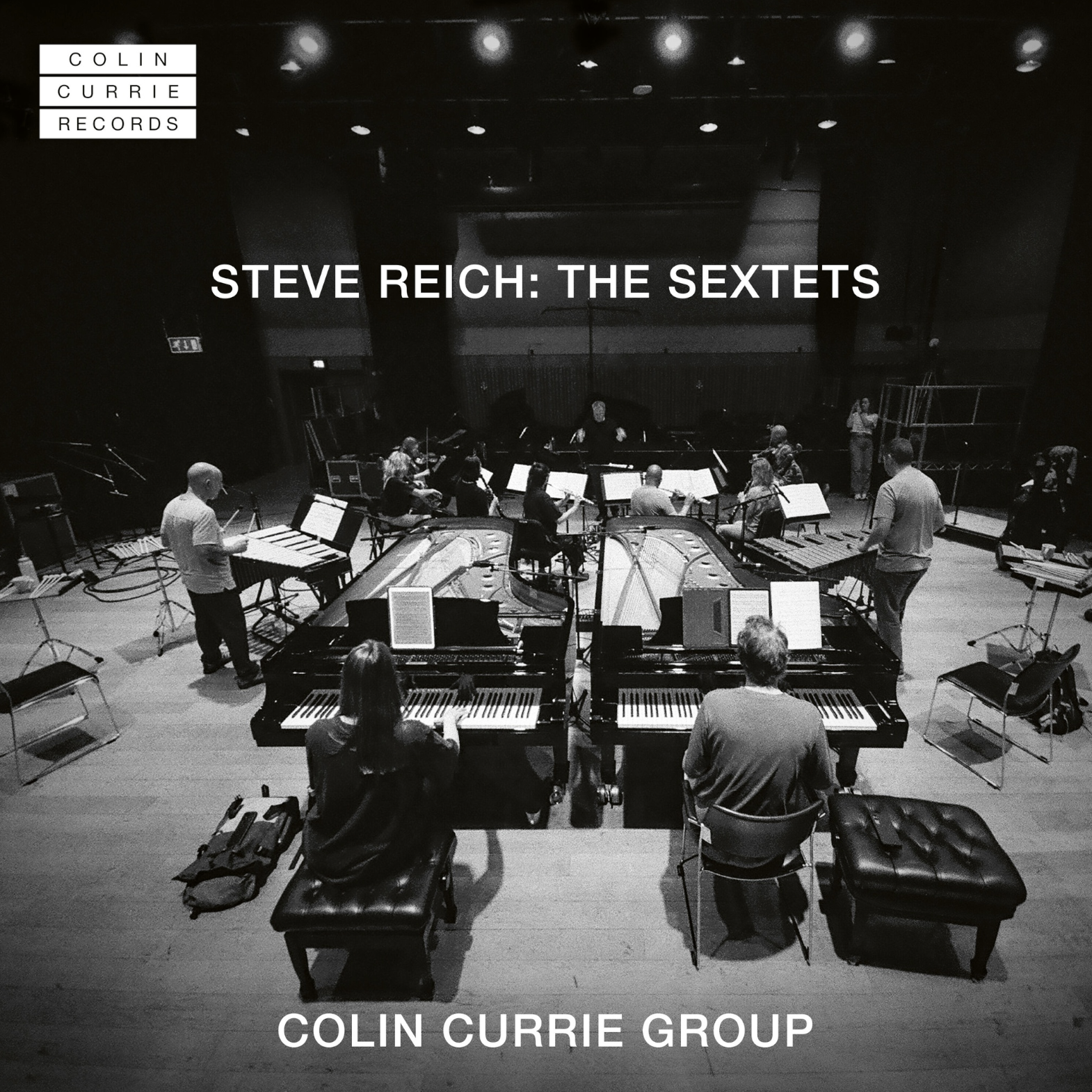
Reich: The Sextets • Colin Currie Group
Steve Reich’s music was easy enough to find even before I went to college. The record companies seemed to like his music, the appeal as “contemporary music” for audiences with a tonal foundation and rhythmic vitality? I can’t say with any authority how well his music is liked, but he’s often paired with Philip Glass as the two most successful composers committed to a minimalist style. That said, the composers’ music is not difficult to confuse for the other. For me the important musical elements championed by each composer are Reich:rhythm and Glass:harmony.
This review focused upon the latest release from the Colin Currie Group, a British percussion ensemble led by Currie that specializes in the performance of Reich’s music. In some ways we might say they’re in an excellent position to present his works. Furthermore, the booklet for this release gives full endorsement by the composer.
Four works are presented, offering variety among the composer’s journey over time:
- Sextet (in five movements) from 1984-85,
- Double Sextet (in three movements) from 2007, premiered at the University of Richmond(!),
- Six Marimbas (1986, based on Six Pianos, 1973), and
- Dance Patterns (2002).
I can still remember, when I was in graduate school, working with one of the teachers I’d do my teaching practicum with who led the band and orchestra program at his high school. One morning I’d come and between classes I played for him a recording of Reich’s Nagoya Marimbas, to this day, my favorite work by the composer. He looked at me quizzically, then asked me to shut it off, telling me the music was awful. I ended up having very little respect for this man, for other reasons, but I found his abject rejection of Reich’s music interesting.
In hindsight, I’d have loved to pushed further with the composer’s Clapping Music.
The music on this album includes bigger, grander musical structures. As such, the music feels less condensed, as the composer has more time to unfold his architectural plan. Some may like that aspect, others like myself, may find these longer structures require more concentration.
One piece I’m very familiar with is the Six Marimbas. On this album it’s presented as a twenty-two minute work, and yes, playing continuously and coordinating entrances and repeating patterns among six players is technically-challenging work. On the surface, this piece puts rhythm forward, producing a sonic texture. Beyond this texture is the composer’s contrapuntal plan. The warm timbre of marimba and the vibrating wood gives the piece its organic yet also very modern sound, although as noted it was originally conceived as a piano work. Anyone who has played with synths and an apreggiator might find a connection here. The music is so repetitive and changes come so slowly that I think the music can sag under its simplicity. Watching a video of this work performed changes the dynamics a bit, as I think it would for a live performance. What may not be perceivable initially is how the material, which the composer describes as a “contrapuntal web” is moving between instruments. It’s a nuance that is aided, again by visually watching the piece, but also sonically through a good stereo setup or headphones.
The sound for me on my two-channel system using loudspeakers offers excellent fidelity but I don’t sense there was a significant desire to capitalize upon exploiting the position of each instrument across the soundstage. To do so in an ultimate way would require a multi-channel recording. I personally would opt to be in the middle of a circle, if Currie and his musicians were granting wishes.
There’s also a case to approach this music as an ambient experience. Many may be familiar with Eno’s ambient pieces, which I’m not suggesting is the same thing here. The idea—and I think the label we use might better be called architectural—is to use the acoustics and space with the composition within a building to enhance your experience there. Just as much as we might pump fragrance into a space like a luxury hotel’s lobby to impart a mood, composers can inject musical sound into their space. As you move about in the space, the effect of what you’re hearing changes. You therefore become a part of the experience.
However you listen to this, I should admit that I’ve found myself playing this piece on more than one occasion while I did something else. This may be a far cry from how the composer might have envisioned people experiencing this, so one should treat my conjectures here as just that. Just as that band director asked me to turn the Nagoya piece off, I’ve also found some who cannot tolerate listening to this piece in the comfort of the living room doing nothing else. It may well be why this type of music tends to lend itself to movement, car rides, train rides, or even movies, where things are going along, the music serving the experience of propulsion.
While this piece may not ultimately be everyone’s cup of tea, the Currie Group’s performance is excellent.
It may well be not an accident that several of the pieces featured on this album were composed to accompany dance performances.
Dance Patterns clocks in just over six minutes, and like the Nagoya Marimbas for me, is a bit more approachable. It’s a quirky piece and the title seems to suit the opening. Before a minute in, intensity is lost, and the color between instruments, the pianos dominating the texture, makes for one of the composition’s charms. This is one of the pieces originally written to accompany choreography.
Sextet for me is the piece I’ve probably listened to the most in the past. The version that came out by Third Coast Percussion in 2016 features my fave Nagoya piece, but the sound and presentation is very different than what the Currie Group has on offer. In the Third Coast release we’re much closer to the instruments and there’s far more dynamic variation throughout the performance. The Currie Group’s recording sets the musicians further away, not unlike the sound we get in a live LSO recording, also from 2016. It’s faster in the opening, too, like the “original” recording that introduced me to the work, made in 1986 that appeared on Nonesuch.
The rationale for mentioning other recordings really is a pragmatic one: if you like Reich’s music and already have it in your collection, what’s the novelty offered in exploring this new recording? There are nuances beyond tempo that differentiate these recordings; for instance, the synthesizers dominate in the Nonesuch recording in a way that’s missing in this one, which I prefer. While I do love the closeness and detail that’s achieved in the Third Coast recording on Çedille, the sound in this new recording, as already noted, is quite good. I’m far from the musicians, but not as far in the nose-bleed seats as in the LSO’s live recording. When the brushes are heard, they give a palpable offering of the acoustic space, with the reflection of sound coming across well. I like this. Another way of expressing this effect is that the recording puts “air” around each instrument. I know that sounds like nonsense, but you’ll find people using that description quite regularly in the hifi press. I’m guessing it’s a result of each musician having some breathing room around themselves upon the stage.
The Sextet was also originally written for dancers and premiered at the Centre Pompidou in Paris. Having been there, I can only imagine the acoustics, and being surrounded by so many visual distractions!
Perhaps the most successful piece for me is the Double Sextet, which is scored for flutes, clarinets, violins, and cellos in addition to percussion. The version presented on eighth blackbird’s album with Bang on a Can is also well performed, but the overall sonic quality of this new recording, I feel, is superior. Both ensembles are technically tight.
The pieces presented on this album were all previously recorded; I could only find one recording of the Dance Patterns, recorded by Reich’s own ensemble. And as such, with the availability of good recordings already, this new release may not be especially interesting unless you’ve read this far, and admit to yourself that you really do like Reich’s music, however you may want to hear it: as background, as accompaniment to dancers, on headphones on a high velocity train, or between two speakers in your living room.
Aside from the performances, I’d wager that there is still untapped potential to present Reich’s music—or other percussion music—in even more engaging ways for a home listener. In a small way, highlighting the dynamics in this recording would have been a step toward that goal.
Without denying earlier efforts to record these pieces by others, I can only imagine Mr. Reich was pleased with this project. For many it may serve as the reference. That said, if you already own recordings of at least some of these pieces, the rationale for approaching this one would be your high interest in the composer’s music and style.