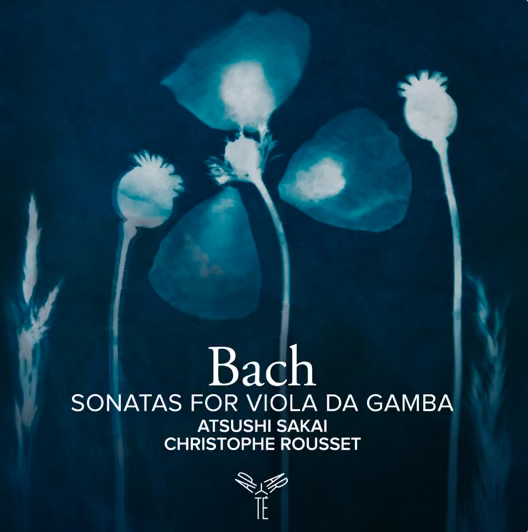
Bach Gamba Sonatas • Sakaï & Rousset
On the heels of that viola pomposa recording, we get the OG version of Bach's sonatas for viola da gamba and keyboard: BWV 1027–1029. The three works don't quite fill a disc, so the artists have added a bonus — but not the typical one. Rather than a suite or a standalone sonata movement, they've recorded BWV 1023, originally scored for violin and continuo, giving Sakaï an additional showcase and the program a satisfying completeness.
The booklet presents its notes as an interview conducted by Stephen Sazio with Atsushi Sakaï, touching on his 20-year collaboration with Rousset and tracing the gambist's history with these works back to his studies in Los Angeles.
Recordings of the gamba sonatas tend to fall into one of two camps. The first plays it safe — tempos too cautious, rhetoric too restrained, the music polite where it should be present. The second overcorrects, pushing pace and emphasis to the point where the balance between instruments starts to fracture. That balance matters more here than in almost any other chamber works Bach wrote: these are trio sonatas in everything but name, with the keyboard's right hand carrying a full melodic voice equal in weight to the gamba. Let that equilibrium tip and the whole architecture suffers.
I first auditioned this album on AirPods Pro 2 at 320kbps MP3 via Qobuz, aboard a Boeing 777 en route to Japan — not ideal conditions, but revealing ones. Both musicians play period instruments, not copies, and even in that format the sound cut through. A full-fidelity re-audition confirmed what the compressed version suggested: this is one of the first recordings in my experience to sidestep both traps entirely. The second movement of BWV 1027 is marked Allegro ma non tanto — fast, but not too much — and they take that direction to heart. The tempos throughout the fast movements hold to that same calibrated restraint: moving, present, never hurried. The recording itself is transparent, each instrument clearly placed, the harpsichord's upper register offering exactly the kind of penetrating clarity that keeps it on equal footing with the gamba rather than receding into accompaniment.
BWV 1023 in E minor is an interesting addition. The lower range of the gamba is disorienting if you know the piece from violin, but the opening Prelude puts Sakaï through his paces and he delivers. This isn't French music, but the energy and gravitas he brings to it called Marais to mind more than once. The absence of a bass voice — here it's harpsichord alone, no continuo — is initially noticeable, but it turns out to be a virtue: cleaner textures, nothing superfluous.
My favorite of the three canonical works remains BWV 1029 in G minor. The opening movement isn't taken quite as fast as I'd prefer, but the tempo holds enough momentum to keep the dialogue between gamba and keyboard alive — Bach's rhythmic motto passes between Sakaï and Rousset's right hand with real conviction, and you can hear twenty years of collaboration in the synchronicity. The slow movement is the one place the performance gave me pause. My reservation is less about tempo than about phrasing: the line needs a certain inevitability, a sense of each phrase breathing into the next, and I found it slightly elusive here. It's not a failure — in the right mood, in the right room, it might land perfectly — but it's the one moment where I hear the music differently than they do.
What rescues any uncertainty is the final movement, and specifically how Rousset enters it. He is, as I've noted before, the ultimate timekeeper — and in this movement you need a strong, unhesitating pulse from the keyboard to set everything in motion. The gamba's role is to respond and counterbalance through tone and dynamics, not to lead. Sakaï understands this completely.
Taken whole, this is the most fully realized recording of the Bach gamba sonatas I know. The artists present the music as written — or in BWV 1023's case, as imaginatively arranged — without importing anything extraneous. There are flashier performances. This one just feels... right.