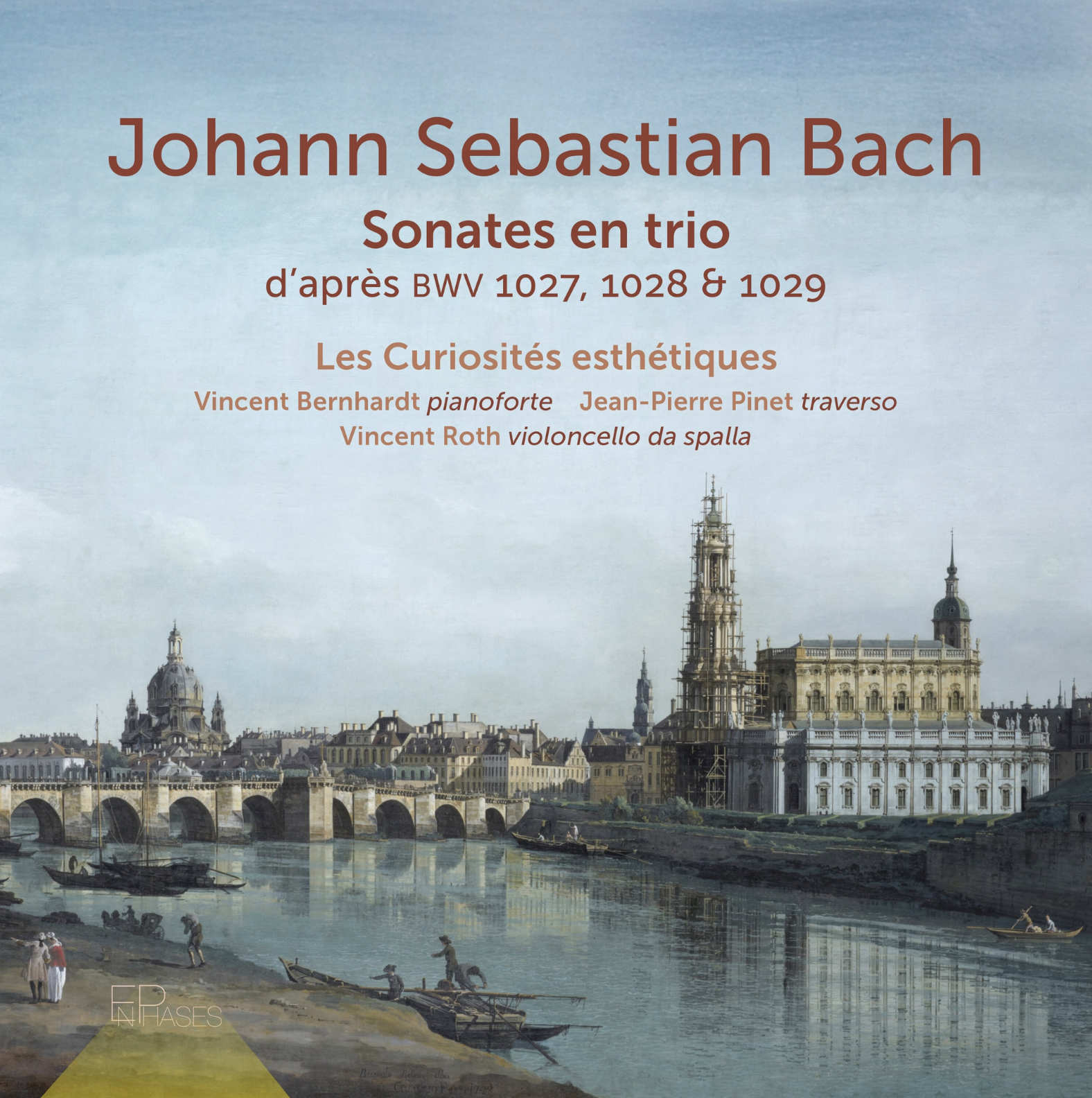
Bach: Sonates en trio • Les Curiosités esthétiques
With all of the recordings of Bach's "trio sonatas" we might have wanted to send him a message to the past to write more. As it turns out, Bach was not in the publishing game like Telemann and as such, combined with his jobs and the requirements for the music he did write, he never gave us a collection of trio sonatas in the same formats that other contemporaries published. It is an interesting form, the combining of two solo voices with basso continuo. Bach did write a set of excellent sonatas for the organ, BWV 525–530, which several enterprising musicians have taken to adapt to a more traditional setting with two solo instruments and continuo.
Bach however wasn't immune to writing in a trio texture. His sonatas for keyboard and violin (BWV 1014–1019) are also wrought in a trio format, wherein the right hand of the keyboard represents one of the solo voices. The same can be found in his sonatas for the viola da gamba and keyboard, BWV 1027–1029, which is the music featured in this new recording. The idea here was to give one of the keyboard parts — the melody — to the flute while also lending the gamba part to the violoncello da spalla, an instrument everyone may not be intimately familiar with.
What strikes you immediately, before a note has been played, is the novelty of the instrumental combination: a reconstructed Cristofori pianoforte from 1726, a Buffardin traverso from around the same period, and a violoncello da spalla — a five-string shoulder cello sometimes called the viola pomposa. This recording is, at its core, a voyage into uncharted territory, and what makes it a success is that the musicians are technically commanding enough to make that voyage feel natural rather than forced.
The instruments
The shoulder cello merits some background. Housed in the University of Leipzig's instrument museum is a five-string instrument believed to have been developed by the luthier Johann Christian Hoffmann so that Bach could lead in church performances. The instrument had a very dormant life until 2004, when the violinist Dimitri Badiarov began making copies of it. A small contingent of musicians have since taken it up. Vincent Roth, a trained violist, brings a strong technique to the instrument here, and his playing is consistently impressive. The parts are demanding, and he meets them with evident command — especially in the faster movements, where articulation has a bite that is sometimes lost on the gamba, with its underhanded bow. That said, I prefer the timbre of the viola da gamba. The shoulder cello has a less sweet, more direct sound. Some listeners may find this a poor analogue to what a fine gambist offers, particularly in the sustained, lyrical passages of the slow movements. Roth wisely avoids leaning on vibrato as a cosmetic solution; instead the instrument offers what it genuinely has to give. It is a different voice, and it shouldn't sound the same. This recording makes the case for the shoulder cello as a legitimate chamber instrument — even if it hasn't displaced the gamba in my affections.
A word about the pianoforte: yes, a 1726 instrument. Most listeners will do a double-take. The piano by 1730 was not yet widespread. Cristofori's instruments were the first working models, and the sound will not compete with a modern Steinway. There isn't much carrying power, and in some ways the metallic timbre isn't far from a harpsichord. What the early pianoforte offers instead is a subtlety of dynamic shading that the harpsichord cannot — not so much loudness differences as timbre differences, a quality that proves remarkably well-suited to this music. Vincent Bernhardt exploits this beautifully. His dynamic coloring feels not like a demonstration of period instrument curiosity but like an expressive tool fully integrated into the ensemble texture. The fourth movement of the Sonata in G, BWV 1027, is an ideal place to hear this.
The choice of Dresden for the cover speaks to the news of the Italian pianos which came to Germany in 1725.
The performances
The gamba sonatas work very well as pieces with flute and a tenor voice. The balance among the three instruments is consistently good, and the flute's presence feels natural — never a compromise. The second movement of the D major sonata, BWV 1028, is simply joyous, with the flute and shoulder cello taking the soprano and tenor roles against the piano, the three voices emerging with pleasing clarity.
There are places where the flute playing could offer more dynamic shading, and a few trills in the original that don't carry over to the adapted parts. These are small concerns against the overall quality of the playing. The tempos chosen throughout are well-judged, and the ensemble's sense of ensemble — the listening, the give-and-take — is evident.
On Track 5 we get a trio from BWV 583, arranged here for piano and flute, which offers a clean, close-up view of both instruments and how they blend. The other bonus work is the opening of the Fantasia and Fugue in A minor, BWV 904, presented as a keyboard solo — a useful demonstration of what the early pianoforte sounds like on its own, free from ensemble texture. The hammering is far subtler than a harpsichord's pluck, and the legato Bernhardt draws from it is persuasive. The recording, made at the Metz Arsenal hall, is close and detailed, without much acoustic interference. For those who want a clear appraisal of the instruments, the engineering serves that purpose well.
A note on the viola pomposa
This recording doesn't fully resolve the question of whether the shoulder cello belongs in the repertoire at a chamber music level — but I'm not sure it needs to. The historical function of the instrument is still being studied, and its use appears to have been pragmatic: allowing a violinist to support a bass part and emerge, as needed, for solo passages, as we see in Bach's cantatas. Whether its more limited adoption was a matter of aesthetics or simply circumstance, I can't say with certainty.
What I can say is that these musicians have done something genuinely valuable. The instruments chosen are novel, the performances are technically strong, and the exploration is conducted with evident care and conviction. The booklet's notes go into considerable detail about the instruments with photographs and should be required reading. Whether or not you leave persuaded that the shoulder cello is the equal of the gamba, you will have heard something you haven't heard before — and heard it played well.